
Jerusalem
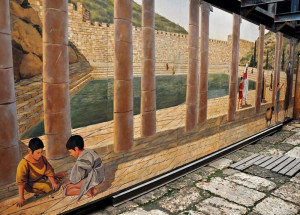
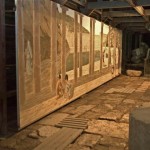
Mural showing what Pool of Siloam might have looked like (© Ferrell Jenkins)
The Pool of Siloam, where Jesus ordered a blind man to wash mud out of his eyes, was one of the most significant pools in Jerusalem’s history. But its true location still eludes archaeologists.
The account of the healing of the man who had been blind since birth (John 9:1-41) is one of the longest Gospel narratives of any of the miracles of Jesus.
The disciples asked whose sin had caused the man’s blindness, his own or his parents? Neither, said Jesus; he was born blind “so that God’s works might be revealed in him”.
Then Jesus spat on the ground, made mud with his saliva and spread the mud on the man’s eyes. “Go, wash in the Pool of Siloam,” he said. The man did as he was told, and he was able to see.
Church built over pool
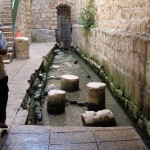
A small pool at the end of Hezekiah’s Tunnel was long regarded as the place where this event happened and was regularly visited by pilgrims. The identification is now uncertain.
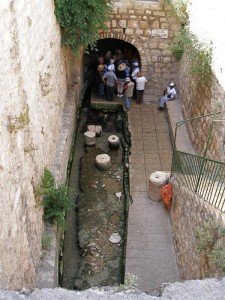
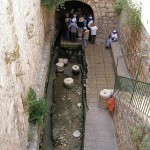
Upper pool from above with outlet of Hezekiah’s Tunnel at far end (Seetheholyland.net)
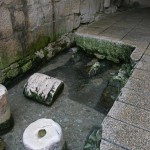
In the 5th century this narrow, rectangular pool had been remodelled, apparently by the Byzantine Empress Eudocia. A church named “Our Saviour, the Illuminator” was built over the pool.
A 6th-century pilgrim described a “hanging basilica” over the pool, in which men and women washed separately in two marble basins “to gain a blessing”.
The church was destroyed in 614 and never rebuilt. The pool was also abandoned. Bounded by high stone walls, it contains some scattered fragments of column drums from the church. It is also the place where walkers through Hezekiah’s Tunnel emerge.
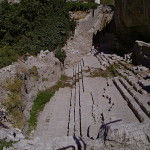
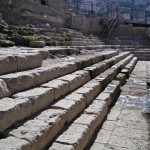
Then in 2004 a drainage repair crew, working on pipe maintenance about 50 metres south-east of this pool, uncovered large stone steps that had apparently led to an ancient pool dating from the first century BC. Coins found in the cement dated from the time of Jesus.
One side of the proposed pool had been buried under a lush garden with figs, pomegranates, cabbages and other fruits.
This property, once part of an orchard known as the King’s Garden, belonged to the Greek Orthodox Church. The building of a wall around the area is recorded in Nehemiah 3:15.
Excavation used bulldozers
In 2004 the church controversially sold the rights to the land to a company which transferred them to Elad, a settler organisation which operates the City of David National Park.
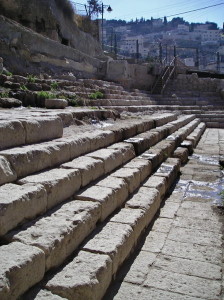
Close-up of steps discovered in 2004 (Abraham / Wikimedia)
In 2022 Israel authorities announced plans to fully excavate the site and include the pool in a controversial “Pilgrims Route” from the City of David to the Western Wall.
Unusually, instead of trowels and brushes, this excavation used bulldozers. To the surprise of the excavators, no evidence of the Pool of Siloam was found.
If a pool had been there, it was probably destroyed by the Roman army during the First Jewish-Roman War in AD 70 and gradually covered with debris. But work began to construct a new pool on the site, using modern stone blocks.
Meanwhile, archaeologists discovered an extensive dam, 12 metres high, constructed around 800 BC in response to changing climate conditions that brought harsh droughts and flash floods to Jerusalem.
The dam, a channel from the Gihon Spring, and the Siloam Pool were key elements of the city’s ancient water system.
Hezekiah’s workmen were ingenious
Hezekiah’s Tunnel was cut through solid rock at the beginning of the 8th century BC. One of the most ingenious engineering accomplishments of ancient times, it bears testimony to the crucial importance of a water supply to Jerusalem.
In times of war and siege, the City of David was vulnerable, since it depended on water from the Spring of Gihon. This spring, which gushes forth intermittently from a natural cave in the Kidron Valley, was outside the city walls.
King Hezekiah decided to bring water from the spring into the city. Following part of a natural fissure, two sets of teams began at opposite ends to cut a winding 533-metre tunnel on a double-S course — and they met in the middle.
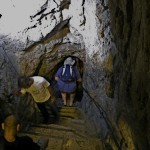
Axe and chisel marks can be seen along the entire length of the tunnel, which averages 60 centimetres wide and 2 metres high.
Inscription describes breakthrough
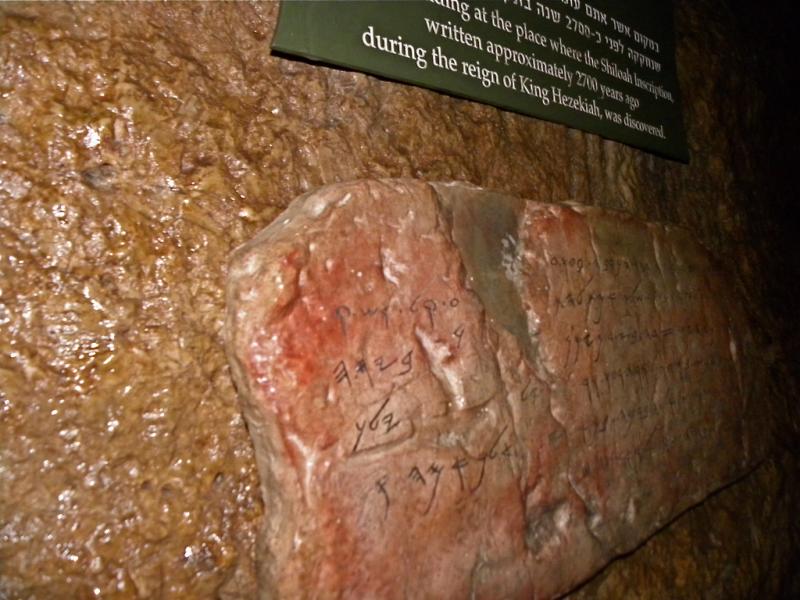
Reconstruction of 8th-century inscription by workers digging Hezekiah’s Tunnel (Ian W. Scott)
In 1880 a boy discovered an inscription in the rock near the mouth of the tunnel, which records its construction.
Of the final breakthrough, it says: “While the labourers were still working with their picks, each toward the other, and while there were still three cubits to be broken through, the voice of each was heard calling to the other, because there was a [crack?] in the rock to the south and to the north. At the moment of breakthrough, the labourers struck each toward the other, pick against pick. Then the water flowed….”
Hezekiah’s Tunnel may be traversed on foot, best starting from the Spring of Gihon, outside the Dung Gate. A reliable torch is necessary and footwear is advisable. Water is generally knee-high but can rise to waist height.
In Scripture:
King Hezekiah digs a tunnel: Sirach 48:17
Building the Pool of Siloam: Nehemiah 3:15
Jesus heals a blind man: John 9:1-41
-
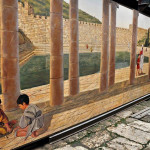
- Mural showing what Pool of Siloam might have looked like (© Ferrell Jenkins)
-
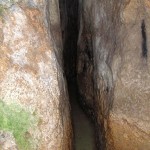
- Outlet of Hezekiah’s tunnel into the upper pool at Siloam (Seetheholyland.net)
-
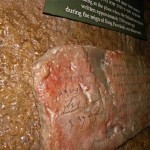
- Reconstruction of 8th-century inscription by workers digging Hezekiah’s Tunnel (Ian W. Scott)
-
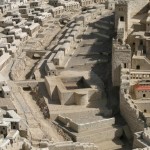
- Pool of Siloam in the Model of Ancient Jerusalem at Israel Museum (© Tom Callinan / Seetheholyland.net)
-
- Looking down on the steps discovered in 2004 (Abraham / Wikimedia)
-
- Reconstructed ancient street at Siloam (© Israel Ministry of Tourism)
-
- Upper pool from above with outlet of Hezekiah’s Tunnel at far end (Seetheholyland.net)
-
- Close-up of steps discovered in 2004 (Abraham / Wikimedia)
-
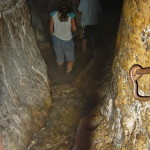
- Inside Hezekiah’s Tunnel (David Q. Hall)
-
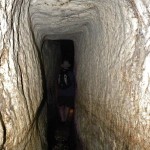
- Narrow width of Hezekiah’s Tunnel (Ian W. Scott)
-
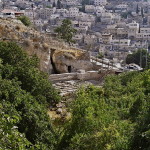
- Looking east over the site of the Pool of Siloam towards the neighbourhood of Silwan (Abraham / Wikimedia)
-
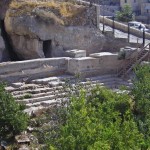
- Steps discovered in 2004 (Abraham / Wikimedia)
-
- Upper pool at the outlet of Hezekiah’s Tunnel (Seetheholyland.net)
-
- Column drums from Byzantine basilica in the upper pool (© Tom Callinan/Seetheholyland.net)
-
- Descent into Hezekiah’s Tunnel at the Gihon Spring (Ian W. Scott)
References
Gonen, Rivka: Biblical Holy Places: An illustrated guide (Collier Macmillan, 1987)
Mackowski, Richard M.: Jerusalem: City of Jesus (William B. Eerdmans, 1980)
Maugh, Thomas H. II: “Biblical Pool Uncovered in Jerusalem”, Los Angeles Times, August 9, 2005
Murphy-O’Connor, Jerome: The Holy Land: An Oxford Archaeological Guide from Earliest Times to 1700 (Oxford University Press, 2005)
Obel, Ash: “Israel, right-wing group to fully excavate biblical Siloam Pool in East Jerusalem”, The Times of Israel, December 27, 2022
Wareham, Norman, and Gill, Jill: Every Pilgrim’s Guide to the Holy Land (Canterbury Press, 1996)
External links