
West Bank
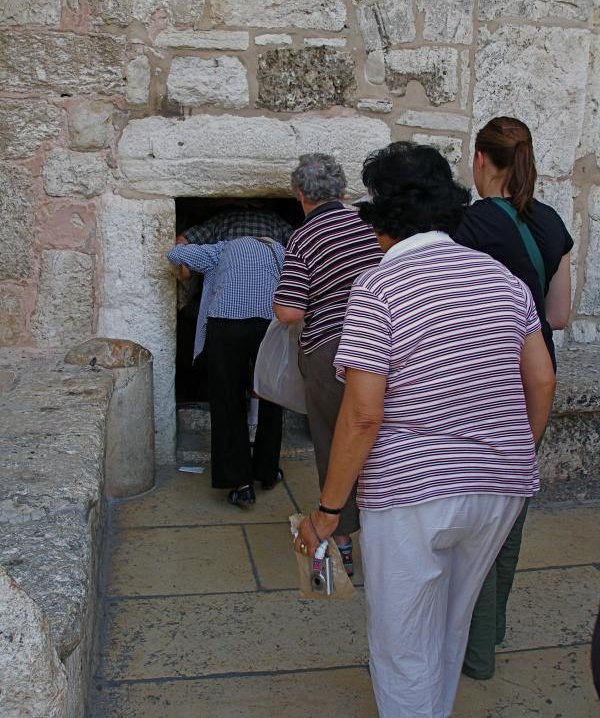
Entering Church of the Nativity (Seetheholyland.net)
Entering the church that marks the site of Christ’s birthplace means having to stoop low. The only doorway in the fortress-like front wall is just 1.2 metres high.
The previous entrance to the Church of the Nativity in Bethlehem was lowered around the year 1500 to stop looters from driving their carts in. To Christians, it seems appropriate to bow low before entering the place where God humbled himself to become man.
Today’s basilica, the oldest complete church in the Christian world, was built by the emperor Justinian in the 6th century. It replaced the original church of Constantine the Great, built over the cave venerated as Christ’s birthplace, and dedicated in AD 339.
Before Constantine, the first Christian emperor, the Romans had tried to wipe out the memory of the cave. They planted a grove dedicated to the pagan god Adonis, lover of Venus, and established his cult in the cave.
As St Jerome wrote in AD 395, “The earth’s most sacred spot was overshadowed by the grave of Adonis, and the cave where the infant Christ once wept was where the paramour of Venus was bewailed.”
Invading Persians spared the church
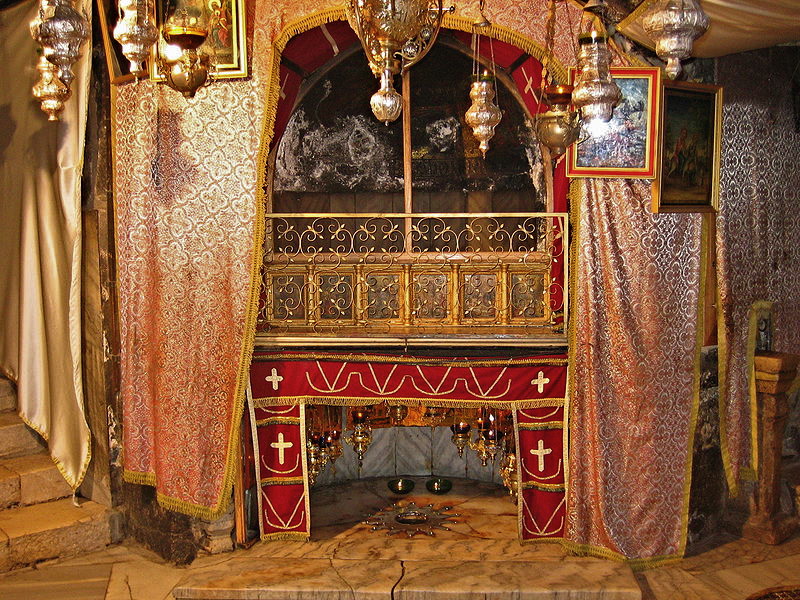
Grotto of the Nativity (Darko Tepert)
The Gospels do not say that Jesus was born in a cave, but there are written references to the Nativity cave as far back as AD 160. Even today in the Judean hills, families live in primitive houses built in front of natural caves used for storage or to shelter animals.
When the original Church of the Nativity was built, the cave was enlarged to make room for pilgrims and a silver manger was installed.
St Jerome did not approve: “If I could only see that manger in which the Lord lay! Now, as if to honour the Christ, we have removed the poor one and placed there a silver one; however, for me the one which was removed is more precious . . . .”
Persians invaded Palestine in 614 and destroyed many churches. They spared the Church of the Nativity when they saw a mosaic on an interior wall depicting the Three Wise Men in Persian dress.
In 1482 King Edward IV sent English oak and tons of lead to renew the roof. In the 17th century the Turks looted the lead to melt into bullets. The roof rotted and most of the rich mosaics on the walls of the nave were ruined.
When Unesco put the basilica on its list of world heritage sites in 2012, it was also deemed to be endangered because of damage due to water leaks. A $US15 million restoration of the church’s roof, walls and mosaics began in 2013.
Christmas is observed on January 7
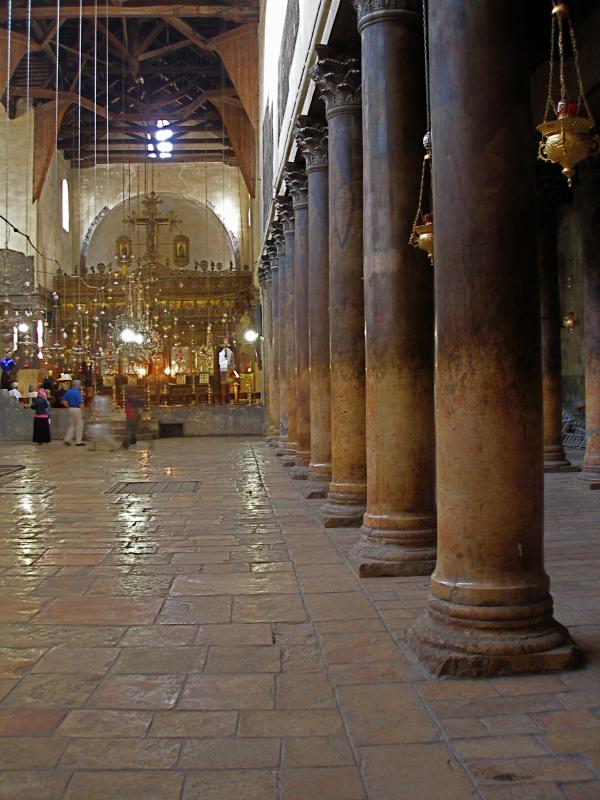
Columns of red limestone in Church of the Nativity (Seetheholyland.net)
Today’s Church of the Nativity is cool and dark, its interior bare with no pews. Wall mosaics from the 12th century — depicting saints, angels and Church councils — have had their original sheen restored.
The restorers even uncovered a 2-metre mosaic of an angel that had been lost for centuries.
Trapdoors in the floor allow glimpses of the mosaic floor of Constantine’s basilica. The red limestone pillars were quarried locally. Many are adorned with Crusader paintings of saints.
Steps to the right of the iconostasis (the carved screen, adorned with icons, that stands in front of the main altar) lead down to the Grotto of the Nativity.
As the ornamentation, icons and lamps in the front of the church suggest, the basilica is now almost wholly a Greek Orthodox place of worship. The Armenian Orthodox own the northern transept. The Catholics have the site of the manger and the adjoining altar next to the Nativity grotto.
So while Christians in the Western world celebrate Christ’s birthday on December 25 of the Gregorian calendar, the church at his birthplace still has 13 days to wait for the Orthodox, using the old Julian calendar, to celebrate it on January 7. Then the Armenians celebrate Jesus’ birth and baptism together on January 19.
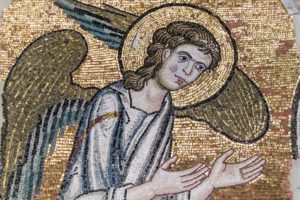
Rediscovered mosaic of an angel in Church of the Nativity (© Piacenti Restoration Center)
So where does the televised Christmas Eve service on December 24 come from? The adjoining Church of St Catherine of Alexandria, which is Catholic.
Other sites in the Bethlehem area:
Church of St Catherine of Alexandria
In Scripture:
The birth of Jesus: Luke 2:1-20; Matthew 1:18-25
The visit of the Wise Men: Matthew 2:1-12
Administered by: Greek Orthodox Church, Franciscan Custody of the Holy Land, Armenian Apostolic Church
Tel.: 972-2-2742440
Open: April-September, Mon-Sat 6.30am-7.30pm. October-March, Mon-Sat: 5.30am-5pm (5.30pm in January, 6pm February-March). Grotto opens at 11.30am on Sundays.
-
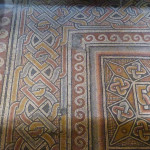
- Mosaic floor from Constantine’s church, in Church of the Nativity (Seetheholyland.net)
-
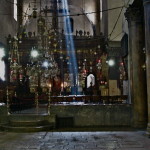
- Sunbeam in Church of the Nativity (James Emery)
-
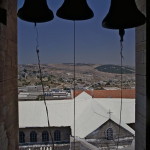
- Bells above Church of the Nativity (© Israel Ministry of Tourism)
-
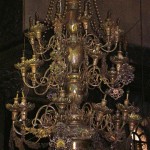
- Close-up of lamp in Church of the Nativity (Seetheholyland.net)
-
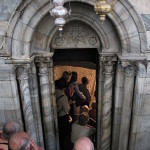
- Steps down to Grotto of the Nativity (James Emery)
-
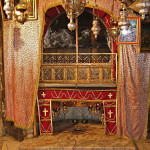
- Grotto of the Nativity (Darko Tepert)
-
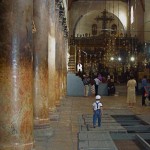
- Inside Church of the Nativity, with trapdoors revealing earlier mosaic floor (Seetheholyland.net)
-
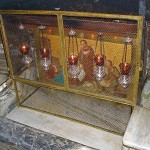
- Grotto of the Manger (Seetheholyland.net)
-
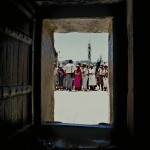
- Looking into Manger Square from Church of the Nativity (© Israel Ministry of Tourism)
-
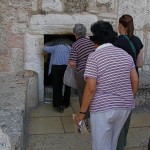
- Entering Church of the Nativity (Seetheholyland.net)
-
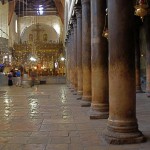
- Columns of red limestone in Church of the Nativity (Seetheholyland.net)
-
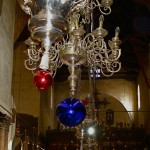
- Hanging lamps in Church of the Nativity (Seetheholyland.net)
-
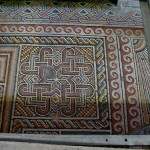
- Detail of mosaic floor from Constantine’s church, in Church of the Nativity (James Emery)
-
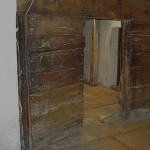
- Door in Church of the Nativity (Seetheholyland.net)
-
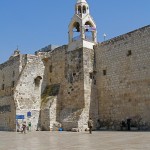
- Armenian convent belltower adjacent to Church of the Nativity (Seetheholyland.net)
-
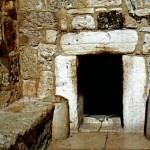
- Doorway to Church of the Nativity (© Custodia Terrae Sanctae)
-
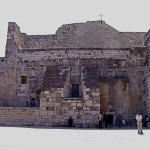
- Entrance to Church of the Nativity (Picturesfree.org)
-
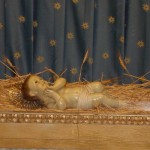
- Effigy of Christ child in Church of the Nativity (Seetheholyland.net)
-
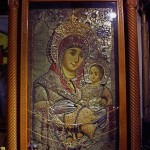
- Icon of Mary and Jesus in Church of the Nativity (Seetheholyland.net)
-
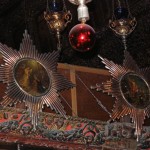
- Star medallions in Church of the Nativity (Seetheholyland.net)
-
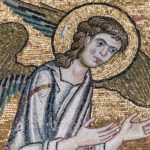
- Rediscovered mosaic of an angel (© Piacenti Restoration Center)
-
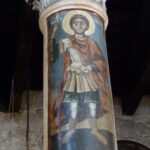
- Pillar painted by Crusaders with image of a saint in Church of the Nativity (Seetheholyland.net)
-
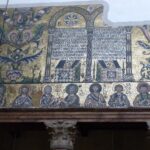
- Wall decoration uncovered during renovation of Church of the Nativity (Seetheholyland.net)
References
Baldwin, David: The Holy Land: A Pilgrim’s Companion (Catholic Truth Society, 2007)
Bastier, Claire, and Halloun, Nizar: “Restoration: Revealing the glories of the Basilica of the Nativity in Bethlehem”, Holy Land Review, winter 2016
Blaiklock, E. M.: Eight Days in Israel (Ark Publishing, 1980)
Brownrigg, Ronald: Come, See the Place: A Pilgrim Guide to the Holy Land (Hodder and Stoughton, 1985)
Chabin, Michele: “Church of the Nativity’s Face-Lift Reveals Ancient Treasures”, National Catholic Register, June 15, 2016
Freeman-Grenville, G. S. P.: The Holy Land: A Pilgrim’s Guide to Israel, Jordan and the Sinai (Continuum Publishing, 1996)
Gonen, Rivka: Biblical Holy Places: An illustrated guide (Collier Macmillan, 1987)
Inman, Nick, and McDonald, Ferdie (eds): Jerusalem & the Holy Land (Eyewitness Travel Guide, Dorling Kindersley, 2007)
Joseph, Frederick: “Bethlehem”, Holy Land, winter 2002
Martin, James: A Pilgrim’s Guide to the Holy Land (Westminster Press, 1978)
Murphy-O’Connor, Jerome: The Holy Land: An Oxford Archaeological Guide from Earliest Times to 1700 (Oxford University Press, 2005)
Wareham, Norman, and Gill, Jill: Every Pilgrim’s Guide to the Holy Land (Canterbury Press, 1996)
External links