
Israel
A fish-market and frontier post beside the Sea of Galilee, Capernaum became Jesus’ home town and the scene of many of his miracles.
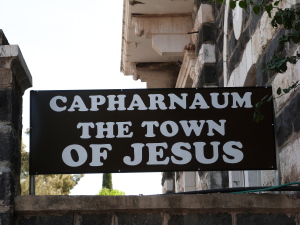
Sign at entrance to Capernaum site (Seetheholyland.net)
It was also the home of the first disciples Jesus called — the fishermen Peter, Andrew, James and John, and the tax collector Matthew (who as Levi collected taxes in the customs office).
In this town:
• Jesus worshipped and taught in the synagogue — where his teaching made a deep impression on the local people because, unlike the scribes, he taught with authority. (Mark 1:21-22)
• In the same synagogue, Jesus promised the Eucharist in his “I am the bread of life” discourse: “Very truly, I tell you, unless you eat the flesh of the Son of Man and drink his blood, you have no life in you.” (John 6:22-59)
• Jesus and healed many people of illness or possession by the devil, including Peter’s mother-in-law and the daughter of Jairus, the leader of the synagogue.
• Jesus pronounced a curse on the town, along with Bethsaida and Chorazin, because so many of its inhabitants refused to believe in him.
Church hovers over Peter’s house
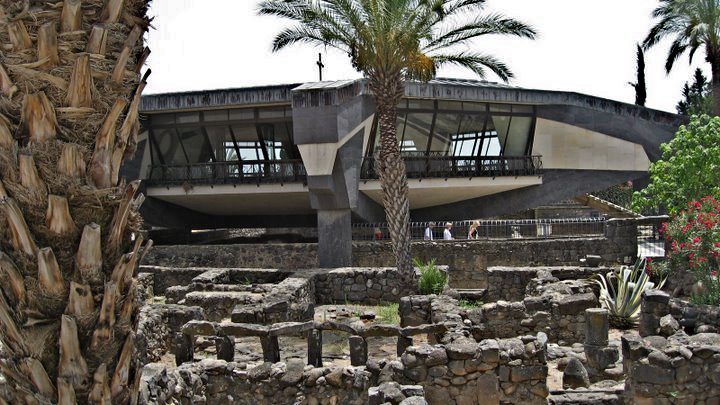
Modern church over St Peter’s house at Capernaum (© Tom Callinan / Seetheholyland.net)
Capernaum later fell into ruin. A 3rd-century report called the town “despicable; it numbers only seven houses of poor fishermen”. It was later resettled but again fell into disrepair. The ruins lay undiscovered until 1838, when a visiting scholar gave this description: “The whole place is desolate and mournful . . . .”
Today an ultra-modern Catholic church, perched on eight sturdy pillars, hovers protectively over an excavation site. It is believed to have been the site of Peter’s house, where Jesus would have lodged.
Archaeologists believe the house was in a small complex grouped around irregular courtyards. Drystone basalt walls would have supported a roof of tree branches covered with straw and earth — a fairly flimsy construction easily breached to lower a paralysed man on a mat, as described in Mark 2:1-12.
Excavations show that one room in this interlinked complex had been singled out since the middle of the 1st century. Graffiti scratched on its plaster walls referred to Jesus as Lord and Christ (in Greek). It is suggested that this room was venerated for religious gatherings as a house church. If so, it would have been the first such example in the Christian world.
In 5th century an octagonal church was built around this venerated room. The present church, dedicated in 1990, repeats the octagonal shape.
Ornate synagogue in white limestone
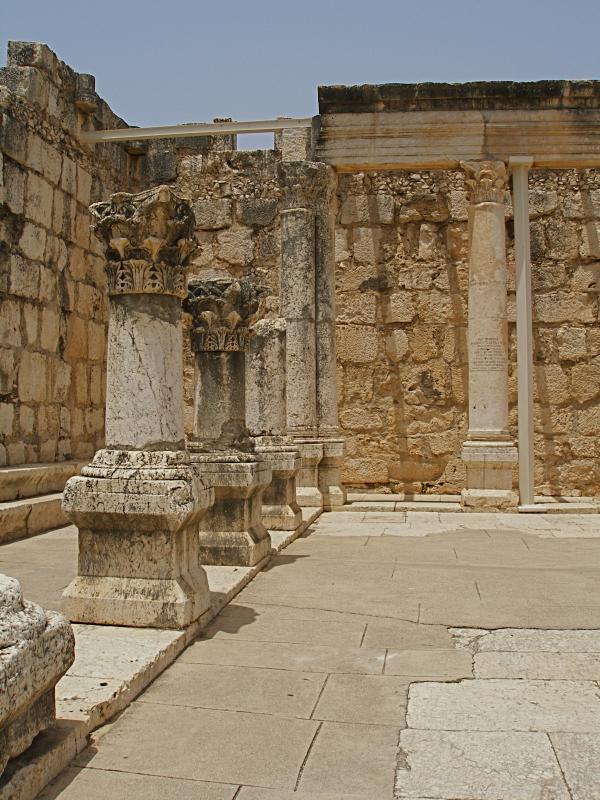
Inside the ancient synagogue at Capernaum (Seetheholyland.net)
Near the church, a partly reconstructed synagogue is believed to have been built on the foundations of the synagogue in which Jesus taught.
Erected in the 4th or 5th centuries, this impressive structure with ornately carved decorations is the largest synagogue discovered in Israel.
Its white limestone, carted from a distant quarry, contrasts with the local black basalt of the synagogue Christ knew. That original synagogue was built by a Roman centurion, the same centurion who had his servant healed after a declaration of faith that amazed Jesus (Luke 7:1-10).
A short distance away, by the Sea of Galilee, can be seen the red domes and white walls of a Greek Orthodox church, built in 1931 and dedicated to the Twelve Apostles.
Related site: Church of the Twelve Apostles
In Scripture:
Jesus makes his home in Capernaum: Matthew 4:12-17
Jesus teaches in the synagogue: Mark 1:21-28
Jesus cures Peter’s mother-in-law: Mark 1:29-31
Paying the temple tax: Matthew 17:24-27
Jesus calls Matthew: Matthew 9:9-12
Jesus condemns Capernaum: Matthew 11:20-24
Jesus heals a centurion’s servant: Luke 7:1-10
Jesus cures a paralysed man: Mark 2:1-12
“I am the bread of life”: John 6:22-59
Administered by: Franciscan Custody of the Holy Land
Tel.: 972-4-6721059
Open: 8am-4.50pm
-
- Sign at entrance to Capernaum site (Seetheholyland.net)
-
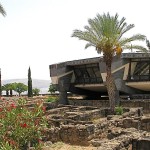
- Modern church at Capernaum (Seetheholyland.net)
-
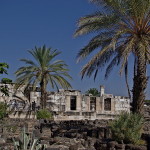
- Ancient Capernaum synagogue (Berthold Werner)
-
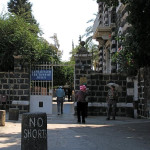
- Modesty message at Capernaum (Seetheholyland.net)
-
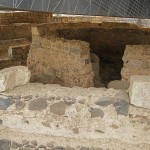
- Centre of octagonal church built on site of Peter’s house (Seetheholyland.net)
-
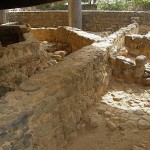
- Remains of octagonal church built on site of Peter’s house (Seetheholyland.net)
-
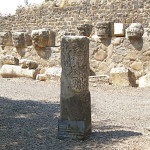
- Roman milestone at Capernaum (Seetheholyland.net)
-
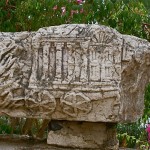
- Stone carving from Capernaum synagogue, usually described as the Ark of the Covenant on a cart, but possibly a shrine in which Torah scrolls were wheeled into the synagogue from storage (Seetheholyland.net)
-
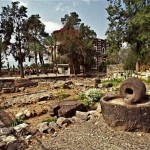
- Ancient oil press at Capernaum (© Israel Ministry of Tourism)
-
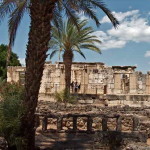
- Ancient synagogue behind palm trees at Capernaum (David Q. Hall)
-
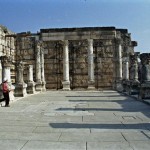
- Interior of the ancient synagogue at Capernaum (© Israel Ministry of Tourism)
-
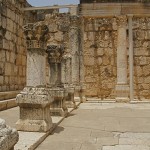
- Inside the ancient synagogue at Capernaum (Seetheholyland.net)
-
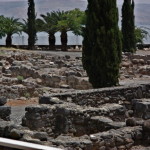
- Excavated ruins between the synagogue and church at Capernaum (Trish Vaughan / Seethe holyland.net)
-
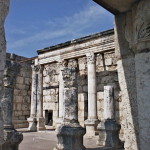
- Inside the synagogue at Capernaum (© Custodia Terrae Sanctae)
-
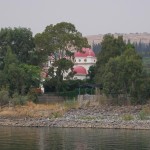
- Greek Orthodox church at Capernaum (Seetheholyland.net)
-
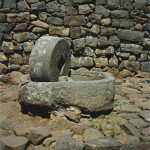
- Millstone found near synagogue at Capernaum (Seetheholyland.net)
-
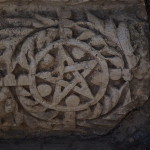
- Five-pointed star in carving at old Capernaum synagogue (Berthold Werner)
-
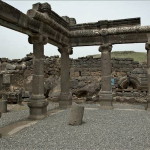
- Inside the ancient synagogue at Capernaum (© Israel Ministry of Tourism)
-
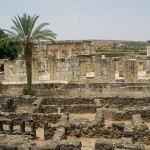
- Ancient synagogue and ruins at Capernaum (Seetheholyland.net)
-
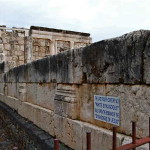
- Wall of the ancient synagogue at Capernaum (David Q. Hall)
-
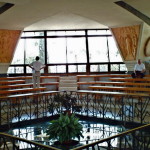
- Inside the Catholic church at Capernaum (Margaret O’Sullivan / Seetheholyland.net)
-
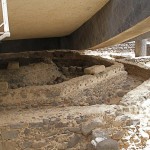
- Octagonal ruins under the Catholic church at Capernaum (Seetheholyland.net)
-
- In the garden at Capernaum (Seetheholyland.net)
-
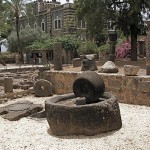
- Ancient olive press at Capernaum (Seetheholyland.net)
-
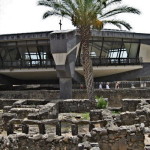
- Modern church over St Peter’s house at Capernaum (© Tom Callinan / Seetheholyland.net)
-
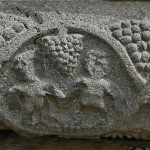
- Basalt stone relief from the ancient synagogue at Capernaum (© Israel Ministry of Tourism)
-
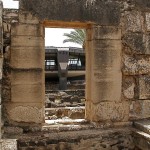
- Modern church seen through doorway of ancient synagogue at Capernaum (Seetheholyland.net)
-
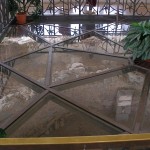
- Looking down on the ruins beneath the Catholic church at Capernaum (Seetheholyland.net)
-
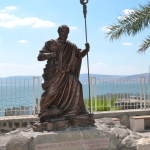
- Statue of St Peter at Capernaum, with Sea of Galilee in background (Seetheholyland.net)
-
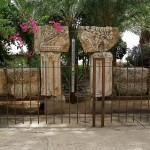
- “May peace prevail on earth,” reads the message on this post at Capernaum (Seetheholyland.net)
-
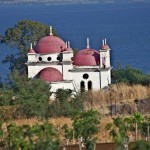
- Greek Orthodox church at Capernaum (© Israel Ministry of Tourism)
References
Charlesworth, James H.: The Millennium Guide for Pilgrims to the Holy Land (BIBAL Press, 2000)
Gonen, Rivka: Biblical Holy Places: An illustrated guide (Collier Macmillan, 1987)
Loffreda, Stanislao: “Capharnaum”, Holy Land, summer and autumn, 2002
Murphy-O’Connor, Jerome: The Holy Land: An Oxford Archaeological Guide from Earliest Times to 1700 (Oxford University Press, 2005)
Rainey, Anson F., and Notley, R. Steven: The Sacred Bridge: Carta’s Atlas of the Biblical World (Carta, 2006)
Strange, James F., and Shanks, Hershel: “Synagogue Where Jesus Preached Found at Capernaum” and “Has the House Where Jesus Stayed in Capernaum Been Found?”, in The Galilee Jesus Knew (Biblical Archaeology Society, 2008)
Wareham, Norman, and Gill, Jill: Every Pilgrim’s Guide to the Holy Land (Canterbury Press, 1996)
External links