. . . your guide to visiting the holy places  
If you have found See the Holy Land helpful and would like to support our work, please make a secure donation.
The Sites

Israel and Palestine – In Jerusalem

Israel and Palestine – Outside Jerusalem

Jordan

Egypt

Extras

Joy Cowley in the Holy Land

Filed under: Documents — 12:23 pm

New Zealand pilgrims see Jesus wherever they go in Galilee

by JOY COWLEY
NZ Catholic: July 15-28, 2007

Christians in Israel call the Holy Land “the Fifth Gospel”. They say that Jesus speaks through the landscape, thus opening up the other four Gospels. We found this true in ways we’d not expected. There we were, 47 NZ Catholic pilgrims, in the land of Jesus with Jesus. The four Gospels would never be the same for us.
Our arrival at Tel Aviv airport had been surprisingly easy. To encourage tourism, Israeli authorities have made security checks less intimidating. We walked out of customs, into the care of Harvest Pilgrimages’ avuncular agent Gabriel, guide Salah and driver Obadiah. By the time our bus wound down through the streets of Tiberias to the shore of Galilee, we were as excited as children on Christmas Eve.
Early morning by the Sea of Galilee is filled with peace. Some of us were up with the birds — trees shaking with twittering sparrows, swallows criss-crossing the sky, white herons flapping above the water. As the sun came up over the Golan Heights on the other side, and spread itself over the lake, we knew that our Lord saw such a morning as he cooked fish on a charcoal fire. Later, we would eat the same kind of fish — telapia, known in Galilee as St Peter’s fish.
That first day, on the way to Mt Tabor, our bus stopped briefly at Nain, where Jesus healed the widow’s son. A woman followed by a goose and two cats opened the church door for us, while several children appeared with hands held out like cups for shekels. We obliged. Why not? We were in celebratory mood.
We climbed back in the bus and minutes later were on the top of Mt Tabor in the Franciscan Church of the Transfiguration, with its beautiful mosaics and sense of light. This was where Bishop Pat Dunn celebrated Mass with his cousin, Fr Tony Dunn, and, like many other churches we would visit, it has great acoustics. Our singing seemed to spiral up around the walls to echo in the mosaic-rich ceiling.
This was where Jesus allowed two of his disciples to see the radiance of his divine nature. We remembered friends in our prayers and felt privileged to be there.
That afternoon we went to Nazareth and the Church of the Annunciation, then the church at Cana where Jesus performed the first miracle. This is a popular place for the renewal of wedding vows. Because the church was full, we stood in the garden while Bishop Pat took couples through their vows. That night at dinner, no one volunteered to turn water into wine, but we found good chardonnay and merlot from the vineyards of Mt Carmel to complete the celebration.
On day two we stayed on and around the Sea of Galilee. In the morning we boarded a large wooden boat that looked as though it had sailed straight out of the Bible, borrowing an engine from the early 20th century on its way. We chugged towards a kibbutz on the other side but first stopped in the middle of the lake for prayer. Air and water were still, diamond bright with sun, and as Bishop Pat read from Scripture, we saw Jesus everywhere — asleep in the boat, calming a storm, walking on the water, with his disciples rowing to the other side.
I reflected on “the other side”, the Decapolis which was pagan territory in Jesus’ time. Our Lord had seen his ministry as being only to the lost sheep of Israel. Yet in the pagan territory of the 10 towns he healed and taught, and people believed in the God of Israel.
What made Jesus change his mind? Scripture tells us it was the Syro-Phoenician woman who wanted healing for her daughter and wouldn’t take no for an answer. I gave thanks for that woman who made the good news of Jesus Christ available to the Gentiles.
The boat chugged to the jetty and we entered a kibbutz where we saw the 2000-year-old boat found in mud during a drought year. Back on the bus, we went to the excavated city of Capernaum and the church built over Peter’s house where Jesus stayed.
Some of us spent time in the ruins of the nearby fourth-century synagogue built on foundations of the synagogue where Jesus taught. In the hot, still air, the foundation stones seemed alive with his words.
The next stop was at the Church of the Primacy of Peter, on the shore of the lake, and here we had Mass in an outdoor chapel — a stone altar, stone seats in a circle under a large tree, the lake shimmering in the background. In this place, where Peter atoned for three denials with three statements of love, we too made our commitment: “Lord, you know that I love you.”
Because the West Bank road was open, we were able to drive around the western shore of the lake, through the Golan Heights, and back to the Church of the Beatitudes, before a visit to the baptismal site on the River Jordan.
The next day we made an unplanned return to the Church of the Beatitudes. We’d spent the morning at the crusader town of Akka (Acre) and the Carmelite church built over Elijah’s cave. Liturgy that afternoon was prepared for the Church of the Multiplication of Loaves and Fishes, but the venue was not available.
Our guide Salah took us back to the Church of the Beatitudes where we had Mass at an outdoor chapel on the hillside. The wind shook trees, flattened grass and clouded the lake with spray. We rejoiced in its energy. How often had Jesus walked on this hill in this wind?
We returned to the hotel, exhilarated and renewed, and were not surprised when Bishop Pat said he’d just looked up the ordinary readings for the day. What were they? The Beatitudes, of course.
Again, Jesus had been truly present in the Fifth Gospel — his turangawaewae [a Maori word meaning “a place to stand” or to feel connected].

Next issue: Jerusalem

Pilgrimage ends at Jerusalem but inner journey continues

by JOY COWLEY
NZ Catholic: July 29-August 11, 2007

Bags were loaded on the bus as 46 pilgrims, under the spiritual direction of Bishop Pat Dunn, prepared for the journey from the shores of Galilee to Jerusalem. We had been journeying with Jesus in his ministry. Now we were going to the region where he spent the first and last days of his Incarnation.
We had been travelling together for over a week and had become family to each other. Our days in Rome and Galilee were enriched with prayer and Eucharist, and warm with humour. Many of the lighter moments came from the Dunns — the bishop, his brother, Joe, and their cousin, Fr Tony, SM — who share genetic laughter.
Our co-ordinators Pat and Suzie McCarthy seemed to clone themselves in order to take care of each one of us. We didn’t know when they slept. And there was something else — a warmth cocooning the entire pilgrimage as though we were being held by something we did not want to name for fear of diminishing it with words.
The bus left the rich Jordan valley and travelled south through hard, dramatic desert to Jericho, where we looked at excavations of the city in Joshua’s time. The sun was turned up to fan bake and, apart from the green garden patch around Elisha’s spring, Jericho, ancient and modern, was cooked to the colour of dust.
Back in the air-conditioned bus, we moved on to Bethany, about two miles outside Jerusalem. Again, the past became present to us and we were in the company of Mary, Martha and Lazarus, good friends of Jesus.
Archaeologist and scholar Yigael Yadin has evidence that Bethany was once a village for Essene lepers and other outcasts. This could be so, for it was in Bethany that Jesus had a meal with Simon the leper. There is also a tradition that Lazarus had some disability. But we were not in Bethany to fill gaps in history. We were with the timeless Jesus, who was returning with his disciples from the Batanea area to the tomb where he would raise Lazarus from the dead.
We stopped in a narrow street and negotiated hazardous steps down to Lazarus’ tomb. The original entrance to the tomb is now closed up, part of the wall of a mosque, although the tomb itself is believed to be original.
Some of the holy sites visited are approximate, others actual. How do we know, for example, that Ein Karem is the birthplace of John the Baptist and the site of the Visitation? Our guide Salah explained. In an attempt to erase Christianity, the Romans built temples to Roman gods over the places venerated by the followers of Jesus. The temples served as markers for the Byzantine reclamation of holy sites.
We celebrated Jesus’ birth for most of our second day in the Jerusalem area, which meant going through the wall to Bethlehem and the Church of the Nativity. The high barrier cutting off the West Bank was covered with slogans, pro-Israeli government on one side and anti-Israeli government on the other, reminding us that this little country has never known prolonged peace.
But there is peace in abundance at the holy places. At Shepherds Field, we had Mass outside under the trees, and the angel song at Jesus’ birth seemed very real to us.
Conflict in Gaza gave us time to reflect on the tension of opposites: The child in the manger and Herod; Jesus and the Pharisees; a holy city and car bombings; angel song and gunfire.
Evil is a certainty but, somehow, it is tied to goodness. My perception is too limited for understanding, yet if I imagine a state of perfect peace, I see stagnancy. There is no growth without tension. It is a condition of human pilgrimage.
We were aware of this the next day when we journeyed with Jesus to Calvary. The morning’s walk through the old city began brightly enough, with crowds moving through security checkpoints to the Pool of Bethesda and the Wailing Wall where Jews from all nations were praying.
A group of Moroccans celebrated a Bar Mitzvah with drums and shofar, clapping and song. Married Hassid women with shaven heads covered by turbans rocked with their prayer books. Every crack in the wall was filled with bits of folded paper — notes to God about broken relationships, financial problems, babies, health, and maybe a word or two of praise.
We moved on through the old city and our pilgrim sky darkened. We had previously visited the House of Caiaphas and St Peter in Gallicantu, where Peter denied his Lord. Now we were doing the actual death walk with Jesus, the Via Dolorosa and the Stations of the Cross. Again we met the tension of opposites.
On both sides of this ancient road where our Lord carried his cross to Calvary were merchants trying to sell us stuffed toy camels and souvenir Jerusalem bags. Did traders also follow the crowd that condemned Jesus?
Mass at the Church of Calvary brought us to the heart of our faith. “Lord by your cross and Resurrection you have set us free.” We rested in sombre mood in the silence between the cross and the Resurrection. Here was the supreme example of the mystery of good and evil, horrifying darkness evolving into eternal light.
That night, Bishop Pat arranged for us a Holy Hour in the Garden of Gethsemane, where we wound back time again to keep watch with Jesus. For many of us, this hour of silent prayer with readings and Taize chant was a peak Jerusalem experience.
Our pilgrimage was almost over. We had time at the museum Shrine of the Book where we saw the Dead Sea Scrolls and a model of Jerusalem in the second temple era, plus a visit to Masada and the Dead Sea; but the journey with Jesus seemed to come to completion with a visit to Emmaus.
At Eucharist we were the disciples who walked with the risen Jesus to this place and our hearts burned within us. But had not our hearts been warm with his presence every day?
The last night was tinged with sadness — farewells, hugs, some tears. Still, it was only the outer journey of this pilgrimage that had ended. The inner journey would go on and on.
« Newer PostsOlder Posts »

Schindler’s grave

Jerusalem


Schindler's grave

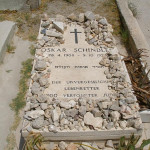
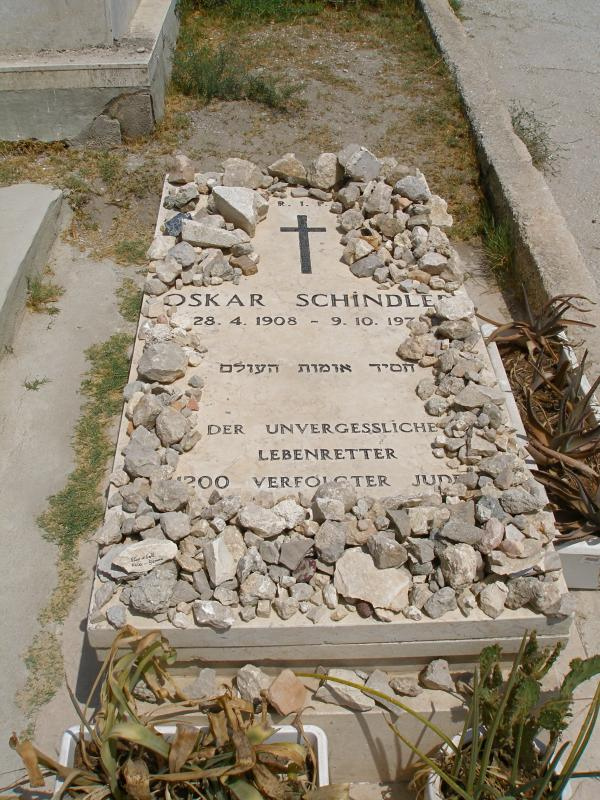
Oskar Schindler’s grave (Seetheholyland.net)

One of the most-visited graves in Jerusalem belongs to Oskar Schindler, the German factory-owner and Nazi Party member credited with saving the lives of 1098 Jews during the Second World War.

His grave in the Catholic cemetery on the southern slope of Mount Zion is visited by Jews, Christians and people of no religious faith.

A complex and conflicted man, Schindler was an unlikely candidate for heroism that involved risking his life to save others.

Born into a Catholic family in Moravia, he was unfaithful to his wife with a succession of mistresses. As a businessman he engaged in black-market dealings and bribery. An ethnic German but a Czech citizen, he worked as a counterintelligence agent for the Nazi armed forces (for which he was jailed by Czechoslovakia) and also collaborated in the German strategy for the invasion of Poland.

Ironically, Schindler’s less endearing character traits equipped him to ingratiate himself with Nazi officials for the sake of his Jewish employees.


At least nine lists were drawn up

Schindler's grave

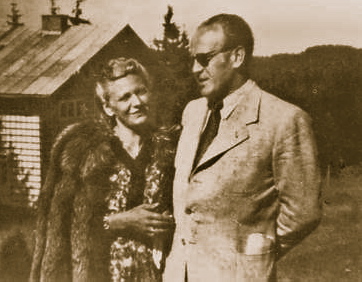
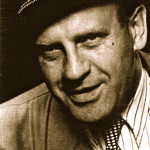
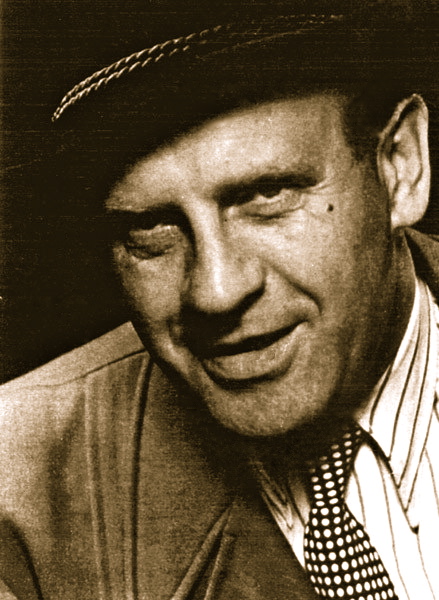
Oskar Schindler in 1947 (Freeinfosociety.com)

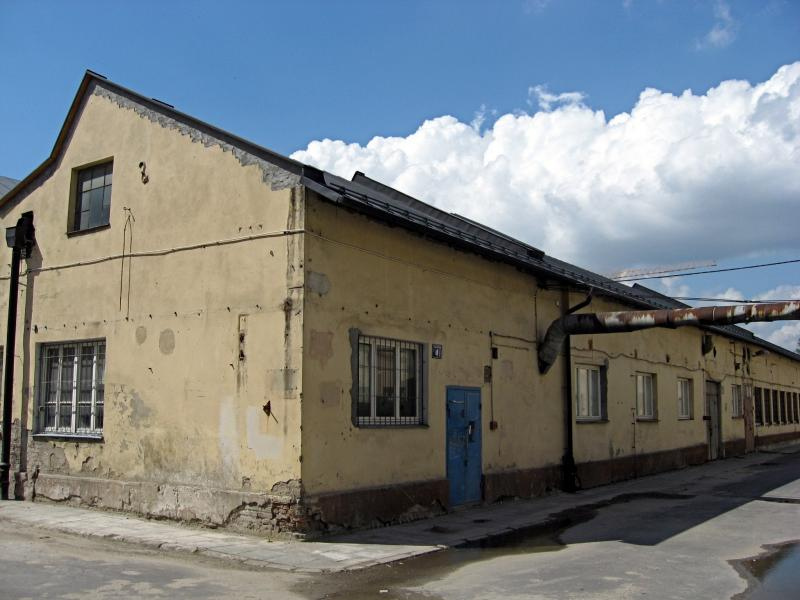
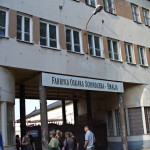
After Germany occupied Poland in 1939, the opportunistic Schindler moved to the Polish city of Krakow and took over a Jewish-owned enamelware factory.

Because the factory was close to the Jewish ghetto he was able to witness the brutal German oppression at firsthand. “And then a thinking man, who had overcome his inner cowardice, simply had to help. There was no other choice,” he said after the war.

Schindler built up his workforce with Jewish forced labourers from the Plaszow labour camp, bribing officials to ensure their wellbeing. He and his wife Emilie especially cared for those who were old or weak.

Schindler's grave

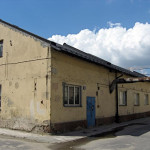
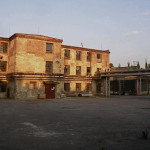
Part of Schindler’s Krakow factory in 2009 (Jongleur100 / Wikimedia)

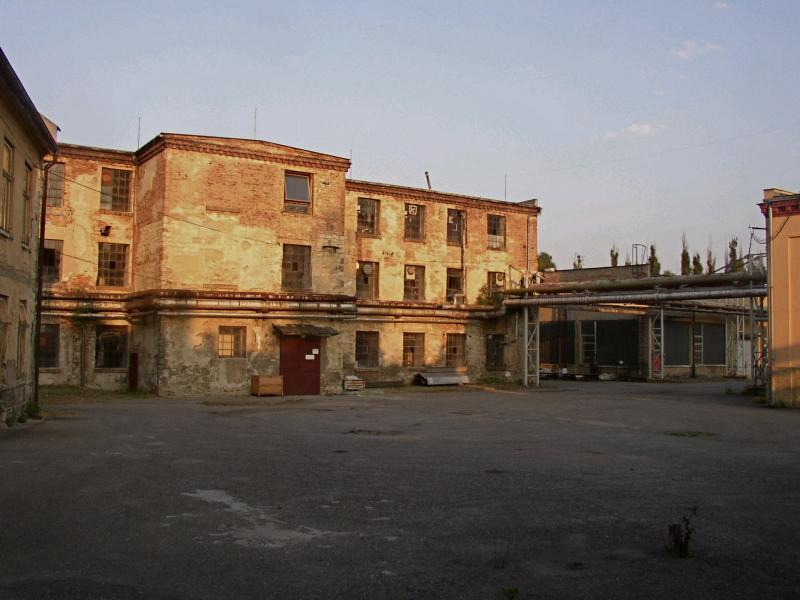
In 1944, when the inmates of Plaszow were destined for deportation to death camps such as Auschwitz, Schindler obtained approval (after paying the necessary bribes) to move his factory to Brünnlitz in Czechoslovakia, on the pretext of making armaments.

The names of the workers chosen to move to the new factory formed the “list” made famous in Thomas Keneally’s 1982 Booker Prize-winning novel Schindler’s Ark and Steven Spielberg’s 1993 Academy Award-winning movie Schindler’s List.

In fact, according to Schindler’s definitive biographer David M. Crowe, at least nine lists, constantly changing, were drawn up in late 1944 and 1945, and they were drawn up by other people — although Schindler had given guidelines as to who he wanted included. However, without Schindler’s efforts there would have been no Jewish workers to be listed.


Declared Righteous Among the Nations

Schindler's grave

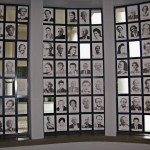
Schindler’s Brünnlitz factory in 2004 (Miaow Miaow / Wikimedia)

By the time the war ended, Schindler’s considerable wealth had been spent on bribes and black-market supplies for his workers and he was reduced to receiving handouts from Jewish organisations.

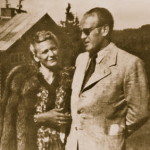
In 1949 he emigrated to Argentina with his long-suffering wife, his current mistress and some Jewish friends. After a farming venture failed he returned alone to Germany and established a cement factory that went bankrupt.

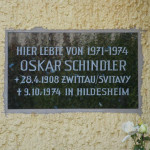
In the 1960s he began annual visits to Israel, where he was feted as a hero, but he was in poverty when he died in 1974, aged 66, in Hildesheim, Germany. It was his own wish to be buried in Jerusalem.

Schindler's grave

Emilie and Oskar Schindler in 1946 (Wikimedia)

Emilie Schindler remained in Argentina, living on a pension. She died in 2001 during a visit to Berlin, aged 94.
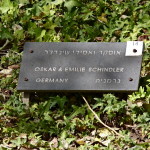
In 1962 a tree was planted in Oskar Schindler’s honour in the Avenue of the Righteous at the Yad Vashem Holocaust museum in Jerusalem. But it was not until 1993 that both Oskar and Emilie were officially recognised by Yad Vashem as Righteous Among the Nations.


Visitors leave stones on grave

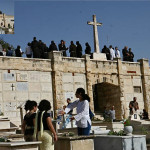
Schindler’s grave in the Mount Zion Catholic Cemetery — not the Protestant Cemetery further west, as some guidebooks have it — is within easy walking distance of the Old City’s Zion Gate.

Schindler's grave

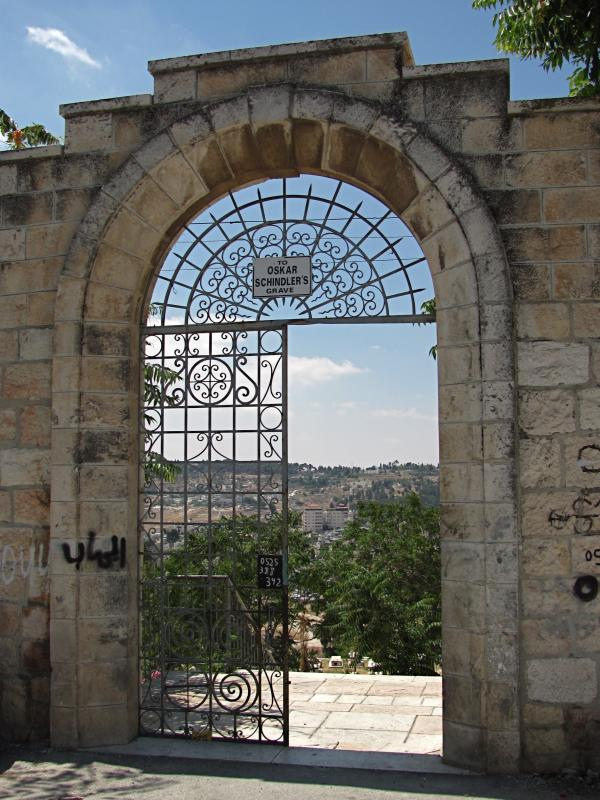
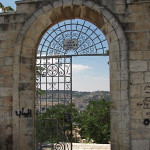
Entrance to Mount Zion Catholic Cemetery (Yoninah / Wikimedia)

Walk out Zion Gate towards the bus parking lot. Take the road on the left until it joins a major road called Ma’aleh Hashalom. Follow this road down the slope of Mount Zion until you come to a high stone wall on the left with a wrought-iron gate. High on the gate is small sign reading “To Oskar Schindler’s Grave”.

For times when the cemetery is closed, the Muslim custodian’s phone number is painted roughly on the gate.

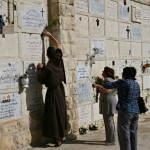
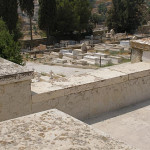
The cemetery is on two levels, with circular steps leading down to the lower level where Schindler is buried. Many of the graves are of Franciscan monks and nuns. Others, as their Arabic inscriptions indicate, belong to Arab Catholic families whose family trees date back hundreds of years.

At the edge of the top level stands a large cross. Facing the cross, look down on the lower level at about 2 o’clock. The flat slab of Schindler’s last resting place stands out from the other graves because of the stones left on it by visitors — a Jewish custom that is also followed by many others who come to pay their respects.

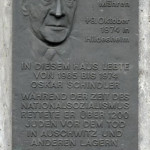
The stones often partly cover the inscriptions, which read (in Hebrew) “Righteous Among the Nations” and (in German) “The Unforgettable Lifesaver of 1200 Persecuted Jews”.


Open: Usually 8-12am (closed Sunday)

Tel.: 0525-388342


References

Burkeman, Oliver, and Aris, Ben: “Biographer Takes Shine off Spielberg’s Schindler”, The Guardian, November 25, 2004
Crowe, David M.: Oskar Schindler: The Untold Account of his Life, Wartime Activities, and the True Story Behind the List (Westview Press, 2004)
Keneally, Thomas: Schindler’s Ark (Hodder and Stoughton, 1982)
Rubenstein, Danny: “A Sign Points to the Grave”, Haaretz, July 19, 2007
Smith, Dinitia: “A Scholar’s Book Adds Layers of Comploexity to the Schindler Legend”, The New York Times, November 24, 2004


External links

Oscar Schindler (Louis Bülow)
Oskar Schindler (Holocaust Education & Archive Research Team)
Oskar Schindler (Encyclopedia of World Biography)
Oskar Schindler (United States Holocaust Memorial Museum)
The Real Oskar Schindler (Herbert Steinhouse)


« Newer PostsOlder Posts »

Taybeh

West Bank


Taybeh

Christian village of Taybeh (© Custodia Terrae Sanctae)

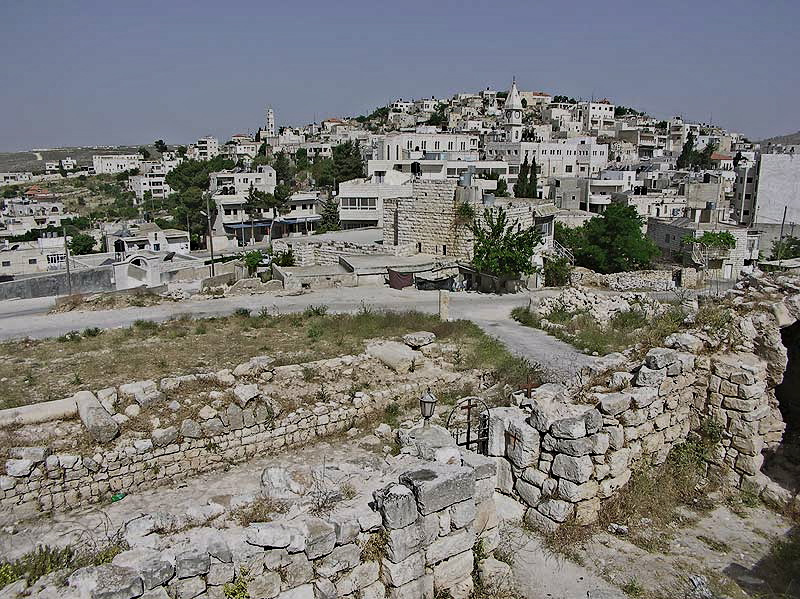
The Palestinian village of Taybeh, the only Christian town left in Israel or Palestine, holds fast to its memory of Jesus seeking refuge there shortly before his crucifixion.
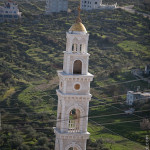
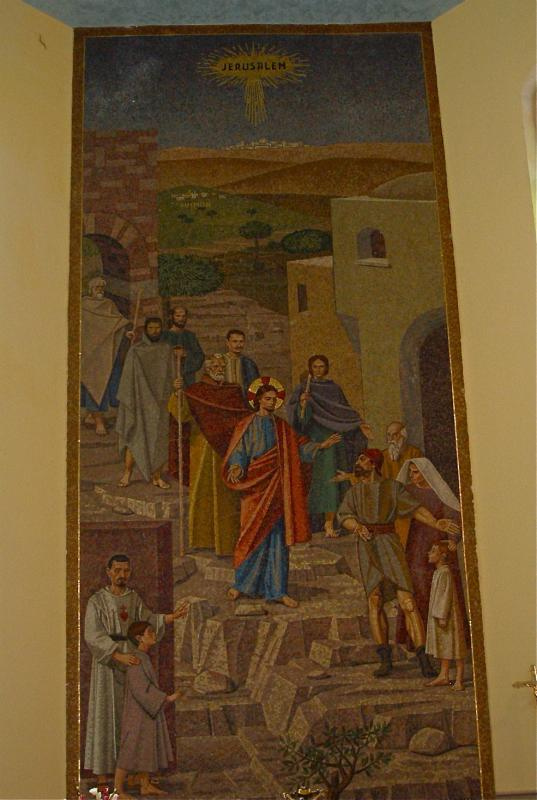
The Gospel of John says Jesus went to Taybeh — then called Ephraim — after he raised Lazarus to life and the Jewish authorities planned to put Jesus to death.
Jesus therefore no longer walked about openly among the Jews, but went from there to a town called Ephraim in the region near the wilderness; and he remained there with the disciples.” (John 11:54)

Taybeh (pronounced Tie-bay) is 30 kilometres northeast of Jerusalem and 12 kilometres northeast of Ramallah. From its elevated site between biblical Samaria and Judea, it overlooks the desert wilderness, the Jordan Valley, Jericho and the Dead Sea.

Taybeh

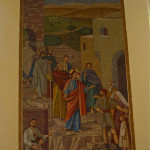
Jesus arriving in Taybeh, mosaic in Roman Catholic church (Seetheholyland.net)

Living amidst Muslim villages, Israeli settlements and military roadblocks, Taybeh’s inhabitants (numbering 1300 in 2010) are intensely proud of their Christian heritage.

The village’s Greek Orthodox, Roman Catholic (Latin) and Greek Catholic (Melkite) communities maintain an ecumenical spirit — even celebrating Christmas together on December 25 according to the Western calendar and Easter according to the Eastern calendar.


Patron is St George

The village of Taybeh was first settled by Canaanites about 2500 years before Jesus came to visit. It is mentioned as Ophrah (or Ofrah), a town of the tribe of Benjamin, in Joshua 18:23, and shown on the 6th-century Madaba mosaic map as “Ephron also Ephraia where went the Lord”.

The Muslim sultan Saladin changed the biblical name to Taybeh (meaning “good and kind” in Arabic) around 1187 after he found the inhabitants hospitable and generous.

Taybeh

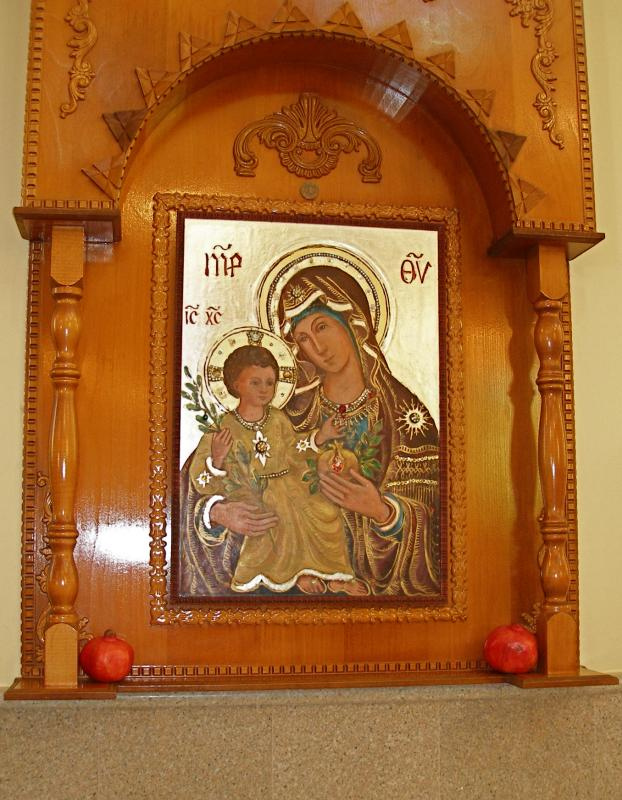
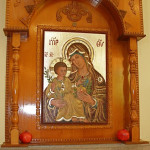
Pomegranates complementing icon in Catholic church, Taybeh (Seetheholyland.net)

The villagers regard St George — whose traditional birthplace is Lod, near Tel Aviv airport — as their patron. The Greek Orthodox and Melkite churches are both named in his honour.
They also see the pomegranate as a symbol of the fullness of Jesus’ suffering and Resurrection. This fruit appears as a motif in religious art in Taybeh.
A tradition says Jesus told the villagers a parable relating to this fruit, whose sweet seeds are protected by a bitter membrane. Using this image, Jesus explained that to reach the sweetness of his Resurrection he had to go through the bitterness of death.


Old house illustrates parables

Taybeh

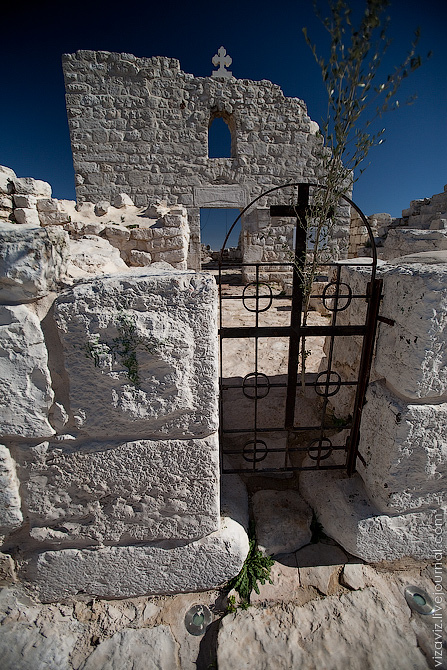
Entrance to ruins of St George’s Church, Taybeh (© vizAviz)

The original Church of St George, built by the Byzantines in the 4th century and rebuilt by the Crusaders in the 12th century, lie in ruins on the eastern outskirts of Taybeh, behind the Melkite church. It is called “El Khader” (Arabic for “the Green One”), a name customarily given to St George.

A wide flight of steps leads up to an entrance portico, nave, two side chapels and a cruciform baptistery with a well-preserved font.

Next to the Greek Orthodox church a 4th-century mosaic depicting birds and flowers has been found. A chapel has been built over the site to protect the mosaic.

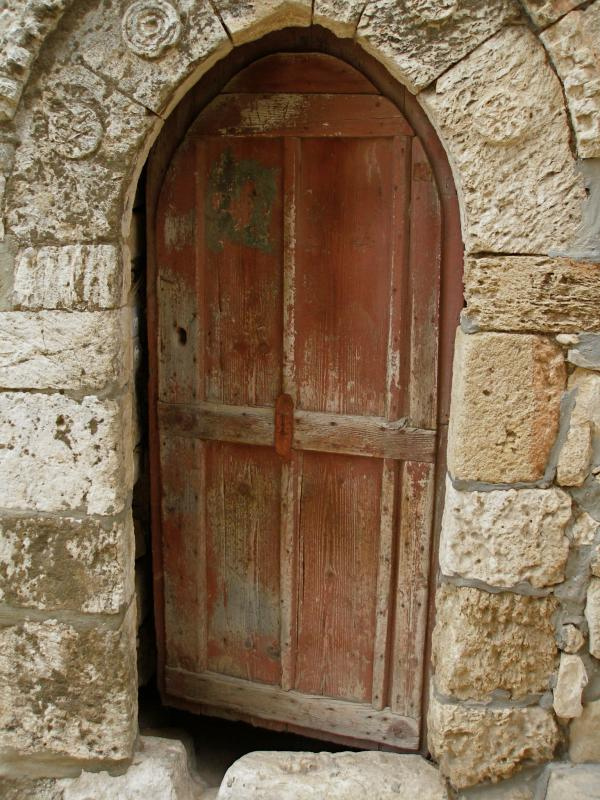
In the courtyard of the Roman Catholic church stands a 250-year-old Palestinian house, occupied by a local Christian family until 1974. The entrance is claimed to be 2000 years old, with five religious symbols of that time engraved in the stone façade above the door.

Known as the Parable House, it has rooms on three levels — for the family, for large animals and for smaller animals (who also have an access hole under the old wooden door).

Taybeh

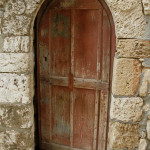
Door of Parable House, Taybeh, with hole for small animals underneath (Seetheholyland.net)

The house and its domestic and agricultural furnishings illustrate the context of many of the parables of Jesus and also offer an insight into how the Nativity cave at Bethlehem may have been configured.


Priest’s retreat is remembered

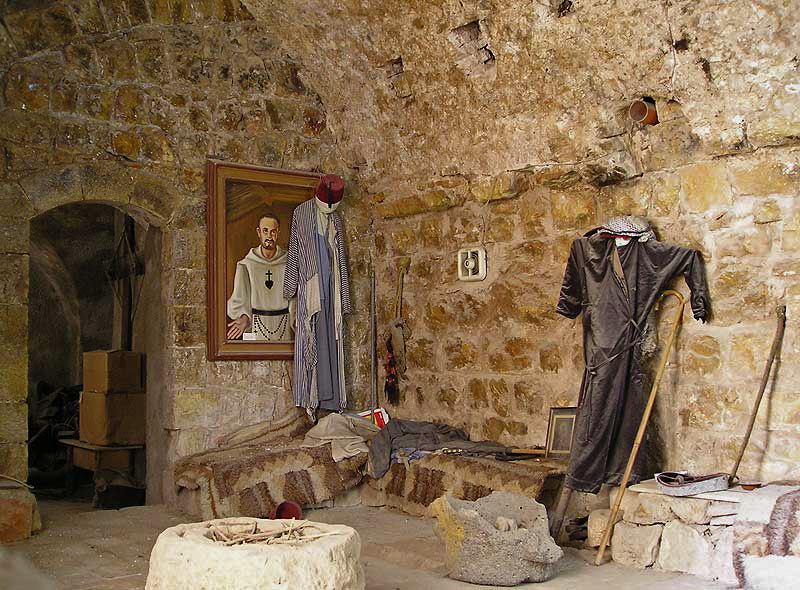
Another celebrated visitor to Taybeh was Charles de Foucauld, a French-born priest, explorer, linguist and hermit who was beatified by the Catholic Church in 2005.

De Foucauld passed through Taybeh as a pilgrim in 1889 and returned in 1898 for an eight-day retreat that is recorded in 45 pages of his spiritual writings.

After his death (he was shot dead by raiding tribesmen in Algeria in 1916, aged 58), his example inspired the founding of several religious congregations.

Taybeh

Charles de Foucauld shrine at Taybeh (© Custodia Terrae Sanctae)

In 1986 a pilgrims’ hostel called the Charles de Foucauld Pilgrim Centre was opened in Taybeh.


Brewery boosts local economy

Economic and political pressures have forced some 12,000 residents of Taybeh to emigrate to the Americas, Europe and Australia. To ensure jobs for those who remain, the churches and the Taybeh Municipal Council are working to improve the local economy.

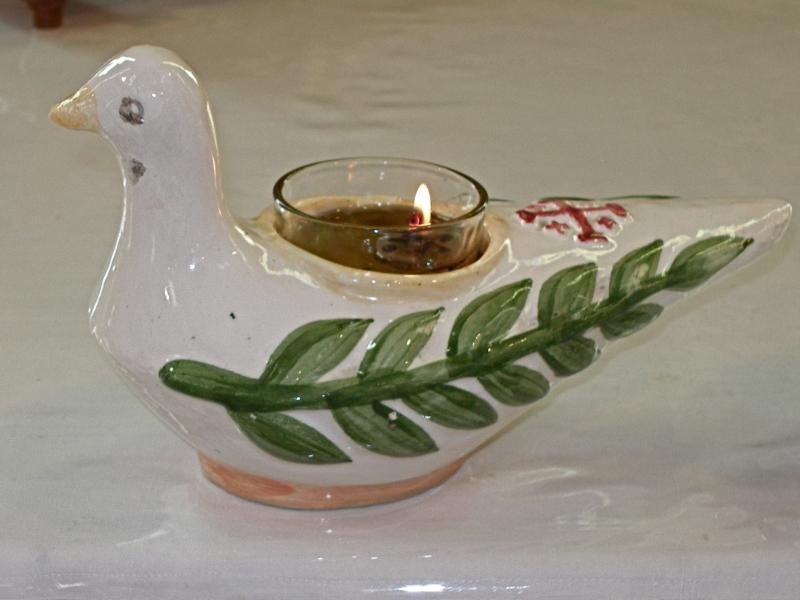
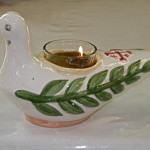
A co-operative to sell olive oil, a ceramic workshop to make dove-shaped peace lamps, and a school to train stone-cutters have been established.

Taybeh

Ceramic peace lamp in Taybeh (Seetheholyland.net)

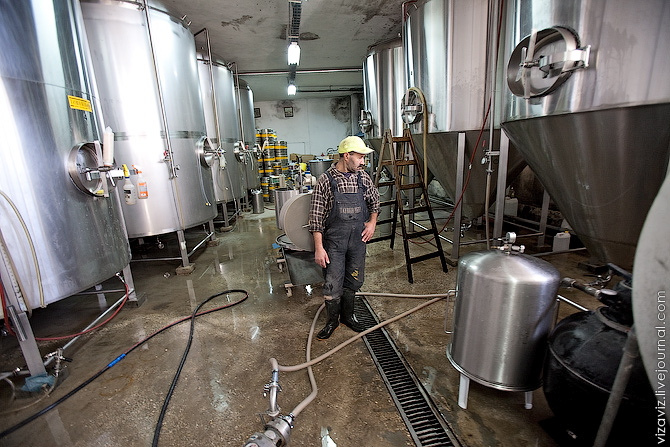
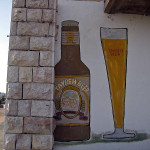
More unusually for a region with a 98 per cent Muslim population, an expatriate family returned to Taybeh in 1995 to open the Middle East’s only microbrewery.

Nadim Khoury, who had studied brewing in the United States, opened Taybeh Brewery with his brother David (who became Taybeh’s first democratically-elected mayor in 2005) and their father. Their beer is even brewed under franchise in Germany.

An annual beer festival in October, backed by church and community organisations as well as by diplomatic missions, promotes local products, culture and tourism. The Taybeh Oktoberfest attracts thousands each year, including Christians, Muslims, Jews and overseas visitors from as far away as Japan and Brazil.

To cater for Muslims — who are forbidden to drink alcohol — the brewery has added non-alcoholic beer to its product line.

Taybeh

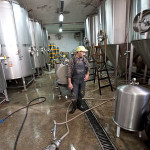
Inside Taybeh Brewery (© vizAviz)


In Scripture

Jesus goes to Ephraim: John 11:54

Ophrah is named as a town of Benjamin: Joshua 18:23


Tel.: Catholic church 972-2-2958020

Greek Orthodox church 972-2-2898282

Taybeh Municipality: 972-2-2898436


References

Deehan, John: “Against the odds”, The Tablet, December 22, 2007
Kalman, Matthew: “Faithful villagers keep it Christian in this last outpost in the Holy Land”, San Francisco Chronicle, December 25, 2005
Levy, Gideon: “Twilight Zone/Taybeh Revisited”, Ha’aretz, July 23, 2010
Shahin, Mariam, and Azar, George: Palestine: A guide (Chastleton Travel, 2005)


External links

Greek Orthodox Church Taybeh
Taybeh Parish (Latin Patriarchate of Jerusalem)
The Village of Taybeh (VisitPalestine)
Peace Lamps — Taybeh (Holy Land Artisans)


« Newer PostsOlder Posts »

Sepphoris

Israel


Sepphoris

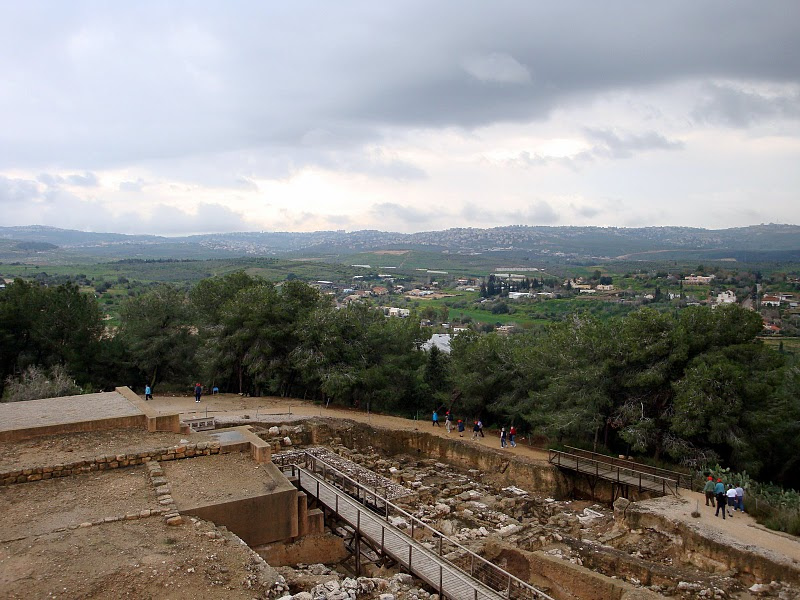
Sepphoris with Nazareth on hill in distance (Steve Peterson)

Sepphoris, a ruined city 6.5 kilometres northwest of Nazareth, was the capital of Galilee during the time of Jesus. Though it is not mentioned in the New Testament, it is of interest to Christian pilgrims for two main reasons:

•  The rebuilding of the city by Galilee’s ruler, Herod Antipas, may have attracted the building tradesman Joseph and his wife Mary to settle in Nazareth when they returned with Jesus from Egypt.

This major building site, 50 minutes’ walk from Nazareth, would have offered Joseph many years of employment. It may also be where Jesus gained insights into the building trade — such as the need to build with foundations on rock rather than on sand (Luke 6:48-49).

•  According to tradition, the original home of Mary’s parents, Joachim and Anne (or Anna), was at Sepphoris. During the 12th century the Crusaders built a huge Church of St Anna, possibly on the site of their home.

Sepphoris rose to prominence during the century before Christ because it overlooked two major highways. A mainly Jewish city, it was given its Hebrew name, Zippori, because it sits on a hilltop like a bird (zippor).

According to the historian Josephus, Herod Antipas made it “the ornament of Galilee”, a term also implying the military connotation of an impregnable city.

Sepphoris

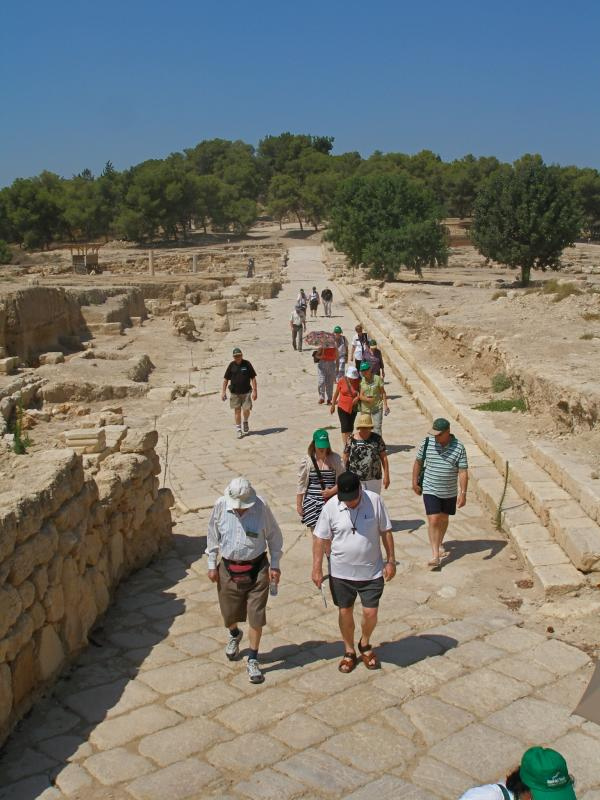
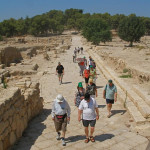
Pilgrims on Decumanus street at Sepphoris (Seetheholyland.net)

After the destruction of Jerusalem in AD 70, Sepphoris became a centre of Jewish learning and seat of the Sanhedrin supreme court. The Mishnah, the first authoritative collection of Jewish oral law, was compiled here.

A Christian community was present by the 4th century. By the 6th century it was sufficiently large to have its own bishop.

It was from Sepphoris that the Crusaders rode out in 1187 for their defeat by the Muslim sultan Saladin at the Horns of Hattin, overlooking the Sea of Galilee — a defeat that brought about the end of the Crusader Kingdom of Jerusalem.


Many changes of name

Sepphoris has worn many names during its history.

It was Zippori (or Tzippori) when Herod the Great captured it during a snowstorm in 37 BC. After Herod’s death in 4 BC the Roman army put down a rebellion of Jewish rebels by destroying the city and selling many of its people into slavery.

When Herod’s son Herod Antipas rebuilt the city, he renamed it Autocratoris.

Because the inhabitants chose not to join the First Jewish Revolt against Rome in AD 66-73, the city was spared the destruction suffered by other Jewish centres, including Jerusalem. Evidence of the city’s pacifist stance comes from coins inscribed “City of Peace” minted there during the revolt.

Before the Second Jewish Revolt in 132-135, the Romans changed the name to Diocaesarea. A massive earthquake in 363 devastated the city and it was only partly rebuilt.

The Muslim conquest in the 7th century saw another name change, to Saffuriya. Except for a period as La Sephorie under the Crusaders, this name remained for what became an Arab village until the population of about 4000 fled attacks by Israeli forces during the 1948 Arab-Israeli War.


Three apses of church still stand

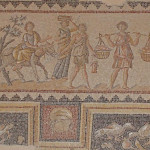
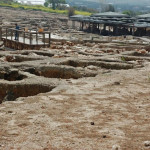
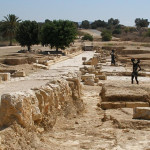
Excavations at Sepphoris have uncovered streets, houses, public buildings, bathhouses, a market, two churches, a synagogue, a Roman theatre, aqueducts, a huge elongated water reservoir (260 metres long) and more than 40 mosaic floors.

Sepphoris

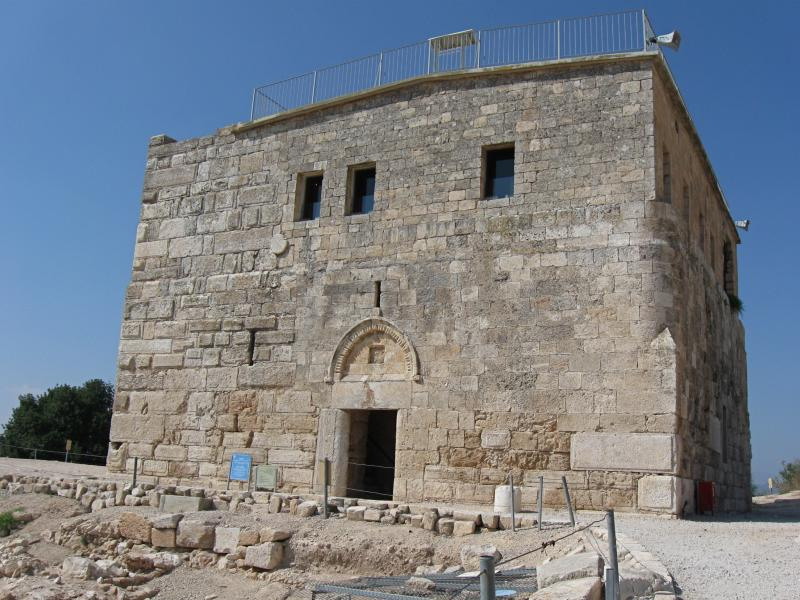
Crusader fortress overlooking Sepphoris (© Ori~ / Wikimedia)

A Crusader fortress, built on the remains of an earlier structure, dominates the upper part of the site and provides a panoramic view from its roof. It now houses a museum.

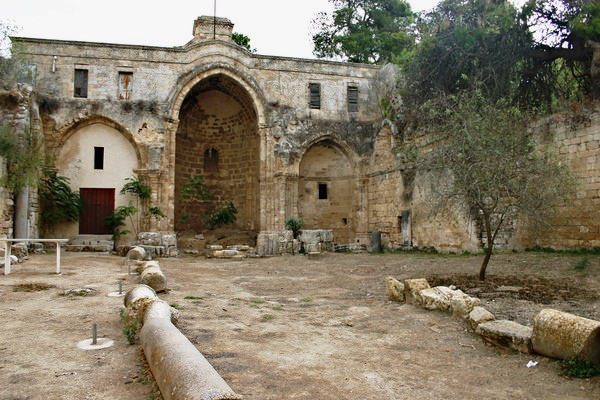
To the west of the summit, on the northwestern perimeter of Sepphoris National Park, are the remains of the Crusader Church of St Anna. Inside a walled enclosure, the three apses are still standing, now incorporated into the western wall of a modern Monastery of the Sisters of St Anne (where the key to the enclosure is available).

Northeast of the fortress is the Roman theatre, its tiers of 4500 seats carved into the northern slope of the hill.

Sepphoris

Remains of Church of St Anna at Sepphoris (© Custodia Terrae Sanctae)

Biblical scholars have conjured with the possibility that Jesus might have known this theatre and even taken from it the word “hypocrite” — Greek for one who is play-acting — which he frequently used (in Matthew 6, for example). But archaeologists are uncertain whether the theatre was in use when Jesus lived in Nazareth.

On the northern edge of the park are remains of a 6th-century synagogue with a mosaic floor depicting biblical scenes, Temple rituals and a zodiac wheel.


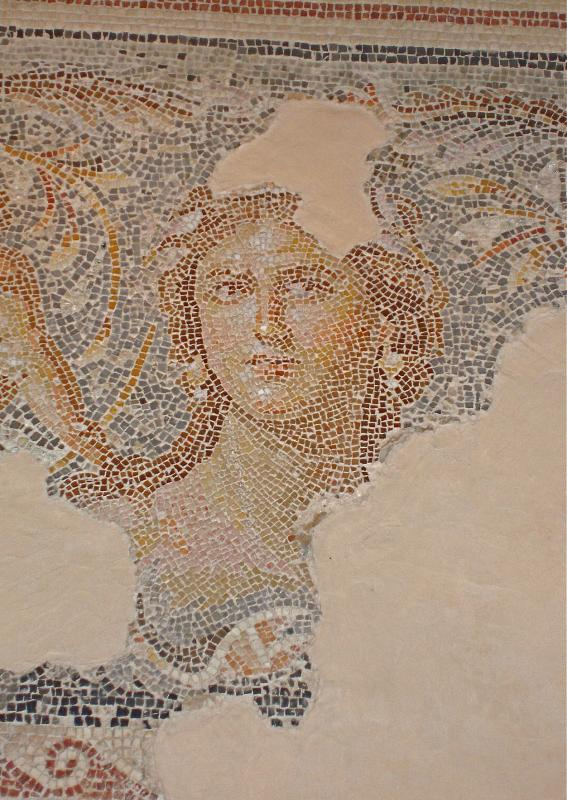
Mosaic portrait dubbed “Mona Lisa”

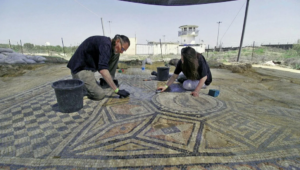
Just south of the Roman theatre stood a palatial mansion built in the 3rd century AD. Known as the Dionysus House, it was destroyed by the earthquake in 363, but the remarkable mosaic carpet in its stately dining room survived well-preserved under the debris.

The 15 centre panels depict scenes from the life of Dionysus, the Greek god of wine and revelry, bordered by medallions of acanthus leaves with hunting scenes.

Sepphoris

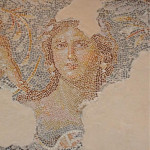
“Mona Lisa of the Galilee” in Roman mansion at Sepphoris (Seetheholyland.net)

Each scene is labelled with a Greek word — a panel displaying a completely inebriated Hercules is labelled MEQH, meaning drunkenness.

But the most remarkable feature of the mosaic floor is an elegant portrait of an unknown woman at the centre of one end. The engaging tilt of her head and enigmatic expression have earned her the nickname “Mona Lisa of the Galilee”.

The unknown artist of this portrait used tiny stones, in a wide range of natural colours, and with an exquisite attention to detail and shading.


Elegant mosaics illustrate life on River Nile

An impressive network of well-planned streets has been exposed in the lower city. Two major intersecting streets, the north-south Cardo and the east-west Decumanus, had covered footpaths and shops on both sides.

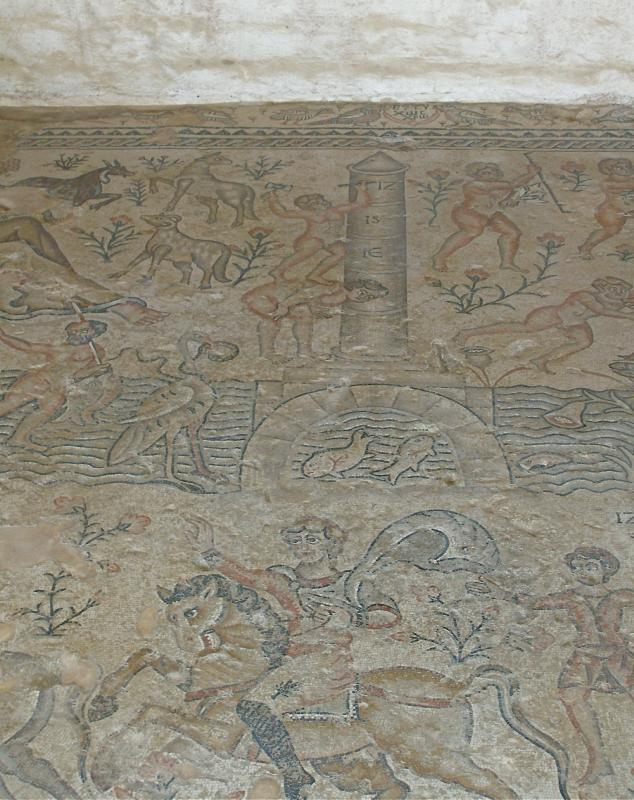
East of the Cardo, a large building called the Nile House had some 20 rooms decorated with multi-coloured mosaic floors. The most elegant depict scenes associated with the River Nile in Egypt.

Sepphoris

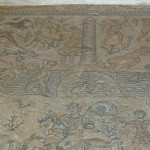
Nilometer and river scenes in Sepphoris mosaic (Seetheholyland.net)

In the most impressive mosaic, the river flows through the picture and wildlife such as fish and birds are seen along its banks. On the left a reclining female figure with a basket of harvest fruits personifies Egypt; on the right a male figure represents the Nile.

In the centre a man standing on a woman’s back records 17 cubits (about 8 metres) on a nilometer — a pillar with a scale to measure the height of the Nile during its seasonal flood.

The lower portion shows hunting scenes: A fierce lion pouncing on the back of a bull, a panther leaping on a gazelle, and a boar being attacked by a bear.

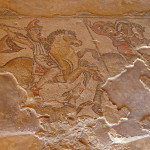
Other mosaics in the building include a depiction of Amazon warriors hunting from horseback.


Administered by: Israel National Parks Authority

Tel.: 04-656-8272

Open: 8am-5pm (4pm Oct-Mar) with last entry one hour earlier; closes at 3pm on Fridays and eves of Jewish holidays.


References

Bourbon, Fabio, and Lavagno, Enrico: The Holy Land Archaeological Guide to Israel, Sinai and Jordan (White Star, 2009)
Chancey, Mark, and Meyers, Eric M.: “Spotlight on Sepphoris: How Jewish was Sepphoris in Jesus’ Time?”, Biblical Archaeology Review, July/August 2000
Charlesworth, James H.: The Millennium Guide for Pilgrims to the Holy Land (BIBAL Press, 2000)
Charlesworth, James H.: Jesus and Archaeology (Wm. B. Eerdmans, 2006)
Freeman-Grenville, G. S. P.: The Holy Land: A Pilgrim’s Guide to Israel, Jordan and the Sinai (Continuum Publishing, 1996)
Kochav, Sarah: Israel: A Journey Through the Art and History of the Holy Land (Steimatzky, 2008)
Losch, Richard R.: The Uttermost Part of the Earth: A guide to places in the Bible (Wm. B. Eerdmans, 2005)
Murphy-O’Connor, Jerome: The Holy Land: An Oxford Archaeological Guide from Earliest Times to 1700 (Oxford University Press, 2005)
Shahin, Mariam, and Azar, George: Palestine: A guide (Chastleton Travel, 2005)
Walker, Peter: In the Steps of Jesus (Zondervan, 2006)
Weiss, Ze’ev. “The Sepphoris Synagogue Mosaic”, Biblical Archaeology Review, September/October 2000
Weiss, Ze’ev, and Tsuk, Tsvika: Zippori National Park (Israel Nature and Parks Authority leaflet)

External links

Sepphoris (BibleWalks)
Sepphoris (BiblePlaces)
Sepphoris (The Bible and Interpretation)
The USF Excavations at Sepphoris (CenturyOne Foundation)
Zippori — “The Ornament of All Galilee” (Israel Ministry of Foreign Affairs)
« Newer PostsOlder Posts »

Megiddo

Israel


Megiddo, named in the Book of Revelation as the setting for a future battle between the forces of good and evil, is for archaeologists perhaps the most important site in Israel dating from biblical times.

Megiddo

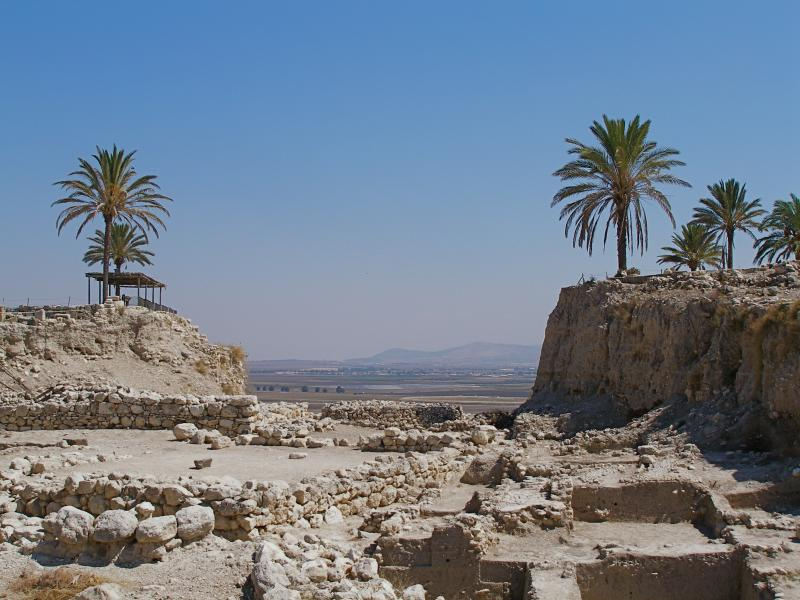
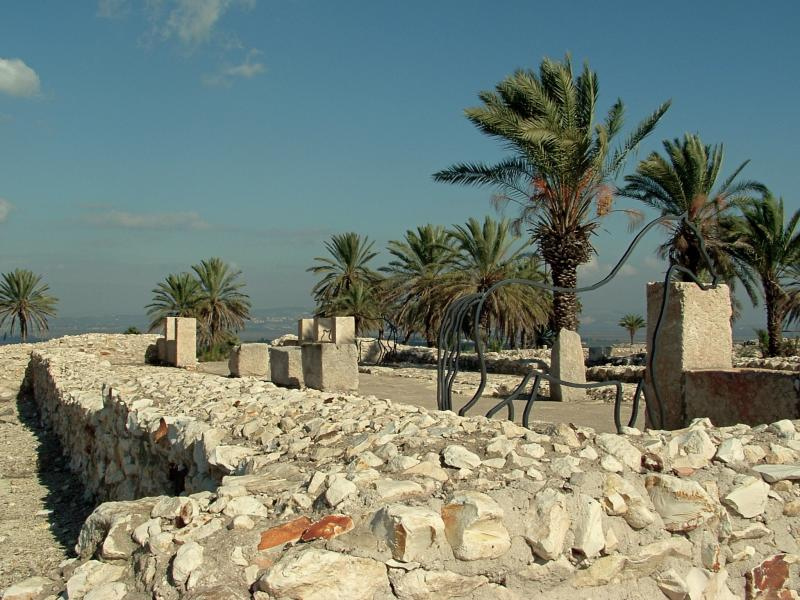
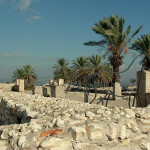
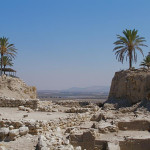
Temple complex, with plain of Jezreel seen through archaeologists’ trench (Seetheholyland.net)

Its much-excavated tel, a mound rising 60 metres above its surroundings, has revealed the remains of at least 20 cities built one on top of the other.

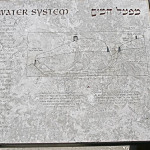
The 6-hectare site has yielded temples, lavish palaces, massive fortifications, private houses, a grain silo and an elaborately-engineered water system.

Megiddo is 35 kilometres southeast of Haifa, at the southern end of the fertile Jezreel Valley. Destroyed and rebuilt many times during its turbulent history, it was occupied almost continuously from around 6000 BC until about 500 years before Jesus Christ was born.

From its strategic position, overlooking the key pass through the Carmel Mountains, it dominated the crossroads of ancient trade and military routes that linked Egypt with Mesopotamia and Asia Minor.

Megiddo

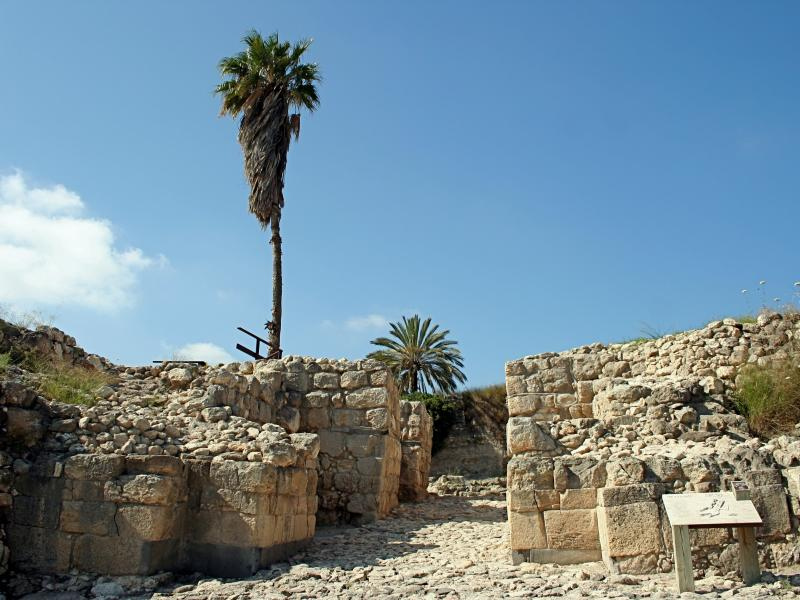
Canaanite city gate from the 15th century BC (Golf Bravo / Wikimedia)

Armies of all the great generals who campaigned in the Middle East tramped across the plain of Jezreel, from the Egyptian pharaoh Thutmose III to General Edmund Allenby, including Alexander the Great and Napoleon. As Thutmose III claimed in the 15th century BC, “Capturing Megiddo is as good as capturing 1000 cities”.

In 2005 the remains of an ancient Christian prayer hall were uncovered in the grounds of a nearby prison. Dated to the middle of the 3rd century, this may be the oldest church discovered in Israel. A mosaic inscription with the words “God Jesus Christ” is one of the earliest ever found that mentions Jesus Christ.


Site of epic battles

Megiddo has been the site of epic and decisive battles down the ages. The Battle of Megiddo in the 15th century BC, when Egyptians under Thutmose III conquered Canaan, is the first reliably recorded battle in history.

Megiddo

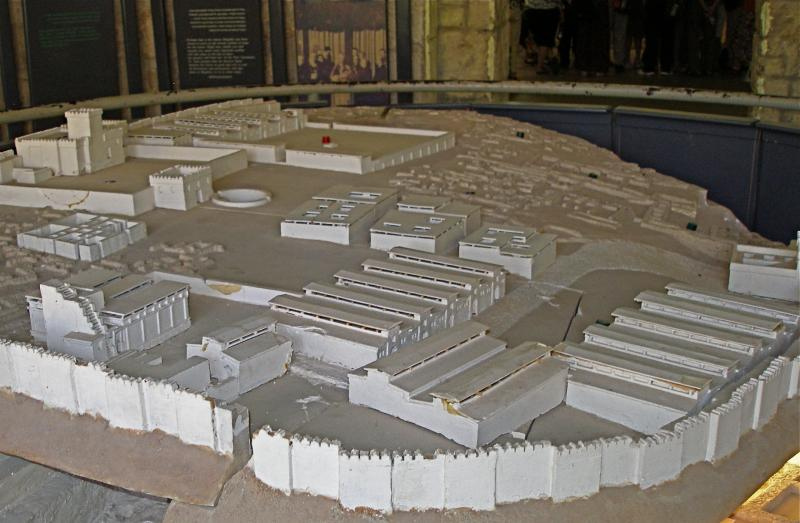
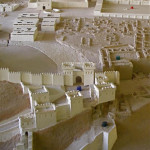
Model of Megiddo tel (Seetheholyland.net)

Battles around Megiddo are mentioned in the Old Testament. The “king of Megiddo” was among those Joshua defeated after the Israelites entered Canaan in the 14th century BC (Joshua 12:21).

A century later the Israelite prophetess Deborah routed the Canaanites “by the waters of Megiddo” (Judges 5:19-21). Two kings of Judah, Ahaziah and Josiah, were battle casualties at Megiddo (2 Kings 9:27; 23:29-30).

In later times Greeks, Romans, Byzantines, Muslims, Crusaders, Mamlukes, Mongols, Persians, French, Ottomans, British, Germans, Arabs and Israelis all fought in this blood-soaked sector of the Holy Land.

The 1918 Battle of Megiddo, in which General Allenby led British, Indian, Australian and New Zealand troops against the Ottoman Turks, was decisive in the Allied conquest of Palestine. When Allenby was made a viscount, he took the title “Lord of Megiddo”.

Because Revelation 16:16 identifies Armageddon (from the ancient Greek Harmagedon, or Mountain of Megiddo) as the scene of an apocalyptic battle between good and evil, the name has become a dramatic byword for the end of the world.

Megiddo

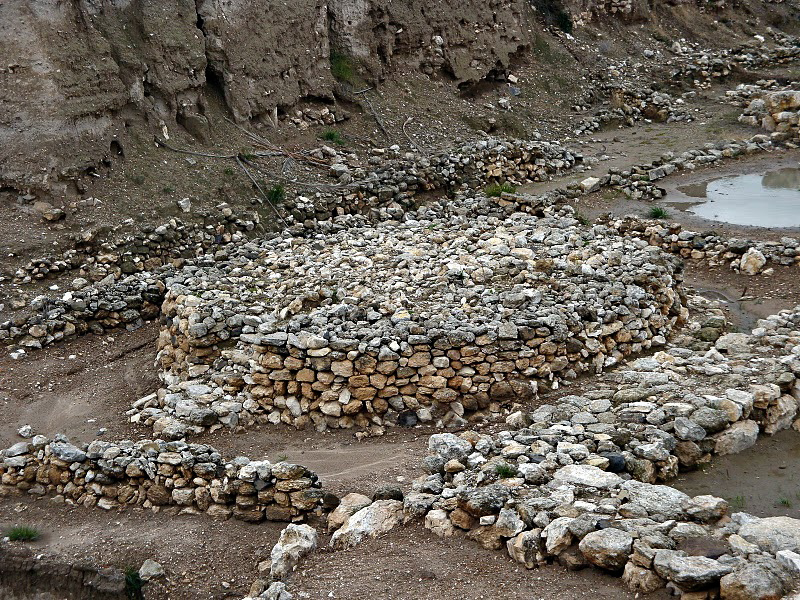
Round altar in temple complex at Megiddo (Steve Peterson)

According to an archaeology guide, K. Kris Hirst, “The archaeological site of Megiddo, known as Tell el-Mutesellim, has had more rubbish written about it in science fiction and horror movies and books than any other single archaeological site on the planet.”

But, contrary to the beliefs of fiction writers, Armageddon is not described as the final battle. The final encounter, at Jerusalem 1000 years later, is to be the battle against Gog and Magog. The ultimate triumph of good over evil, it will precede “the new Jerusalem, coming down out of heaven from God” (Revelation 20:7-10; 21:2).


Many archaeological remains to see

Visitors to the World Heritage Site of Megiddo have much to see, beginning with a model in the reception centre depicting the tel during the 10th-century BC reign of King Solomon — who used forced labour to fortify the city (1 Kings 9:15).

Megiddo

Remains of what may have been stables (Hanay / Wikimedia)

Other highlights along the path around the mound include:

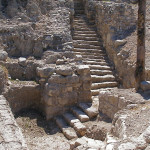
• A flight of well-preserved stone steps from around the 7th century BC, leading from the city gates down to a plastered pool.

• The Canaanite city gate from 1550-1200 BC. Flanked by four chambers, it led to the palace complex of Megiddo’s rulers.

• A massive stone wall, 2 metres thick, marking the site of the Canaanite palace destroyed in the 12th century BC. A treasure trove of 382 carved ivory artifacts, including ornaments and combs, discovered in one of its rooms testifies to ancient Megiddo’s wealth and sophistication.

Megiddo

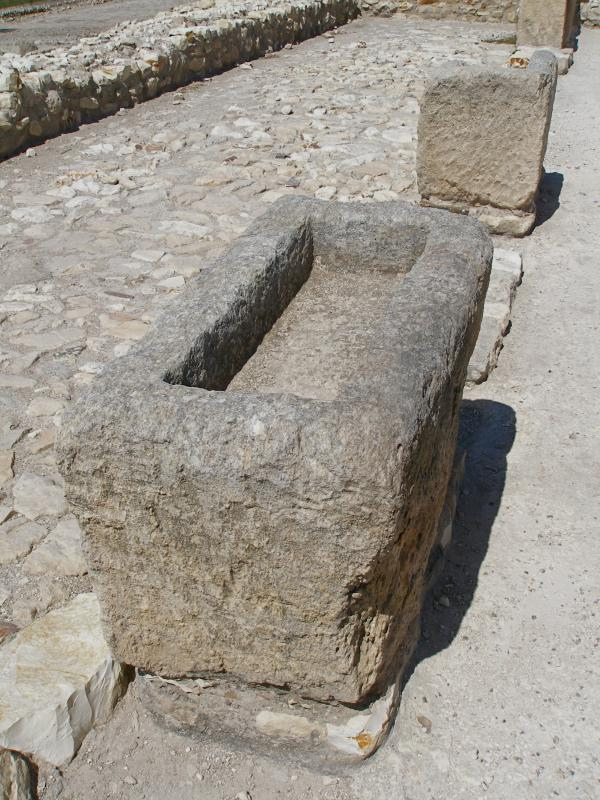
Stone trough from the 9th century BC (Seetheholyland.net)

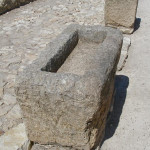
• Two elongated complexes often called Solomon’s stables, though now attributed to King Omri or King Ahab in the 9th century BC. Archaeologists also debate whether they were stables, some arguing they were too small for horses and were more likely storehouses, markets or even barracks for troops. Stone troughs indicate that horses were fed in the area.

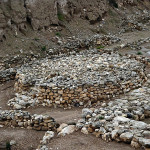
• A “high place” with remains of several Canaanite temples and a circular altar of unhewn stones, 8 metres in diameter and 1.5 metres high, with seven steps leading to its top, where animal sacrifices took place. This sacred area, uncovered when archaeologists cut a deep channel through the tel prior to the First World War, was in use for 2000 years from about 3000 BC.

• A huge circular silo, dug 7 metres into the ground and 11 metres in diameter, capable of storing 1000 tons of grain. Two staircases around the sides lead to the bottom and a domed roof probably covered the structure, which dates from 700 BC.

Monumental project brought water into city

Megiddo

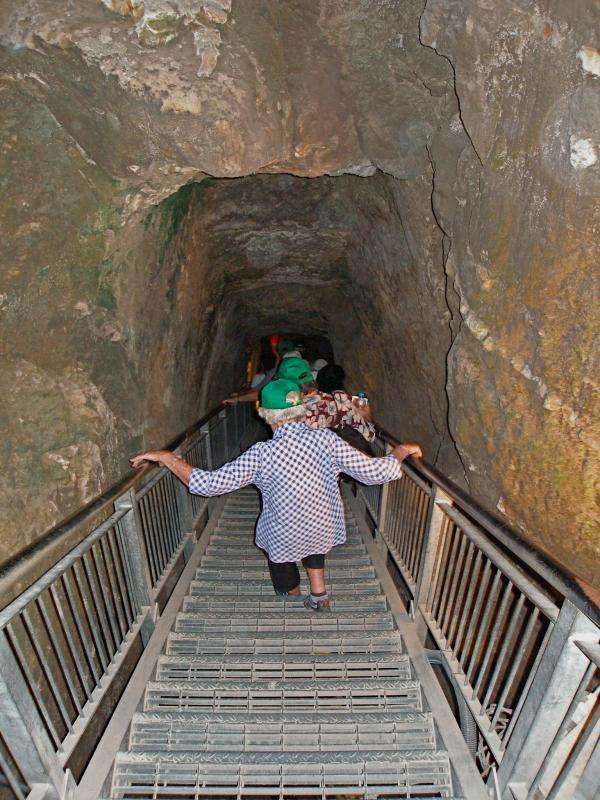
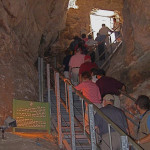
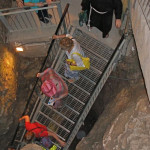
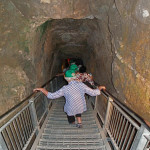
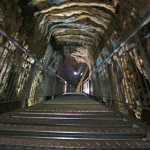
Descent into the Megiddo water tunnel (Seetheholyland.net)

The most impressive construction at Megiddo is underground.

To ensure access to the spring at the bottom of the tel’s southwestern slope, engineers in the much-besieged city dug a 25-metre vertical shaft down to bedrock, then a 70-metre tunnel sloping up to the spring.

The tunnel was cut from both ends and the two gangs of workers had to make only a small correction before they met.

Then the outside entrance to the spring was sealed with a massive stone wall and concealed with earth so a besieging enemy could not discover it.

This monumental project was apparently undertaken during the reign of King Ahab, about 150 years before King Hezekiah quarried his water tunnel in Jerusalem.

When it was completed, residents standing at the top of the shaft could lower buckets to draw water without entering the tunnel or leaving the city.

Modern stairways — 187 steps down and 77 steps up — allow hardy visitors to view this engineering feat from the inside.


Unique inscription in ancient church

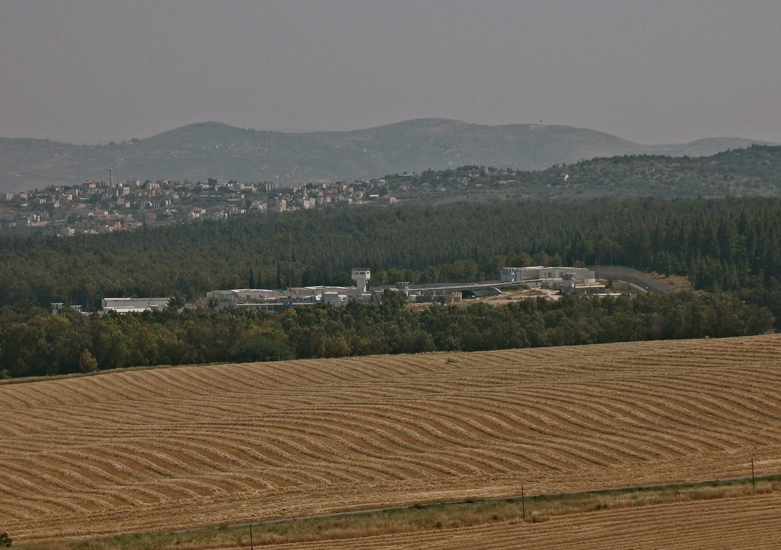
What may be the oldest church remains in Israel were also among the most inaccessible when they were discovered in 2005 — in the grounds of a military prison near Megiddo.

Megiddo

Megiddo prison where ancient church was found (James Emery)

Work on detention cells to replace a prisoners’ tent encampment was under way when an inmate worker discovered ancient remains.

A prayer hall measuring about 10 metres by 5 metres was found in the southwest corner of a large building that also functioned as a Roman military administrative centre.

Believed to be from the middle of the 3rd century — before Christianity became the religion of the Roman Empire — it evidently served Christian soldiers in the two Roman legions based there, as well as the local Christian community.

In the superbly preserved mosaic floor, an inscription records that a woman named Akeptous offered the eucharistic table “to God Jesus Christ as a memorial”. No earlier inscription mentioning Jesus Christ has been found in the Holy Land.

Cleaning and preparing the Megiddo mosaic for travel to the Museum of the Bible in the United States, with the Megiddo prison watchtower in the background (Emil Aladjem / Israel Antiquities Authority)

Other inscriptions name a Roman centurion, Gaianus, who paid for the mosaic floor; an artisan, Brutius, who made it; and four women — Primilla, Cyriaca, Dorothea and Chreste. Images of fish — an early Christian symbol — are also found.

The Israel Antiquities Authority has recommended moving the prison to a new location so the discoveries can be displayed. In the meantime, the church has been covered with dirt and tarpaulins.

In 2024 the mosaic was displayed at the Museum of the Bible in Washington, DC.


In Scripture:

Joshua defeats the king of Megiddo: Joshua 12:7,21

Deborah defeats Sisera’s Canaanites: Judges 5:19-20

Solomon fortifies Megiddo: 1 Kings 9:15

King Ahaziah dies at Megiddo: 2 Kings 9:27

Josiah killed at Megiddo: 2 Kings 23:29; 2 Chronicles 35:20-24

The battle of Harmagedon: Revelation 16-18


Administered by: Israel Nature and Parks Authority

Tel.: 972-4-6590316

Open: Apr–Sep 8am–5pm, Oct–Mar 8am–4pm (last entry one hour before closing time)


References

Bourbon, Fabio, and Lavagno, Enrico: The Holy Land Archaeological Guide to Israel, Sinai and Jordan (White Star, 2009)
Bowker, John: The Complete Bible Handbook (Dorling Kindersley, 1998)
Brownrigg, Ronald: Come, See the Place: A Pilgrim Guide to the Holy Land (Hodder and Stoughton, 1985)
Charlesworth, James H.: The Millennium Guide for Pilgrims to the Holy Land (BIBAL Press, 2000)
Finkelstein, Israel, and Ussishkin, David: “Back to Megiddo” (Biblical Archaeology Review, January/February 1994)
Freeman-Grenville, G. S. P.: The Holy Land: A Pilgrim’s Guide to Israel, Jordan and the Sinai (Continuum Publishing, 1996)
Gonen, Rivka: Biblical Holy Places: An illustrated guide (Collier Macmillan, 1987)
Kochav, Sarah: Israel: A Journey Through the Art and History of the Holy Land (Steimatzky, 2008)
Metzger, Bruce M., and Coogan, Michael D.: The Oxford Companion to the Bible (Oxford University Press, 1993)
Murphy-O’Connor, Jerome: The Holy Land: An Oxford Archaeological Guide from Earliest Times to 1700 (Oxford University Press, 2005)
Samet, Inbal: Megiddo National Park (Israel Nature and Parks Authority leaflet)
Tzaferis, Vassilios. “Inscribed ‘To God Jesus Christ’ ” (Biblical Archaeology Review, March/April 2007)
Wareham, Norman, and Gill, Jill: Every Pilgrim’s Guide to the Holy Land (Canterbury Press, 1996)

External links

The Megiddo Expedition (Tel Aviv University)
Tell Megiddo (BibleWalks)
Tel Megiddo (Wikipedia)
Megiddo — the Solomonic Chariot City (Israel Ministry of Foreign Affairs)


« Newer PostsOlder Posts »

Temple Mount

Jerusalem

Temple Mount

Walled platform of Jerusalem’s Temple Mount (Yonderboy / Wikimedia)

The Temple Mount, a massive masonry platform occupying the south-east corner of Jerusalem’s Old City, has hallowed connections for Jews, Christians and Muslims.

All three of these Abrahamic faiths regard it as the location of Mount Moriah, where Abraham prepared to offer his son Isaac (or Ishmael in the Muslim tradition) to God.

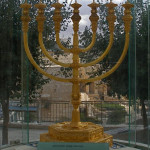
• For Jews, it is where their Temple once stood, housing the Ark of the Covenant. Now, for fear of stepping on the site of the Holy of Holies, orthodox Jews do not ascend to the Temple Mount. Instead, they worship at its Western Wall while they hope for a rebuilt Temple to rise with the coming of their long-awaited Messiah.

Temple Mount

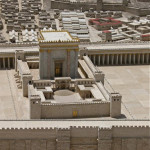
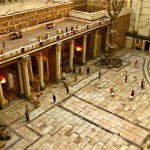
Model of Herod’s Temple by English pensioner Alec Garrard (© Geoff Robinson)

• For Christians, the Temple featured prominently in the life of Jesus. Here he was presented as a baby. Here as a 12-year-old he was found among the teachers after the annual Passover pilgrimage.

Here Jesus prayed and taught. Here he overturned money-changers’ tables and foretold the destruction of the Temple: “Not one stone will be left here upon another; all will be thrown down” (Mark 13:2). And here the earliest Judaeo-Christians met.

• For Muslims, the Temple Mount is al-Haram al-Sharif (the Noble Sanctuary). It is Islam’s third holiest site, after Mecca and Medina, and the whole area is regarded as a mosque.

Temple Mount

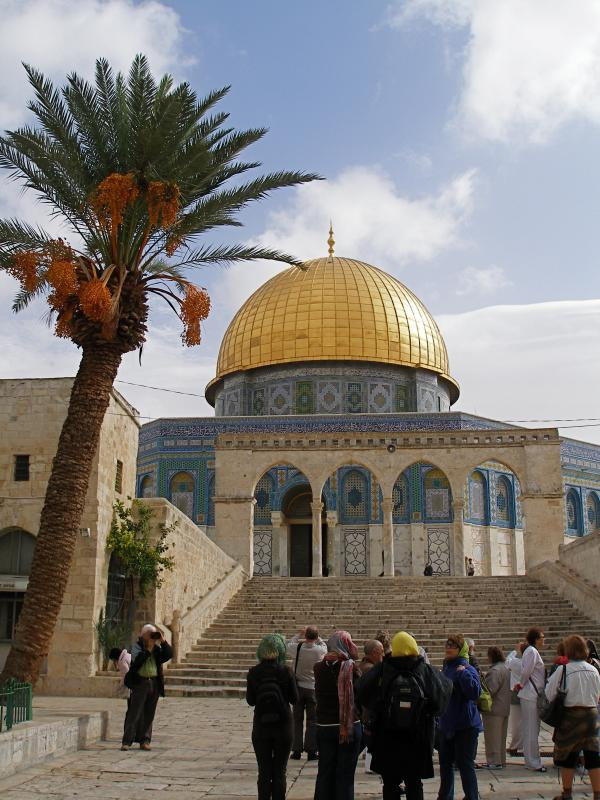
Temple Mount visitors in front of Dome of the Rock (Seetheholyland.net)

Muslims believe their gold-roofed Dome of the Rock — an iconic symbol of Jerusalem — covers the rock from which Muhammad visited heaven during his Night Journey in the 7th century.


Solomon built First Temple

Israel’s King Solomon built the first Temple around 950 BC on the traditional site of Mount Moriah. His father, King David, had bought a Jebusite threshing floor on the windy hilltop where Abraham had prepared to sacrifice Isaac and “built there an altar to the Lord” (2 Samuel 24:25) some 40 years earlier.

Solomon’s lavish Temple, built of stone and timber with an exterior of white marble and a gold-plated façade, was to provide a fitting resting place for the Ark of the Covenant, containing the stone tablets inscribed with the Ten Commandments.

Its altar, the central place where Jews offered sacrifices to Yahweh, was probably close to the sites of Abraham’s and David’s altars.

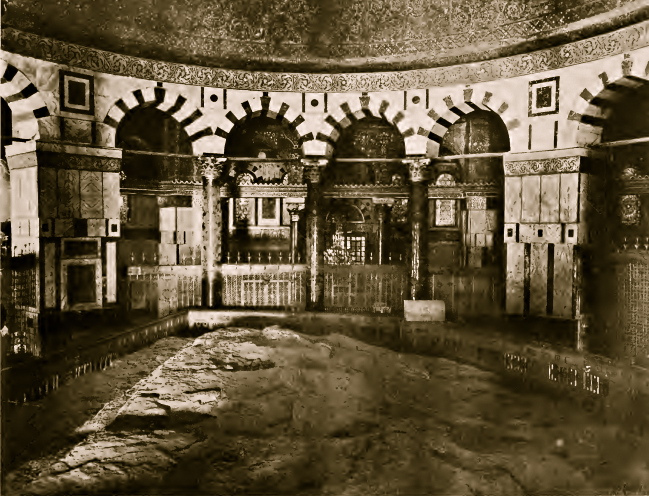
Temple Mount

Rock of Mount Moriah as it was in 1910 (Robert Smythe Hichens / Wikimedia)

Solomon’s Temple stood for about 360 years until invading Babylonians destroyed it and took most of the Jews into exile. The Mishnah says the Ark of the Covenant was hidden in an underground chamber. What became of it is unknown, though the second book of Maccabees says the prophet Jeremiah hid it in a cave on Mount Nebo (2:4-6).

Fifty years later the Jews were allowed to return from Babylon. They rebuilt the Temple, completing it in 515 BC.


Herod built second Temple

The Temple Jesus knew was rebuilt by Herod the Great in a project he began around 20 BC. Although the Temple had already been rebuilt once, Herod’s Temple is still known in Jewish tradition as the Second Temple.

Herod began his grandiose project by extending the Temple Mount on the north, south and west to create a vast platform bordered by a retaining wall of huge limestone blocks.

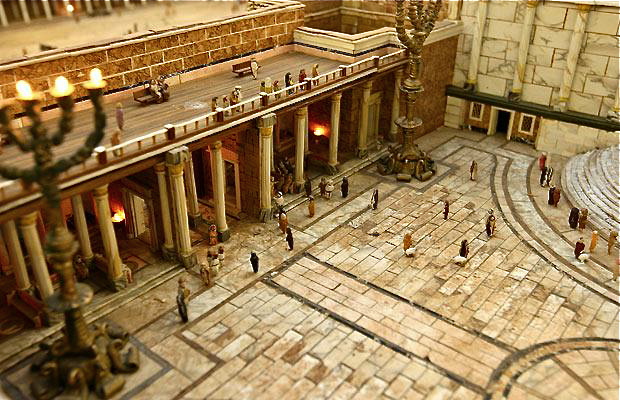
Temple Mount

Court of the Women in a model of Herod’s Temple by English pensioner Alec Garrard (© Geoff Robinson)

These blocks, some weighing more than 100 tons, were cut from quarries at a higher level, just north of the Temple Mount, and put in place with pulleys and cranes.

The expansion — to today’s 14 hectares, nearly twice the previous area — involved burying several structures, including Solomon’s palace.

Of the Temple itself, the historian Josephus said “it appeared from a distance like a snow-clad mountain; for all that was not overlaid with gold was of purest white”.

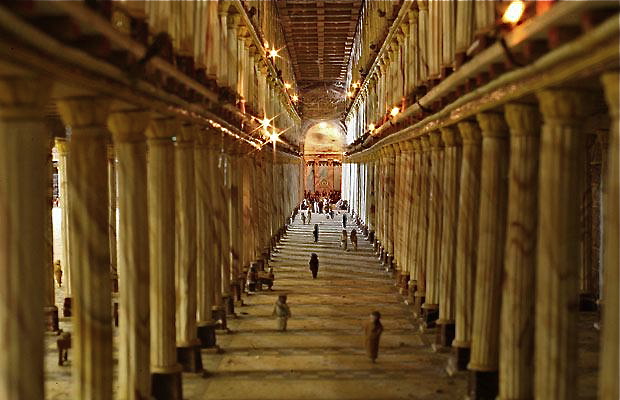
Temple Mount

Inside Royal Stoa of Alec Garrard’s Temple model (© Geoff Robinson)

Surrounding the Temple were four courts: The Court of the Priests (containing the altar of sacrifice); the Court of Israel (for men only); the Court of the Women; and, on a lower level, the Court of the Gentiles. Notices warned Gentiles not to enter the higher courts on the pain of death.

Along each edge of the Temple Mount was a covered and columned gallery called a portico. Solomon’s Portico, on the east, was probably where Mary and Joseph found their son among the teachers of the Law. The Royal Stoa, on the south, was a place of public business and trade.


Romans destroyed Temple

Temple Mount

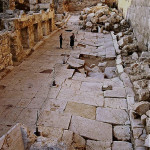
Masonry blocks thrown by Roman soldiers on to street below when they destroyed the Temple (Freestockphotos.com)

Herod’s Temple was totally destroyed when the Roman army under the emperor Titus took Jerusalem in AD 70, ending the First Jewish Revolt. As Jesus had prophesied, not one stone was left upon another.

The emperor Hadrian in AD 130 converted Jerusalem into a Roman colony, called Aelia Capitolina, which Jews were forbidden to enter. Hadrian placed statues of himself on the Temple Mount.

After the Roman Empire adopted Christianity in the 4th century, the emperor Constantine’s mother, St Helena, is believed to have built a small church on the Temple Mount. Otherwise the area was ignored — it was actually used for a rubbish dump — while Christians focused on the new Church of the Holy Sepulchre.

Arab Muslims conquered Jerusalem in the 7th century and converted the Temple Mount into an Islamic sanctuary. They cleared the rubbish and erected the Dome of the Rock and Al-Aqsa Mosque.

Temple Mount

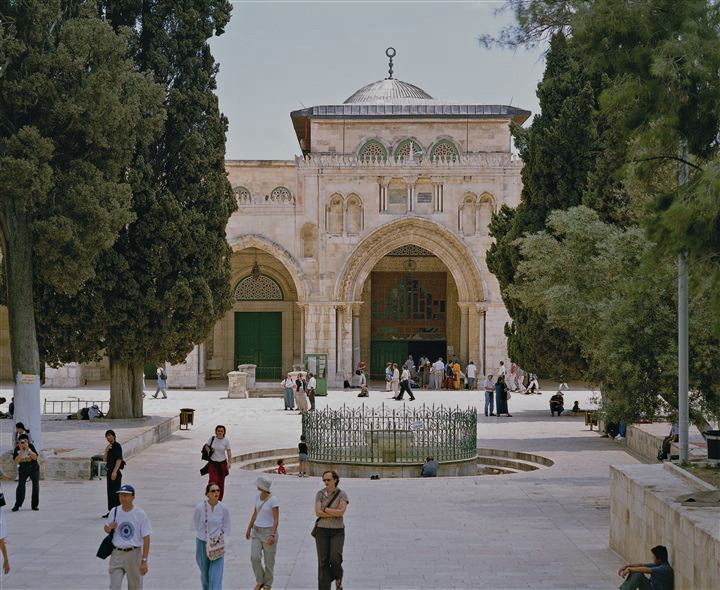
Al-Aqsa Mosque (© Israel Ministry of Tourism)

When Crusaders captured Jerusalem in 1099 they Christianised these Muslim structures and gave them misleading names. The Dome of the Rock became a church called the Templum Domini (Temple of the Lord); the Al-Aqsa Mosque became the palace of the King of Jerusalem, then the headquarters of the Knights Templar, under the name of the Templum Salomonis (Temple of Solomon).

Muslims under the sultan Saladin reconquered Jerusalem less than a century later, restoring the Noble Sanctuary to its former Islamic status. Even after Israeli forces captured the Temple Mount from Jordan in the 1967 Six Day War, Israel left its management in the hands of an Islamic foundation (called the Waqf), which has undertaken controversial digs and earthworks.

Judgement scales and Messiah’s entry

Temple Mount

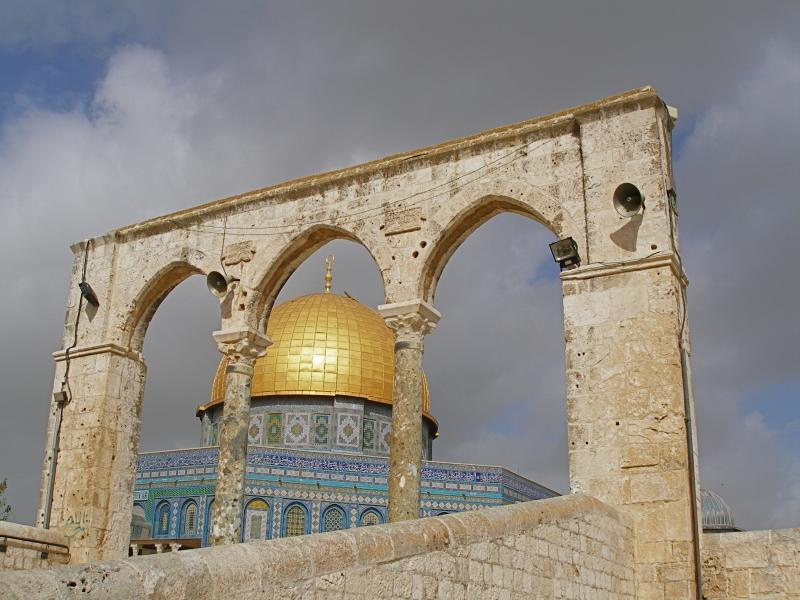
Arches where Muslim tradition says scales to weigh souls will be hung at Last Judgement (Seetheholyland.net)

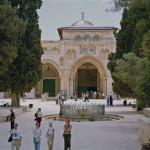
Today’s Temple Mount is a spacious plaza of minarets, domed pavilions, fountains, date palms and cypress trees. It occupies about one-sixth of the Old City.

Eight stairways ascend to the platform of the Dome of the Rock, each culminating in a set of slender arches where Islamic tradition says scales to weigh souls will be hung at the Last Judgement.

In the southwest corner of the Temple Mount, near the Al-Aqsa Mosque, the Islamic Museum displays ceramics, gifts to the sanctuary and architectural items removed during restorations.

The walls of the Temple Mount platform originally contained several gateways, with stairs or ramps leading to and from the city. All are now blocked, though the outlines of some are still visible.

Temple Mount

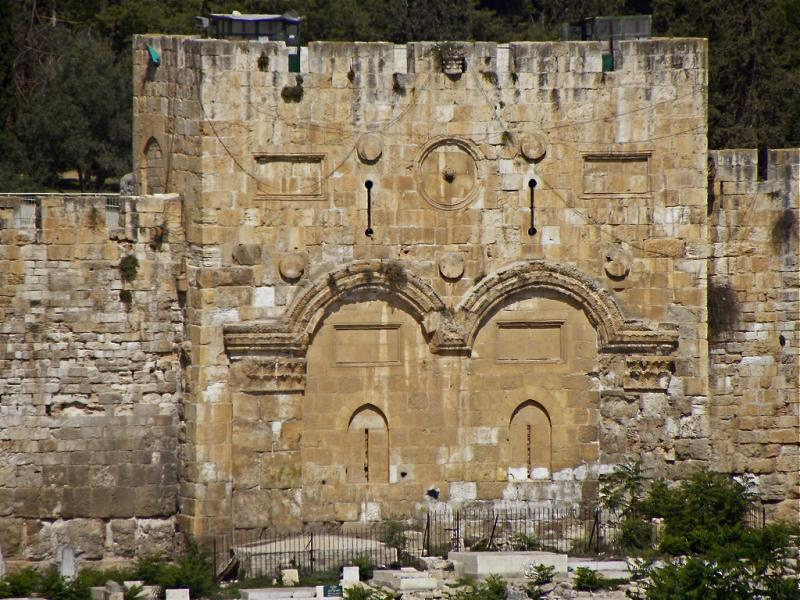
Exterior view of Golden Gate in wall of Temple Mount (Ian W. Scott)

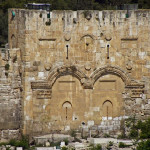
In the eastern wall were the Golden Gate, through which Jews expect their Messiah will enter Jerusalem, and the gate from which the scapegoat was driven into the wilderness on the Day of Atonement. Most pilgrims entered the Temple Mount at the southeast corner through the Double Gate, whose steps have been reconstructed.

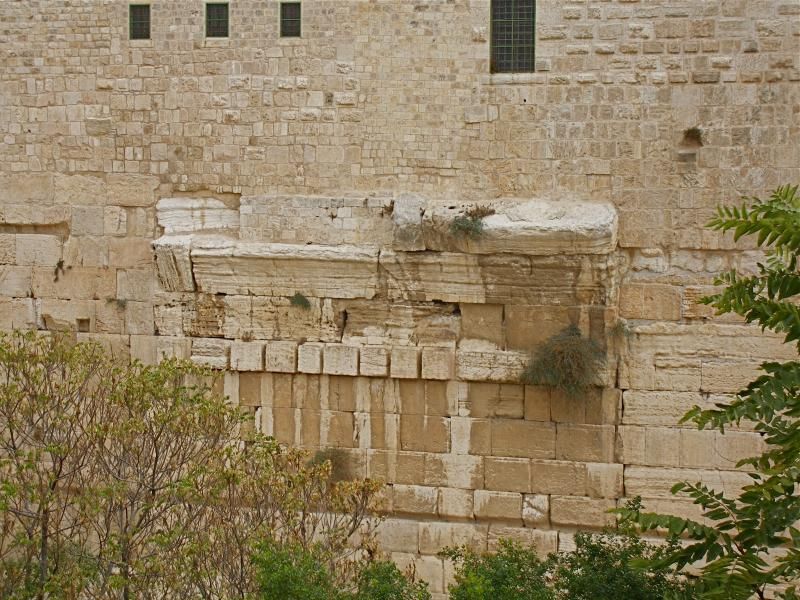
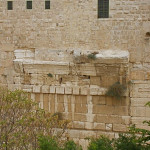
To the right of the Western Wall plaza can be seen the stub of Robinson’s Arch (named after a 19th-century archaeologist), which supported a monumental staircase from the street to the Temple Mount.

Temple Mount

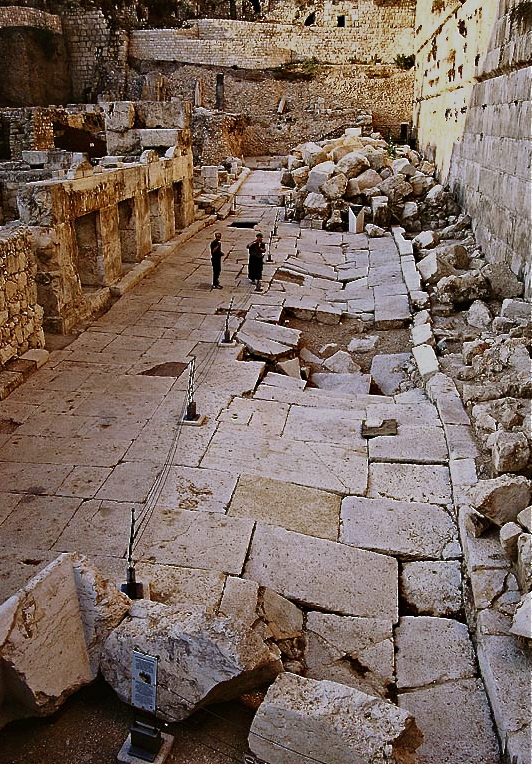
Remains of Robinson’s Arch, which supported a stairway to the Temple (Seetheholyland.net)

Over the centuries the deep valley that ran beside the Western Wall in the time of Jesus became filled with rubble. Today’s wall stands 19 metres high, but a further 13 metres of Herod’s blockwork lie hidden beneath ground level.


Sites in the Temple Mount area:

Al-Aqsa Mosque

Dome of the Rock

Western Wall


In Scripture:

Abraham prepares to sacrifice Isaac: Genesis 22:1-19

David buys the threshing floor: 2 Samuel 24:18-25

Solomon builds the First Temple: 1 Kings 5-6

Jeremiah hides the Ark of the Covenant: 2 Maccabees 4-6

Jesus is presented in the Temple: Luke 2:22-38

Jesus is found among the teachers in the Temple: Luke 2:41-51

Jesus cleanses the Temple: John 2:14-16

Jesus prophesies the destruction of the Temple: Matthew 24:1-2


Administered by: Islamic Waqf Foundation

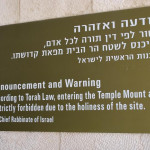
Open: Non-Muslims are permitted to enter the Temple Mount through the Bab Al-Maghariba (Moors’ Gate), reached through a covered walkway next to the Western Wall plaza, during restricted hours. These are usually 7.30-11am and 1.30-2.30pm (closed Fridays and on religious holidays), but can change. Access is not allowed during times of Muslim prayer nor at times of tension between Arabs and Jews. Modest dress is required. Non-Muslims are not normally allowed into the Dome of the Rock or the Al-Aqsa Mosque. Non-Muslim prayer on the Temple Mount is not permitted.


References

Bahat, Dan: “Jerusalem Down Under: Tunneling Along Herod’s Temple Mount Wall” (Biblical Archaeological Review, November/December 1995)
Baldwin, David: The Holy Land: A Pilgrim’s Companion (Catholic Truth Society, 2007)
Bourbon, Fabio, and Lavagno, Enrico: The Holy Land Archaeological Guide to Israel, Sinai and Jordan (White Star, 2009)
Freeman-Grenville, G. S. P.: The Holy Land: A Pilgrim’s Guide to Israel, Jordan and the Sinai (Continuum Publishing, 1996)
Garrard, Alec: The Splendor of the Temple (Angus Hudson, 2000)
Jacobson, David: “Sacred Geometry: Unlocking the Secret of the Temple Mount” (Biblical Archaeological Review, July/August and September/October 1999)
Kochav, Sarah: Israel: A Journey Through the Art and History of the Holy Land (Steimatzky, 2008)
McCormick, James R.: Jerusalem and the Holy Land: The first ecumenical pilgrim’s guide (Rhodes & Eaton, 1997)
Mackowski, Richard M.: Jerusalem: City of Jesus (William B. Eerdmans, 1980)
Metzger, Bruce M., and Coogan, Michael D.: The Oxford Companion to the Bible (Oxford University Press, 1993)
Meyer, Gabriel: “The Temple and the Lord” (Holy Land Review, winter 2010)
Murphy-O’Connor, Jerome: The Holy Land: An Oxford Archaeological Guide from Earliest Times to 1700 (Oxford University Press, 2005)
Notley, R. Steven: Jerusalem: City of the Great King (Carta Jerusalem, 2015)
Prag, Kay: Jerusalem: Blue Guide (A. & C. Black, 1989)
Ritmeyer, Leen: “Locating the Original Temple Mount” (Biblical Archaeological Review, March/April 1992)
Walker, Peter: In the Steps of Jesus (Zondervan, 2006)
Wareham, Norman, and Gill, Jill: Every Pilgrim’s Guide to the Holy Land (Canterbury Press, 1996)
Woodfin, Warren T.: “The Holiest Ground in the World” (Biblical Archaeological Review, September/October 2000)


External links

The Noble Sanctuary
Temple Mount (Wikipedia)


« Newer PostsOlder Posts »

Jacob’s Well

West Bank


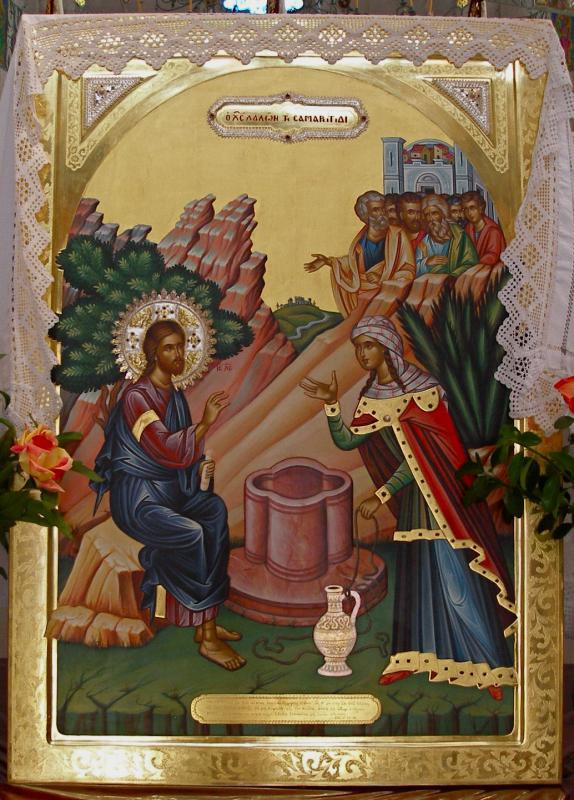
Jacob’s Well, where Jesus asked a Samaritan woman for a drink and offered her “living water”, lies in the crypt of a modern Greek Orthodox church at Nablus in the West Bank.

Jacob's Well

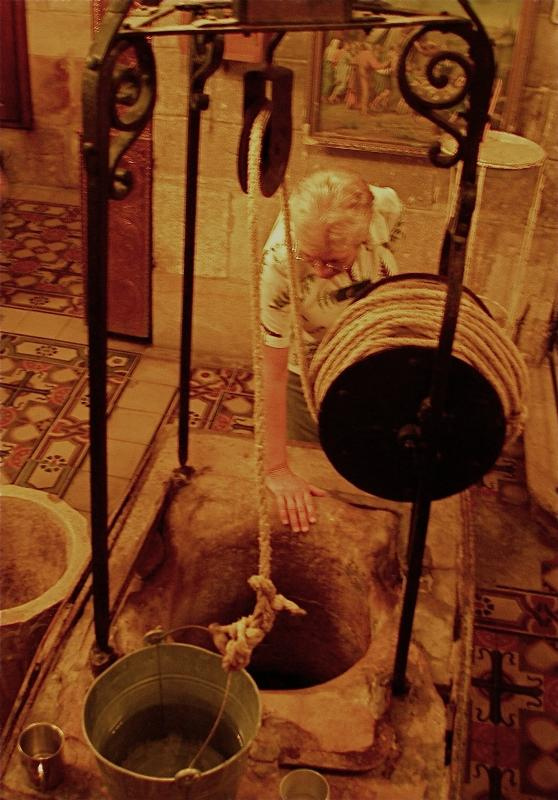
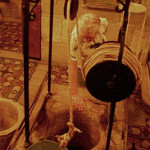
Mouth of Jacob’s Well (Seetheholyland.net)

It is often considered the most authentic site in the Holy Land — since no one can move a well that was originally more than 40 metres deep.

Jewish, Samaritan, Christian and Muslim traditions all associate the well with Jacob.

The location, at the entrance to a mountain pass between Mount Gerizim and Mount Ebal, is 2km east of Nablus. It is near the archaeological site of Tell Balata — thought to be the biblical Shechem — and about 63km north of Jerusalem.

It was at Shechem that the patriarch Jacob bought “the land on which he had pitched his tent” (Genesis 33:19).

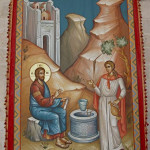
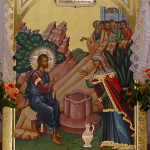
The Samaritan woman reminded Jesus that Jacob “gave us the well, and with his sons and his flocks drank from it”. He told her he was the promised Messiah, and she and many residents of her village believed in him. (John 4:5-42)


Samaritan woman venerated as martyr

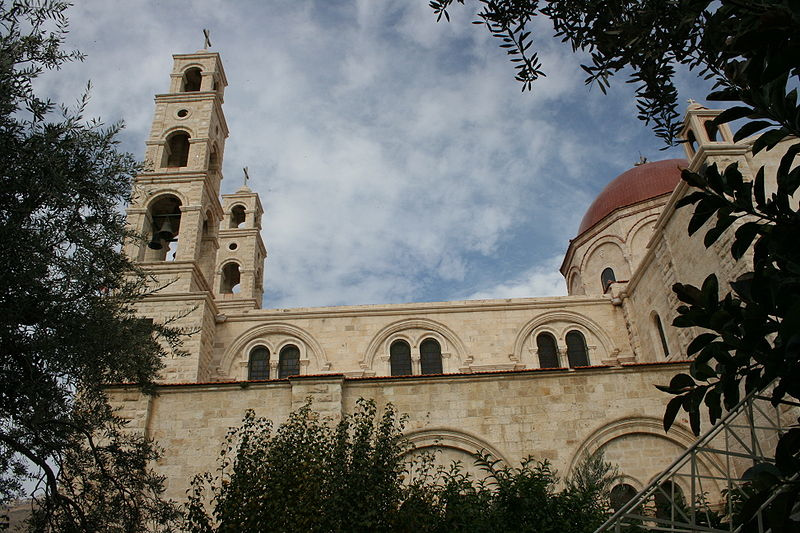
Access to Jacob’s Well is by entering the Church of St Photina and descending stairs in front of the iconostasis to the crypt.

Photina (Svetlana in Russian) is the name Orthodox tradition has given to the Samaritan woman. She is venerated as a martyr who was flayed alive and thrown down a well in Rome by the emperor Nero.

Jacob's Well

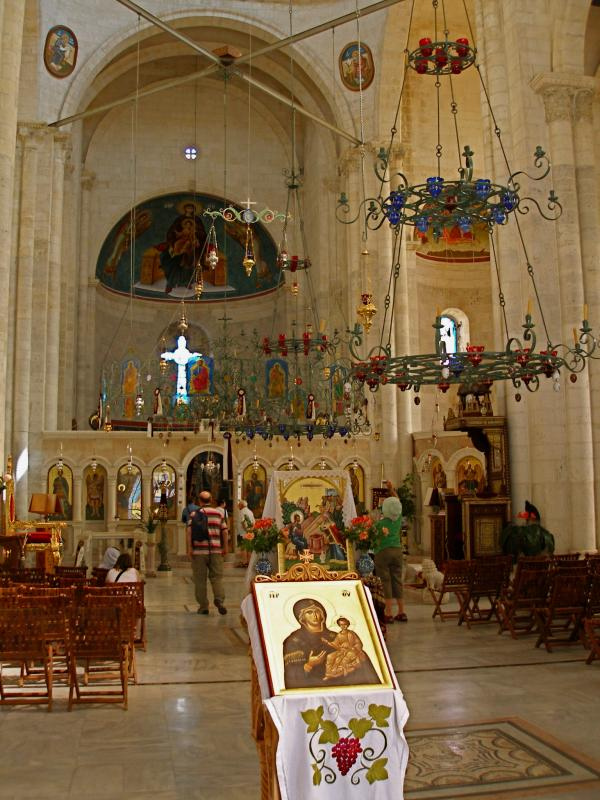
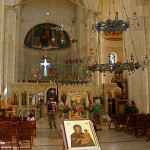
Interior of Church of St Photina (Seetheholyland.net)

A masonry structure surrounds the mouth of the well. On it stands a metal-framed pulley with a coil of rope long enough to reach the water.

A neck section about 50cm across and 1.2 metres deep opens into a shaft about 2.5 metres in diameter, hewn through solid rock.

Though the Samaritan woman told Jesus “the well is deep” (John 4:11), measurements of the depth have varied over the years, due to accumulation of debris (and stones dropped by curious visitors).

A depth of more than 40 metres recorded in 1935 had reduced to something over 20 metres by the 21st century. In ancient times the well was sunk much deeper, probably twice as far.

At times Jacob’s Well has been dry in summer.


Samaria was a ‘no-go’ area

Because of friction between Jews and Samaritans, the territory of Samaria was usually a “no-go” area for Galileans travelling to or from Jerusalem.

Jacob's Well

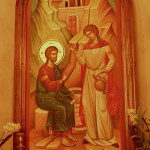
Icon of Jesus and Samaritan woman, in Church of St Photina (Seetheholyland.net)

The Gospel of Luke (9:51-55) tells of a Samaritan village that refused to receive Jesus because he was going to Jerusalem (on that occasion two of his disciples wanted to bring fire from heaven down on the village).

Samaritans have their origins in Judaism but, as the woman at the well pointed out to Jesus (John 4:20), they worship on Mount Gerizim rather than in Jerusalem.

They also regard Moses as the only prophet and accept only the first five books of the Old Testament (the Books of Moses, or the Torah).

The Samaritans at one time numbered in the hundreds of thousands but by 2007 only 700 remained, living mostly at Mount Gerizim and near Tel Aviv.


Succession of churches on the site

Pilgrims’ writings refer to Christian veneration of Jacob’s Well from the 3rd century. The earliest source, the anonymous Pilgrim of Bordeaux, mentions a bath (presumed to be a baptistry) that took its water from the well.

Jacob's Well

Church of St Photina at Jacob’s Well (Tiamat / Wikimedia)

A cruciform church built around 380 was the first of a succession of churches erected over the well. One of them appears in the 6th-century Madaba mosaic map.

In 1860 the Greek Orthodox Church acquired the property and began restoring the crypt. Construction of a new church was hindered by the 1917 Russian Revolution, which halted Russian funding, and by an earthquake in 1927.

The present church, completed in 2007, is modelled on a basilica from the Crusader era. In an attractive setting of trees and pot plants, it is well-lit, spacious and airy — a contrast to older Orthodox churches in the Holy Land.

Framed icons in modern style and bright colours are fixed to walls and ceilings, rather than being rendered on to these surfaces.


Place of conflict and violence

Nablus was an arena of conflict between militant Palestinians and the Israel Defence Force during the Second Intifada, between 2000 and 2005, but has since rebuilt itself as an industrial and commercial centre.

Jacob’s Well has also been a site of contention and violence. In 1979 a Zionist group claimed it as a Jewish holy place and demanded that crosses and icons be removed. A week later the custodian, Archimandrite Philoumenos, was butchered to death in the crypt and the church was desecrated. No one was ever convicted of his murder.

Jacob's Well

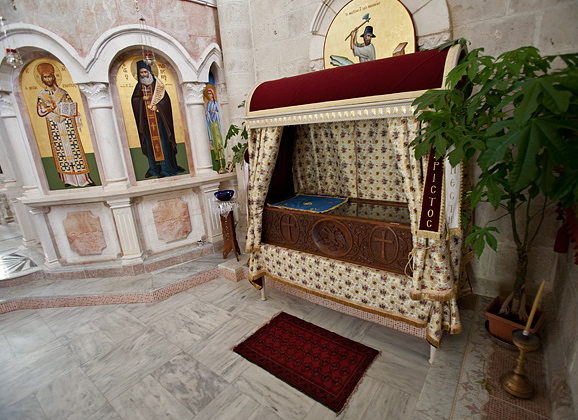
Remains of Archimandrite Philoumenos in Church of St Photina (© vizAziz)

The remains of Archimandrite Philoumenos are venerated in the right-hand chapel of the Church of St Photina.

North of Jacob’s Well is a related site, Joseph’s Tomb. This white-domed tomb is believed to be where the bones of Jacob’s son Joseph were buried after being brought back from Egypt (Joshua 24:32).


In Scripture: Jesus and the woman at the well: John 4:5-42

Administered by: Greek Orthodox Church

Tel.: 972-2-2375123

Open: 9am-1pm, 2pm-5pm; ring the bell


References

Charlesworth, James H.: The Millennium Guide for Pilgrims to the Holy Land (BIBAL Press, 2000)
Freeman-Grenville, G. S. P.: The Holy Land: A Pilgrim’s Guide to Israel, Jordan and the Sinai (Continuum Publishing, 1996)
Gonen, Rivka: Biblical Holy Places: An illustrated guide (Collier Macmillan, 1987)
Murphy-O’Connor, Jerome: The Holy Land: An Oxford Archaeological Guide from Earliest Times to 1700 (Oxford University Press, 2005)
Walker, Peter: In the Steps of Jesus (Zondervan, 2006)
Wareham, Norman, and Gill, Jill: Every Pilgrim’s Guide to the Holy Land (Canterbury Press, 1996)


External links

The Geographical, Historical & Spiritual Significance of Shechem (Biblical Studies Foundation)
Samaritans (Wikipedia)
The Samaritans (The Israelite Samaritan Community in Israel)


« Newer PostsOlder Posts »

Churches in the Holy Land

Eastern Orthodox

Oriental Orthodox

Eastern Catholic

Roman Catholic

Anglican/Protestant/Evangelical

More than a score of Christian churches and denominations have a presence in the Holy Land — not always co-existing in harmony. In fact the scandal of the disunity of Christians is perhaps more evident in the land where the Church began than anywhere else on earth.

In the early centuries, when the Judaeo-Christian Church was still one and undivided, its expansion required organising into geographic units. Bishops of important centres became known as patriarchs — the title accorded Old Testament leaders such as Abraham.

The earliest patriarchates were Antioch (where the name “Christian” was first used), Alexandria and Rome, with Rome (the see of Peter) accorded primacy of honour. Each brought its own culture and traditions to its church-community.

Two more patriarchates, Constantinople and Jerusalem (the “Mother Church”), were later recognised, with Constantinople eventually being accorded second place after Rome. All were Greek-speaking except for Latin-speaking Rome.

Holy Land Christians

Church leaders of East and West at an ecumenical meeting (© Custodia Terrae Sanctae)

From the 4th century, theological disagreements arose over the nature of Christ. Often exacerbated by political and social tensions, these led the Assyrian Church of the East and what we know as the Oriental Orthodox churches (Armenian, Coptic, Ethiopian, Syriac) to break away. They are still not in communion with either Constantinople or Rome.

In the 11th century, long-standing disputes between the Eastern (Greek) and Western (Latin) branches of Christianity incited the Great Schism between Eastern Orthodoxy and Roman Catholicism.

From the 16th century, groups within several Oriental and Eastern Orthodox churches re-established communion with the Roman Catholic Church. These became the Eastern Catholic churches.

The 16th century also saw dissent within the Western (Roman) Church spark the Protestant Reformation, resulting in a multitude of new denominations.

The main Christian groupings in the Holy Land today are Eastern Orthodox, Oriental Orthodox, Eastern Catholic, Roman (Latin) Catholic and Evangelical or Protestant.

Eastern Orthodox

Holy Land Christians

Greek Orthodox procession in Jerusalem (© Deror Avi)

Greek Orthodox form the largest Christian church in the Holy Land, their patriarch claiming direct descent from St James, the first bishop of Jerusalem.

Leadership in Israel is predominantly expatriate Greek, with married parish clergy and mainly Arab laity (in Jordan and Syria the leadership is largely Arab).

The Greek Orthodox holds major rights to the Church of the Holy Sepulchre in Jerusalem and the Church of the Nativity in Bethlehem.

The community’s St John the Baptist Church on Christian Quarter Road is one of the oldest in Jerusalem, built originally in the 5th century, and today below street level.

Russian Orthodox pilgrims from Russia visited the Holy Land from the 11th century, but the church did not establish its own institutions in Palestine until the 19th century, when an area now known as the Russian Compound on the Jaffa Road was developed.

Holy Land Christians

Russian Church of St Mary Magdalene (Seetheholyland.net)

The Russian Revolution of 1917 ended pilgrimages from Russia and also led to a Russian Orthodox Church Outside Russia, in opposition to the Orthodox Moscow Patriarchate. The two churches signed an act of canonical communion in 2007.

The best-known property of the Church Outside Russia is the onion-domed Church of St Mary Magdalene on the Mount of Olives. The main Moscow Patriarchate church is the Cathedral of the Holy Trinity in the Russian Compound.

Romanian Orthodox, with their headquarters in Bucharest, established themselves in Jerusalem in 1935. The interior of their church, St George’s, at 46 Shivtei Israel Street, outside the Old City, is covered with frescoes in neo-Byzantine style.

A small number of clergy look after a big number of Romanian guest workers in Israel.

Oriental Orthodox

Holy Land Christians

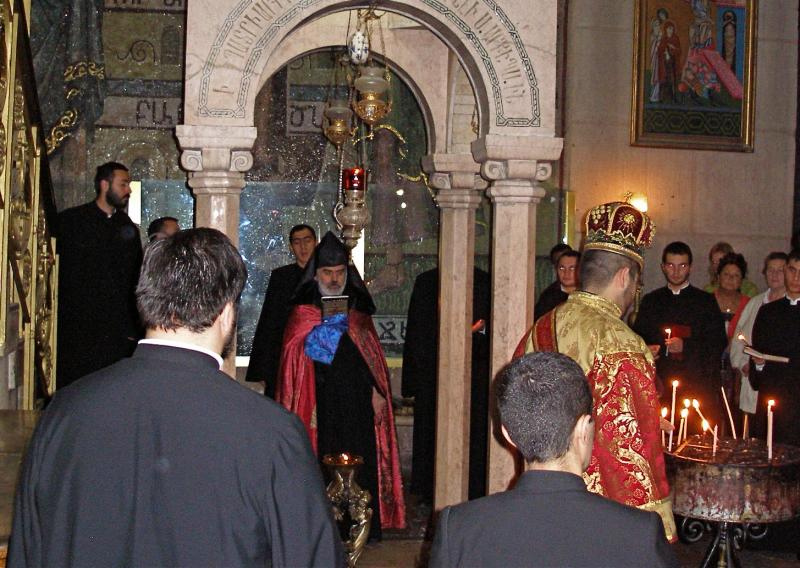
Armenian Orthodox ceremony in Church of the Holy Sepulchre (Seetheholyland.net)

Armenian Orthodox form the world’s oldest national church, since Armenia was the first nation to adopt Christianity as a state religion, in AD 301.

Large numbers came to Jerusalem, where they claim the longest uninterrupted Christian presence. The Armenian Quarter occupies about one-sixth of the Old City.

St James’s Cathedral, in Armenian Orthodox Patriarchate Road, is on the site of the original church built over the place where the Armenians believe the head of the apostle James the Great is buried.

The community holds dearly to the memory of the genocide of more than a million Armenians by Ottoman Turks at the time of the First World War.

Holy Land Christians

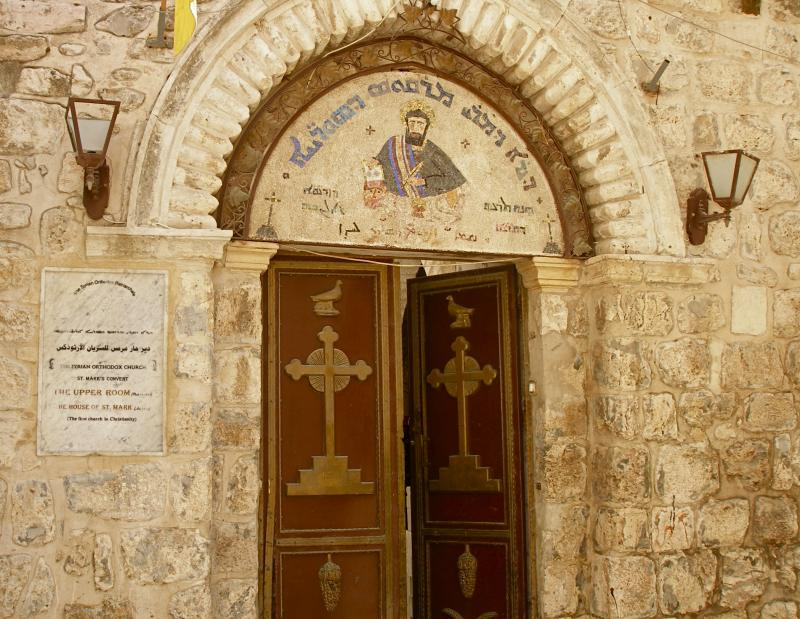
Entrance to St Mark’s Syriac Orthodox Church (Seetheholyland.net)

Syriac Orthodox trace their church back to first-century Antioch (in present-day Turkey) and claim the apostle St Peter as their first patriarch in AD 37. Before going to Rome, Peter served seven years in Antioch.

The word “Syriac” is not a geographic indicator, but refers to the use of the Syriac Aramaic language, a dialect of the tongue Jesus spoke in first-century Palestine, in worship.

The Syriac Orthodox (often called “Jacobites”, after an early bishop) believe their St Mark’s Church is on the site of the Last Supper and the coming of the Holy Spirit at Pentecost. Their Patriarch of Antioch is based in Damascus.

Holy Land Christians

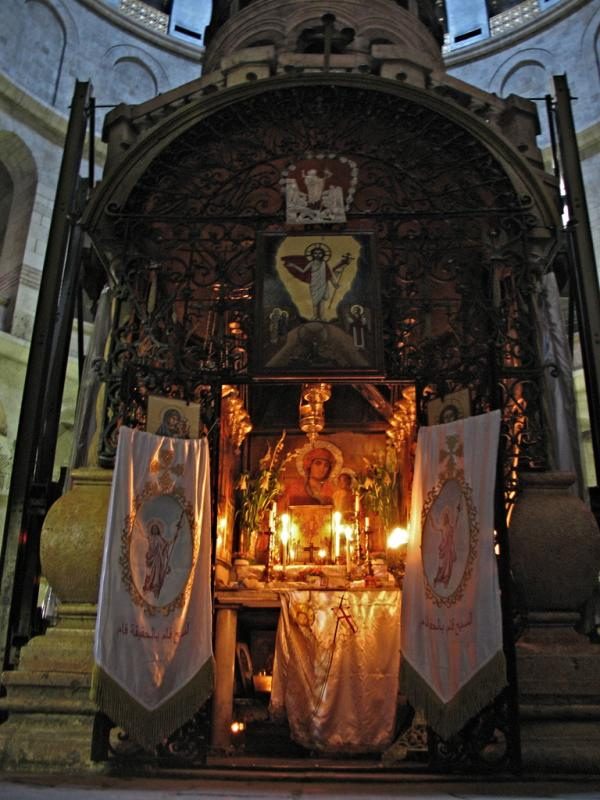
Coptic Orthodox chapel in Church of the Holy Sepuchre (James Emery)

Coptic Orthodox make up the largest Christian church in the Middle East, founded in Alexandria by the evangelist St Mark. Their leader, with the title of pope, is in Egypt. The liturgy is in Coptic, the ancient language of Egypt, with readings in Arabic.

The Jerusalem patriarchate and St Antony’s Church are close to the Ninth Station of the Via Dolorosa. The Coptic Orthodox also have a tiny chapel at the back of the Tomb of Christ in the Church of the Holy Sepulchre.

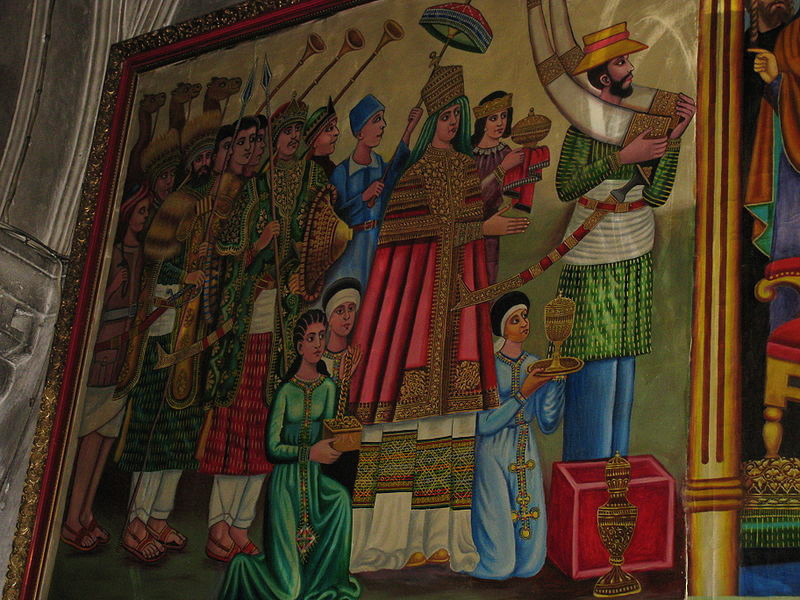
Ethiopian Orthodox trace their connection to Jerusalem back 1000 years before Christ, when the Ethiopian Queen of Sheba visited King Solomon (1 Kings 10:1-13, 2 Chronicles 9:1-12). She embraced his Jewish faith — and apparently Solomon too, since tradition credits them with a son named Menelik, who became emperor of Ethiopia.

Christianity is believed to have been introduced into Ethiopia by the eunuch finance minister of Queen Candace who came to Jerusalem to worship and was baptised by the apostle Philip (Acts 8:26-40).

Holy Land Christians

Queen of Sheba bringing gifts to Solomon, in Ethiopian Orthodox chapel (© Deror Avi)

The Ethiopian Orthodox retain some Jewish practices, including circumcision, and use freshly-baked bread for Communion.

Their biggest church in Jerusalem is the circular Dabra Gannat Monastery on Ethiopia Street, just off Prophet’s Street. They also occupy two chapels in the Church of the Holy Sepulchre and a mud-hut village on its roof.

Eastern Catholic

Greek Catholics, known as Melkites (a word meaning “royalist”), form the second largest Christian church in the Holy Land — after the Greek Orthodox, whose Byzantine liturgy they share. Their Patriarch of Antioch is in Damascus.

Holy Land Christians

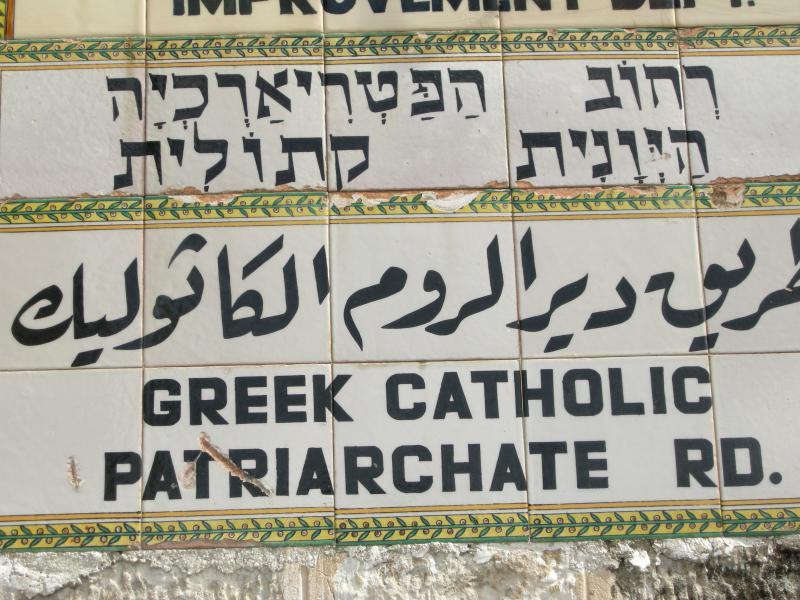
Street sign for Greek Catholic Patriarchate Road (Yoav Dothan / Wikimedia)

This Arab church has big numbers in the Galilee region and a small community in Jerusalem.

The fresco-covered patriarchate Church of the Annunciation, inside the Jaffa Gate and up Greek Catholic Patriachate Road, is described in the Living Stones Pilgrimage guidebook as “arguably the most representative Byzantine church in Jerusalem and . . . perhaps the best place to introduce yourself to Orthodox places of worship”.

Within the patriarchate building is a museum of Eastern Church traditions in the Holy Land (open 9am-12pm daily, except Sunday).

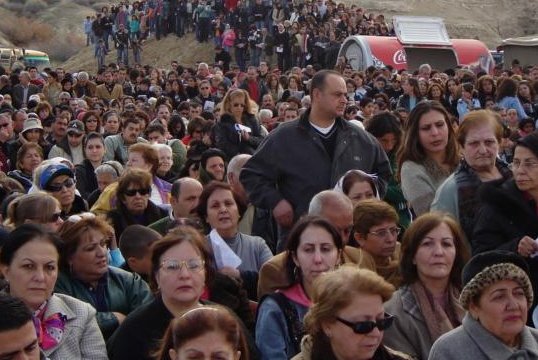
Chaldean Catholics separated from the Church of the East (also known as the Nestorian Church) in 1552. Most members are in Iraq (where they are the largest Christian church) and Iran, with a refugee Iraqi community in Jordan and emigrant communities as far away as Australia and New Zealand.

Holy Land Christians

Chaldean Catholic refugees in Jordan (© Tasher Bahoo / Wikimedia)

The patriarchal seat is in Baghdad. In Jerusalem the patriarchal exarchate is at 7 Chaldean Street (off Nablus Road).

Syriac Catholics broke away from the Syriac Orthodox Church and have been in communion with Rome since the 1780s. They also trace their origins to the See of Antioch established by St Peter and retain much of the liturgy (in Aramaic) of their Orthodox counterpart.

Their Patriarch of Antioch is in Beirut. The Jerusalem patriarchal exarchate Church of St Thomas is at 2 Chaldean Street (off Nablus Road).

Armenian Catholics, who separated from the Armenian Orthodox Church, have been in communion with Rome since 1742. They have kept much of the Orthodox liturgy (in classical Armenian) and, like the Armenian Orthodox, suffered in the genocide by Ottoman Turks during the First World War.

Their headquarters is in Bzoummar, Lebanon. The Jerusalem patriarchal exarchate is at the Third Station of the Cross on the Via Dolorosa.

Holy Land Christians

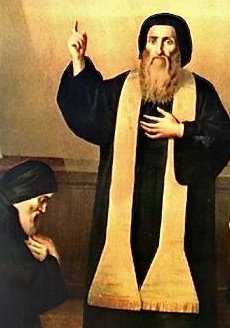
St Maron, who gave the Maronite Catholics their name

Maronite Catholics, the largest Christian community in Lebanon, form the only Eastern church which has always been Roman Catholic, without an Orthodox counterpart.

Founded by St Maron, a 5th-century Syrian hermit, they use Aramaic in their worship and their patriarch is in Beirut. Their membership base in the Holy Land is in Galilee, which is just south of Lebanon.

The patriarchal vicariate is in the Old City on Maronite Convent Road, Jaffa Gate.

Roman Catholic

A Latin patriarchate was established in Jerusalem in 1099, 46 years after the East-West schism, during the Crusades. When the Crusaders were routed 90 years later, the Latin hierarchy fled the Holy Land.

Holy Land Christians

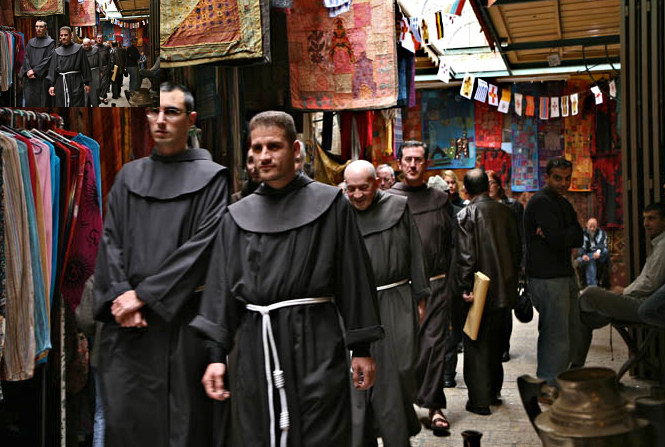
Franciscan friars in a Jerusalem market (© Custodia Terrae Sanctae)

In 1342 Pope Clement VI gave the custodianship of the holy places to the Franciscan order, whose founder, St Francis of Assisi, had visited the Holy Land in 1219-20.

The brown-robed Franciscans are still a familiar feature of the Holy Land, caring for holy places and active in parishes, schools and social works. Their Custody of the Holy Land is based at St Saviour’s Monastery on St Francis Street, New Gate, where St Saviour’s Church is the only Latin parish church in the Old City. They also retain possession of some chapels in the Church of the Holy Sepulchre.

Holy Land Christians

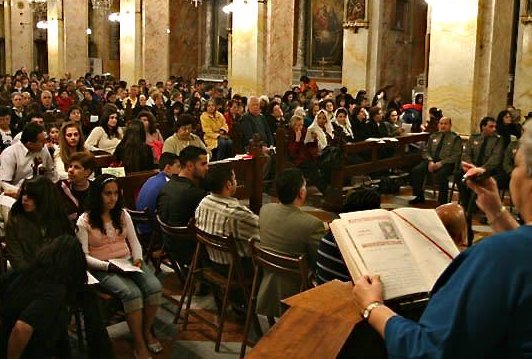
Congregation in St Saviour’s Church (© Custodia Terrae Sanctae)

About 100 other Roman Catholic religious orders (70 of women and 30 of men) serve in the Holy Land.

In 1847 Pope Pius IX re-established a Latin patriarchate in Jerusalem, with headquarters in Latin Patriarchate Road. Latin-rite Catholics are predominantly Palestinian Arabs (as is the patriarch), though their numbers have been boosted by migrant workers from Asia and Latin America.

Since the mid-1950s there has also been a Hebrew-speaking Catholic community — including convert Jews, Catholic spouses of Jews, and immigrants who have assimilated into the Hebrew-speaking society — which now has its own patriarchal vicar.

Anglican/Protestant/Evangelical

The Anglican and Lutheran churches jointly set up a Jerusalem-based diocese for the Middle East in 1841, though this joint missionary venture ended in 1886. Today both churches have separate bishops (both Palestinian Arabs).

The Anglicans, usually referred to as “Evangelicals” or “Episcopals”, have St George’s Cathedral on Nablus Road, with both Arab and expatriate congregations. St George’s College, a continuing education centre, is within the cathedral compound.

Until the cathedral opened, the bishop’s seat was Christ Church, near the Jaffa Gate in the Old City. The first Protestant church in the Holy Land when it was completed in 1849, it serves Messianic Jews among its charismatic congregation.

Holy Land Christians

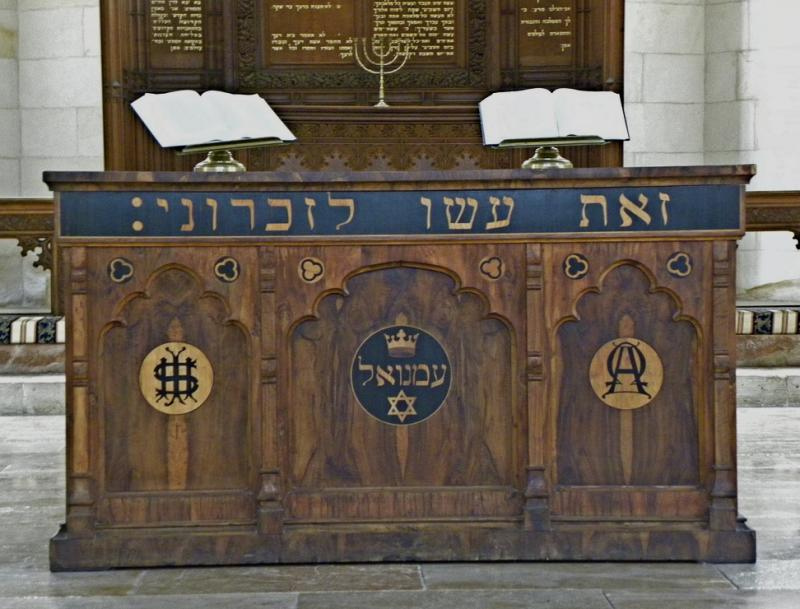
Hebrew-inscribed altar in Christ Church (Ian W. Scott)

Kaiser Wilhelm of Germany built the Church of the Redeemer in Muristan Road for the Lutherans and personally dedicated it in 1898.

The church has Arabic, German, English and Danish congregations, and its tall bell tower offers an overview of the Old City.

Several other Reformed churches are established in the Holy Land. They include Baptist, Christian and Missionary Alliance, Christian Brethren, Church of God, Church of the Nazarene, Church of Scotland (Presbyterian), King of Kings Assembly, Pentecostal and Seventh-Day Adventist communities. Most evangelical Protestant churches are not recognised by the state of Israel.

Among those who identify as Jewish there are groups of Messianic Christians whose theology is conservatively evangelical and whose politics is predominantly Zionist, seeing the modern state of Israel as a fulfilment of biblical prophecies.

Related articles:

Inside an Eastern church

The Holy Land’s Christians

How to contact churches in Jerusalem

PHOTO CREDITS: Where the images above are not created by Seetheholyland.net, links to the sources can be found on our Attributions Page.


References

Bailey, Betty Jane and J. Martin: Who Are the Christians in the Middle East? (William B. Eerdmans, 2010)
Bausch, William J.: Pilgrim Church: A Popular History of Catholic Christianity (Twenty-Third Publications, 1993)
Caffulli, Giuseppe: “Jordan’s Christians: A Living Force” (Holy Land Review, Winter 2010)
Cragg, Kenneth: The Arab Christian: A History in the Middle East (Westminster/John Knox, 1991)
Doyle, Stephen: The Pilgrim’s New Guide to the Holy Land (Liturgical Press, 1990)
Eber, Shirley, and O’Sullivan, Kevin: Israel and the Occupied Territories: The Rough Guide (Harrap-Columbus, 1989)
Faris, John D.: “Peter’s First See” (CNEWA World, March-April 2003)
Hilliard, Alison, and Bailey, Betty Jane: Living Stones Pilgrimage: With the Christians of the Holy Land (Cassell, 1999)
McCormick, James R.: Jerusalem and the Holy Land: The first ecumenical pilgrim’s guide (Rhodes & Eaton, 1997)
Macpherson, Duncan (ed.): A Third Millennium Guide to Pilgrimage to the Holy Land (Melisende, 2000)
Marchadour, Alain, and Neuhaus, David: The Land, the Bible and History: Toward the Land That I Will Show You (Fordham University Press, 2007)
Pentin, Edward: “Leading Efforts to Keep Christians in Holy Land” (Holy Land Review, Spring 2009)


« Newer PostsOlder Posts »

Herodium

West Bank

Herodium

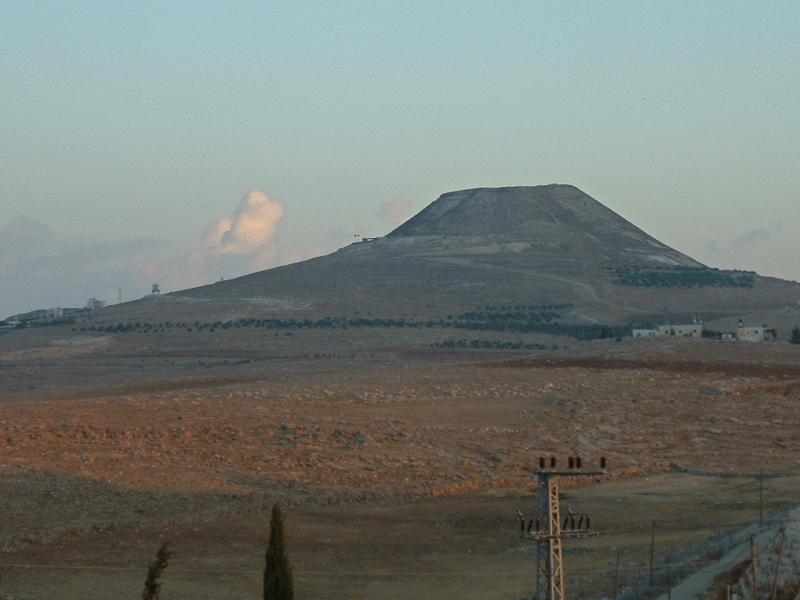
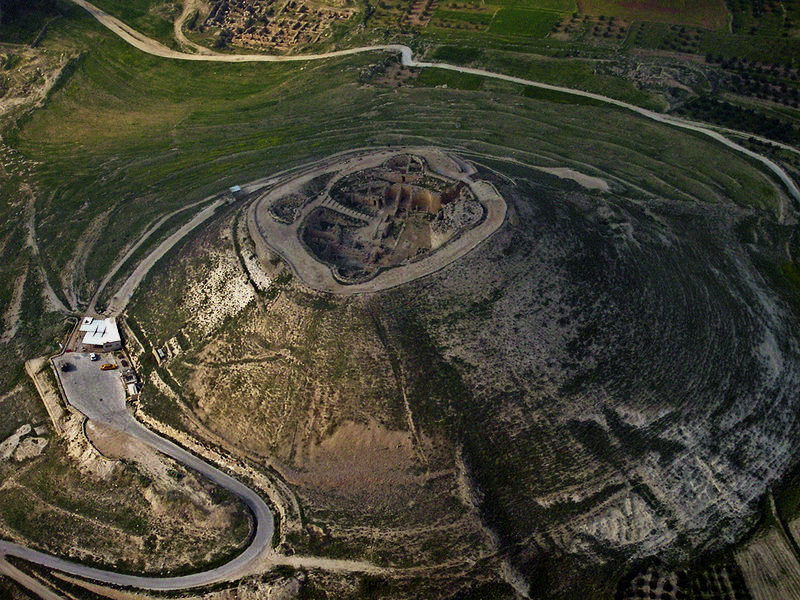
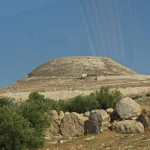
Herodium (David Pishazaon / Wikimedia)


Looking south-east from Bethlehem, the skyline is dominated by a volcano-shaped mountain on which Herod the Great built the fortress-palace he dedicated to himself.

Constructed within two huge concentric walls, the seven-storey Herodium palace was “private, intimate, exotic and protected”, according to archaeologist Ehud Netzer — who in 2007 announced he had discovered Herod’s long-lost tomb on the mountain’s north-east slope.

But to the Bethlehem parents whose infant sons Herod had massacred in a desperate attempt to eliminate the newborn “King of the Jews”, the presence of Herodium less than 6 kilometres away would have been a daily reminder of the king’s brutality.


Murderer and visionary builder

Herodium

Inside the ruins of Herodium (© Deror Avi / Wikimedia)

The “Massacre of the Innocents”, following the visit of Wise Men from the East to pay homage to the baby Jesus, is recorded only in Matthew’s Gospel.

Other sources record that the murderous Herod had two of his sons strangled, executed one of his 10 wives for treason, killed numerous in-laws and on his deathbed ordered his eldest son beheaded.

Herod, who ruled Judea on behalf of Rome from 37 to 4 BC, was also a man of great architectural vision. His projects included the Second Temple in Jerusalem, the desert fortress of Masada and the city and massive harbour works at Caesarea.

He chose the site of Herodium because it was near the scene of a crucial battle victory against a bitter rival, Antigonus, the last Hasmonean king.


Pleasure palace and small city

Construction of Herodium began around 25 BC. Using thousands of slaves, Herod reshaped the summit of the hill to create an almost impregnable pleasure palace, the third largest in the Roman world.

Herodium

Herodium from the air (Asaf T. / Wikimedia)

The historian Josephus described it as “a hill raised to a height by the hand of man and rounded off in the shape of a breast . . . . Within it are costly royal apartments made for security and for ornament . . . .”

At its base stood a small city. Its architectural focus was a huge artificial pool, more than twice the area of a modern Olympic swimming pool, and deep enough to accommodate boats. An aqueduct brought water from spring nearly 6 kilometres away.

Four towers gave a commanding view of the Judean desert and as far as the Dead Sea and the mountains of Moab. Using mirrors to reflect the sun, Herod could convey messages from Jerusalem to Herodium to Masada.


Grave was undiscovered until 2007

After Herod’s time, the Romans used the fortress against the insurgents during the First Jewish Revolt in AD 70. In AD 132-135 the Jewish Zealot leader Bar Kokhba converted it into his headquarters in the Second Revolt.

Herodium

Herod’s tomb (© Deror Avi / Wikimedia)

In succeeding centuries, the abandoned Herodium was occupied by monks. In the lower part, three different churches have been excavated, all with mosaic floors.

The location of Herod’s grave continued to puzzle archaeologists until 2007. Thirty-five years after he began excavating Herodium, Ehud Netzer of the Hebrew University of Jerusalem reported success when he and his team uncovered pieces of a large sarcophagus made of pink Jerusalem limestone and decorated with expertly carved floral motifs.

These were found among the ruins of a lavish, two-storey mausoleum about 25 metres high.

“The location and unique nature of the findings, as well as the historical record, leave no doubt that this was Herod’s burial site,” Netzer told reporters.

While continuing excavations, Netzer suffered fatal injuries when a wooden railing at the site gave way in October 2010.


Other sites in the Bethlehem area:

Bethlehem

Church of the Nativity

Grotto of the Nativity

St Jerome’s Cave

Church of St Catherine of Alexandria

Milk Grotto

Shepherds’ Field

Tomb of Rachel

Field of Ruth


In Scripture:

The massacre of the Innocents: Matthew 16-18

Administered by: Israel National Parks Authority

Tel.: 050-623-5821

Open: 8am-5pm (4pm Oct-Mar)


References

Brownrigg, Ronald: Come, See the Place: A Pilgrim Guide to the Holy Land (Hodder and Stoughton, 1985)
Freeman-Grenville, G. S. P.: The Holy Land: A Pilgrim’s Guide to Israel, Jordan and the Sinai (Continuum Publishing, 1996)
Maier, Paul L. (trans. and ed.): Josephus: The Essential Writings (Kregel Publications, 1988).
Murphy-O’Connor, Jerome: The Holy Land: An Oxford Archaeological Guide from Earliest Times to 1700 (Oxford University Press, 2005)
Inman, Nick, and McDonald, Ferdie (eds): Jerusalem & the Holy Land (Eyewitness Travel Guide, Dorling Kindersley, 2007)
Wareham, Norman, and Gill, Jill: Every Pilgrim’s Guide to the Holy Land (Canterbury Press, 1996)


External links

Herodium (BiblePlaces)
Herodium (Israel Ministry of Foreign Affairs)
Tomb of King Herod discovered at Herodium (Israel Ministry of Foreign Affairs)
« Newer PostsOlder Posts »

Bibliography

Filed under: Extras — 4:43 pm

Books and articles referred to are listed here. Those relevant to particular articles are listed at the end of each article.

BOOKS

Bagatti, Bellarmino: Ancient Christian Villages of Galilee (Studium Biblicum Franciscanum, 1999)
Bailey, Betty Jane and J. Martin: Who Are the Christians in the Middle East? (William B. Eerdmans, 2010)
Baldwin, David: The Holy Land: A Pilgrim’s Companion (Catholic Truth Society, 2007)
Bar-Am, Aviva: Beyond the Walls: Churches of Jerusalem (Ahva Press, 1998)
Bausch, William J.: Pilgrim Church: A Popular History of Catholic Christianity (Twenty-Third Publications, 1993)
Beitzel, Barry J.: Biblica, The Bible Atlas: A Social and Historical Journey Through the Lands of the Bible (Global Book Publishing, 2007)
Benelli, Carla, and Saltini, Tommaso (eds): The Holy Sepulchre: The Pilgrim’s New Guide (Franciscan Printing Press, 2011)
Blaiklock, E. M.: Eight Days in Israel (Ark Publishing, 1980)
Bourbon, Fabio, and Lavagno, Enrico: The Holy Land Archaeological Guide to Israel, Sinai and Jordan (White Star, 2009)
Bourbon, Fabio: Yesterday and Today: The Holy Land: Lithographs and Diaries by David Roberts, R.A. (Swan Hill, 1997)
Bowker, John: The Complete Bible Handbook (Dorling Kindersley, 1998)
Bradley, Ian: Pilgrimage: A spiritul and cultural journey (Lion, 2009)
Brisco, Thomas: Holman Bible Atlas (Broadman and Holman, 1998)
Brownrigg, Ronald: Come, See the Place: A Pilgrim Guide to the Holy Land (Hodder and Stoughton, 1985)
Burckhardt, Johann Ludwig: Travels in Syria and the Holy Land (John Murray, 1822)
Burgon, John William: Petra, a prize poem (Oxford, 1845)
Charlesworth, James H.: The Millennium Guide for Pilgrims to the Holy Land (BIBAL Press, 2000)
Cohen, Daniel: The Holy Land of Jesus (Doko Media, 2008)
Cohen, Raymond: Saving the Holy Sepulchre: How Rival Christians Came Together to Rescue their Holiest Shrine (Oxford University Press, 2008)
Cox, Ronald: The Gospel Story (CYM Publications, 1950)
Cragg, Kenneth: The Arab Christian: A History in the Middle East (Westminster/John Knox, 1991)
Crowe, David M.: Oskar Schindler: The Untold Account of his Life, Wartime Activities, and the True Story Behind the List (Westview Press, 2004)
De Sandoli, Sabino: Emmaus-el Qubeibe (Franciscan Printing Press, 1980)
Donner, Herbert: The Mosaic Map of Madaba: an introductory guide (Kok Pharos, 1992)
Doyle, Stephen: The Pilgrim’s New Guide to the Holy Land (Liturgical Press, 1990)
Dyer, Charles H., and Hatteberg, Gregory A.: The New Christian Traveler’s Guide to the Holy Land (Moody, 2006)
Eber, Shirley, and O’Sullivan, Kevin: Israel and the Occupied Territories: The Rough Guide (Harrap-Columbus, 1989)
Freeman-Grenville, G. S. P.: The Holy Land: A Pilgrim’s Guide to Israel, Jordan and the Sinai (Continuum Publishing, 1996)
Garrard, Alec: The Splendor of the Temple (Angus Hudson, 2000)
Giroud, Sabri, and others, trans. by Carol Scheller-Doyle and Walid Shomali: Palestine and Palestinians (Alternative Tourism Group, 2008)
Gonen, Rivka: Biblical Holy Places: An illustrated guide (Collier Macmillan, 1987)
Goulburn, Edward Meyrick: John William Burgon, late Dean of Chichester: a biography, volume 1 (J. Murray, 1892)
Haddad, Fadi Shawkat: A Christian Pilgrimage Journey in Jordan (published by author, PO Box 135, Amman 11733, 2015)
Hilliard, Alison, and Bailey, Betty Jane: Living Stones Pilgrimage: With the Christians of the Holy Land (Cassell, 1999)
Hoffman, Lawrence A.: Israel: A Spiritual Travel Guide (Jewish Lights Publishing, 1998)
Inman, Nick, and McDonald, Ferdie (eds): Jerusalem & the Holy Land (Eyewitness Travel Guide, Dorling Kindersley, 2007)
Irving, Sarah: Palestine (Bradt Travel Guides, 2011)
Josephus, Flavius: The Jewish War, trans. William Whiston (Kregel, Baker, 1960)
Kauffmann, Joel: The Nazareth Jesus Knew (Nazareth Village, 2005)
Keneally, Thomas: Schindler’s Ark (Hodder and Stoughton, 1982)
Kilgallen, John J.: A New Testament Guide to the Holy Land (Loyola Press, 1998)
Kochav, Sarah: Israel: A Journey Through the Art and History of the Holy Land (Steimatzky, 2008)
Lofenfeld Winkler, Lea, and Frenkel, Ramit: The Boat and the Sea of Galilee(Gefen Publishing House, 2010)
Losch, Richard R.: The Uttermost Part of the Earth: A guide to places in the Bible (Wm. B. Eerdmans, 2005)
Mackowski, Richard M.: Jerusalem: City of Jesus (William B. Eerdmans, 1980)
Macpherson, Duncan (ed.): A Third Millennium Guide to Pilgrimage to the Holy Land (Melisende, 2000)
McCormick, James R.: Jerusalem and the Holy Land: The first ecumenical pilgrim’s guide (Rhodes & Eaton, 1997)
Maier, Paul L. (trans.): Eusebius: The Church History (Kregel Publications, 2007)
Maier, Paul L. (trans.): Josephus: The Essential Writings (Kregel Publications, 1988)
Marchadour, Alain, and Neuhaus, David: The Land, the Bible and History: Toward the Land That I Will Show You (Fordham University Press, 2007)
Martin, James: A Pilgrim’s Guide to the Holy Land (Westminster Press, 1978)
Metzger, Bruce M., and Coogan, Michael D.: The Oxford Companion to the Bible (Oxford University Press, 1993)
Meyers, Carol L., Craven, Toni, and Kraemer, Ross S. (eds): Women in Scripture: A Dictionary of Named and Unnamed Women in the Hebrew Bible, the Apocryphal/Deuterocanonical Books and New Testament (Wm. B. Eerdmans Publishing, 2001)
Millgram, Abraham Ezra: Jerusalem Curiosities (Jewish Publication Society, 1990)
Murphy-O’Connor, Jerome: Keys to Jerusalem (Oxford University Press, 2012)
Murphy-O’Connor, Jerome: The Holy Land: An Oxford Archaeological Guide from Earliest Times to 1700 (Oxford University Press, 2005)
Nicholson, Peter C.: The Churches of Antonio Barluzzi (The McCabe Educational Trust)
Notley, R. Steven: Jerusalem: City of the Great King (Carta Jerusalem, 2015)
Pearlman, Moshe: Digging up the Bible: The stories behind the great archaeological discoveries in the Holy Land (William Morrow, 1980)
Piccirillo, M., Alliata, E. (ed.): Mount Nebo. New Archaeological Excavations 1967-1997 (Franciscan Printing Press, 1998)
Pixner, Bargil: With Jesus in Jerusalem – his First and Last Days in Judea (Corazin Publishing, 1996)
Pixner, Bargil: With Jesus Through Galilee According to the Fifth Gospel (Corazin Publishing, 1992)
Prag, Kay: Israel & the Palestinian Territories: Blue Guide (A. & C. Black, 2002)
Prag, Kay: Jerusalem: Blue Guide (A. & C. Black, 1989)
Rainey, Anson F., and Notley, R. Steven: The Sacred Bridge: Carta’s Atlas of the Biblical World (Carta, 2006)
Rossing, Daniel: Between Heaven and Earth: Churches and monasteries of the Holy Land (Penn Publishing, 2012)
Saltini, Tommaso (ed.): Sabastiya — The fruits of history and the memory of John the Baptist (ATS Pro Terra Sancta exhibition catalogue, 2011)
Samet, Inbal: Megiddo National Park (Israel Nature and Parks Authority leaflet)
Schaiek. Z.: The Sea of Galilee (Palphot, 1997?)
Shahin, Mariam, and Azar, George: Palestine: A guide (Chastleton Travel, 2005)
Shanks, Hershel (ed.): Partings: How Judaism and Christianity Became Two (Biblical Archaeology Society, 2013)
Simmermacher, Günther: The Holy Land Trek: A Pilgrim’s Guide (Southern Cross Books, 2012)
Storme, Albert: Gethsemane (Franciscan Printing Press, 1970)
Sussman, Ayala, and Peled, Ruth: The Dead Sea Scrolls (Israel Antiquities Authority and Israel Museum Products, 1994)
The New Jerusalem Bible (Darton, Longman & Todd, 1990)
The New Revised Standard Version Bible (Thomas Nelson, 1993)
Thiede, Carsten Peter: The Emmaus Mystery: Discovering Evidence for the Risen Christ (Continuum International, 2006)
Twain, Mark: The Innocents Abroad (Wordsworth, 2010)
Vamosh, Miriam Feinberg: Beit She’an: Capital of the Decapolis (Israel Nature and National Parks Protection Authority, 1996)
Walker, Peter: In the Steps of Jesus (Zondervan, 2006)
Wareham, Norman, and Gill, Jill: Every Pilgrim’s Guide to the Holy Land (Canterbury Press, 1996)

ARTICLES

Alliata, Eugenio, OFM: “Archaeological Excavations at Cana of Galilee”, Holy Land, summer 2004
Anonymous: “Christian Mount Sion”, Holy Land, spring 2003
Anonymous: “Griechisch-Katholisch-Melkitisches Patriarchat” (Greek Catholic Patriarchate leaflet, undated)
Anonymous: “The Dead Sea”, Holy Land, summer 2005
Anonymous: “The Monastery of the Twelve Apostles” (Greek Orthodox Church leaflet, undated)
Anonymous: “Mary Leads us to Jesus” (Association Marie de Nazareth brochure, undated)
Ashkenazi, Eli: “Two-year fishing ban cut down to four-month annual break”, Haaretz, February 16, 2011
Bagatti, Bellarmino: “ ‘Footprints’ of the Saviour on the Mount of Olives”, Holy Land, winter 2005
Bahat, Dan: “Does the Holy Sepulchre Church Mark the Burial of Jesus?”, Biblical Archaeology Review, May-June 1986
Bahat, Dan: “Jerusalem Down Under: Tunneling Along Herod’s Temple Mount Wall”, Biblical Archaeological Review, November/December 1995
Basile, Joseph J. “When People Lived at Petra”, Biblical Archaeology Review, July/August 2000
Bastier, Claire, and Halloun, Nizar: “Restoration: Revealing the glories of the Basilica of the Nativity in Bethlehem”, Holy Land Review, winter 2016
Bechtel, F.: “Bethsaida”, The Catholic Encyclopedia (Robert Appleton Company, 1914)
Bellarmino Bagatti: “Nain of the Gospel”, Holy Land, summer 2001
Bikai, Patricia Maynor: “The Churches of Byzantine Petra”, Near Eastern Archaeology, December 2002
Bohstrom, Philippe: “King Herod’s Throne Room Where ‘Salome Danced’ Found in Jordan”, Haaretz, December 14, 2020
Bouwen, Frans: “St Anne’s Church and the Pool of Bethesda”, Cornerstone, spring 2000
Burkeman, Oliver, and Aris, Ben: “Biographer Takes Shine off Spielberg’s Schindler”, The Guardian, November 25, 2004
Caffulli, Giuseppe: “Jerash, Pompeii of the East”, Holy Land Review, spring 2010
Caffulli, Giuseppe: “Jordan’s Christians: A Living Force”, Holy Land Review, Winter 2010
Caffulli, Giuseppe: “Precious Fragrances”, Holy Land Review, Spring 2009
Chabin, Michele: “Church of the Nativity’s Face-Lift Reveals Ancient Treasures”, National Catholic Register, June 15, 2016
Chadwick, Jeffrey R.: “Discovering Hebron: the City of the Patriarchs Slowly Yields Its Secrets”, Biblical Archaeology Review, September/October 2005
Chancey, Mark, and Meyers, Eric M.: “Spotlight on Sepphoris: How Jewish was Sepphoris in Jesus’ Time?”, Biblical Archaeology Review, July/August 2000
Cignelli, Lino: “Our Lady’s Tomb in the Apocrypha”, Holy Land, spring 2005
Corbett, Joey: “New Synagogue Excavations In Israel and Beyond”, Biblical Archaeological Review, July/August 2011
Daniel W. Casey, Jr, “House of the Fishers”, Holy Land, autumn 1997
Dark, Ken: “Has Jesus’ Nazareth House Been Found?”, Biblical Archaeology Review, March-April 2015
Dillon, Edward: “The Sanctuaries at Gethsemane”, Holy Land, spring 1998
Faris, John D.: “Peter’s First See”, CNEWA World, March-April 2003
Finkelstein, Israel: “In the Eye of Jerusalem’s Archaeological Storm”, Forward, May 6, 2011
Finkelstein, Israel, and Ussishkin, David: “Back to Megiddo”, Biblical Archaeology Review, January/February 1994
Fletcher, Elaine Ruth: “Searching for the site of Jesus’ Baptism”, Religion News Service, January 1, 2000
Fortescue, Adrian: “Jerusalem (AD 71-1099)”, The Catholic Encyclopedia (Robert Appleton Company, 1910)
Frumkin, Amos: “How Lot’s Wife Became a Pillar of Salt”, Biblical Archaeology Review, May/June 2009
Hadid, Diaa: “Risk of Collapse at Jesus’ Tomb Unites Rival Christians”, The New York Times, April 6, 2016
Gochis, Djinna, and Michaels, Christine: “Mysterious Petra Rediscovered”, Catholic Near East Magazine, fall 1978
Goldfus, H., et al.: “The significance of geomorphological and soil formation research for understanding the unfinished Roman ramp at Masada”, Catena, 2016
Hasson, Nir: “Digging completed on tunnel under Old City walls in East Jerusalem”, Haaretz, January 25, 2011
Hasson, Nir: “Jerusalem’s time tunnels”, Haaretz, April 24, 2011
Herman, Danny: “Who Moved the Ladder?”, Biblical Archaeology Review, January/February 2010
Hoppe, Leslie: “Holy Land – Holy People”, Holy Land, spring 1999
Hoppe, Leslie: “The Dome of the Rock”, Holy Land, summer 1999
Israel Antiquities Authority: “A Residential Building from the Time of Jesus was Exposed in the Heart of Nazareth”, media release, December 23, 2009
Jacobson, David: “Sacred Geometry: Unlocking the Secret of the Temple Mount”, Biblical Archaeological Review, July/August and September/October 1999
Jeffay, Nathan, and Singh, Anita: “Fishing banned on the Sea of Galilee”, The Telegraph, April 3, 2010
Joseph, Frederick: “Basilica of the Annunciation in Nazareth”, Holy Land, spring 2005
Joseph, Frederick: “Bethlehem”, Holy Land, winter 2002
Joseph, Frederick: “Caesarea”, Holy Land, winter 2004
Kershner, Isabel: “A Rare Middle East Agreement, on Water”, New York Times, December 9, 2013
Khouri, Rami: “Where John Baptized: Bethany Beyond the Jordan”, Exploring Jordan: The Other Biblical Land (Biblical Archaeology Society, 2008)
Kloetzli, Godfrey: “Jericho”, Holy Land, summer 2004
Kloetzli, Godfrey: “Ain Karim”, Holy Land, winter 2003
Laney, J. Carl: “The Identification of Bethany Beyond the Jordan”, from Selective Geographical Problems in the Life of Christ, doctoral dissertation (Dallas Theological Seminary, 1977)
Laney, J. Carl: “The Identification of Emmaus”, from Selective Geographical Problems in the Life of Christ, doctoral dissertation (Dallas Theological Seminary, 1977)
Lefkovits, Etgar: “Second temple model to link history, archaeology”, Jerusalem Post, May 25, 2006
Lidman, Melanie: “As the Dead Sea dries, its collapsing shores force a return to nature”, Times of Israel, February 13, 2017
Loffreda, Stanislao: “Capharnaum”, Holy Land, summer and autumn, 2002
Maas, Anthony: “The Blessed Virgin Mary”, The Catholic Encyclopedia (Robert Appleton Company, 1912)
Mancini, Ignatius: “New Archaeological Discoveries at Cana of Galilee”, Holy Land, autumn 1998
Manns, Frédéric: “Stones of Memory”, Holy Land Review, winter 2017
Martin, George: “The Melkites of Jerusalem”, Catholic Near East, November-December 1995
Maugh, Thomas H. II: “Biblical Pool Uncovered in Jerusalem”, Los Angeles Times, August 9, 2005
Mazar, Eilat: “Temple Mount Excavations Unearth the Monastery of the Virgins”, Biblical Archaeology Review, May/June 2004
Meistermann, Barnabas: “Naim”, The Catholic Encyclopedia (Robert Appleton Company, 1911)
Merk, August: “Magdala”, The Catholic Encyclopedia (Robert Appleton Company, 1910)
Meyer, Gabriel: “The Temple and the Lord”, Holy Land Review, winter 2010
Miller, Charles: “Bethany Beyond the Jordan”, CNEWA World, January 2002
Milne, Mary K.: “Rose-Red City, Half as Old as Time”, CNEWA World, September/October 2002
Miriam Simon: “Jerusalem’s Glory Days”, Eretz, September-October 2006
Nun, Mendel: “Cast Your Net Upon the Waters: Fish and Fishermen in Jesus’ Time”, Biblical Archaeology Review, November/December 1993
Nun, Mendel: “Ports of Galilee”, Biblical Archaeology Review, July/August 1999
Pentin, Edward: “Leading Efforts to Keep Christians in Holy Land”, Holy Land Review, Spring 2009
Petrozzi, Maria Teresa: “The Nativity Grotto”, Holy Land, winter 1997
Petrozzi, Maria Tereza: “The Place of Mary’s Dormition”, Holy Land, spring 2005
Pfann, Stephen; Voss, Ross; and Rapuano, Yehudah: “Surveys and Excavations at the Nazareth Village Farm (1997–2002): Final Report”, Bulletin of the Anglo-Israel Archaeological Society, volume 25 (2007)
Piccirillo, Michele: “The Madaba Mosaic Map”, Holy Land, winter 2002
Pierri, Rosario: “The Emmaus Enigma”, Holy Land Review, spring 2010
Pixner, Bargil: “Church of Apostles found on Mt Zion”, Biblical Archaeological Review, May/June 1990
Poni, Shachar: “Renovating Royal Tomb”, The Jewish Voice, February 5, 2010
Porath, Yosef: “Caesarea: Herod and Beyond: Vegas on the Med.”, Biblical Archaeology Review, September/October 2004
Powers, Tom: “The Church of the Holy Sepulchre: Some perspectives from history, geography, architecture, archaeology and the New Testament”, Artifax, Autumn 2004-Spring 2005
Reich, Ronny, and Zapata Meza, Marcela: “A Preliminary Report on the Miqwa’ot of Migdal”, Israel Exploration Journal, vol. 64, no. 1, 2014
Ritmeyer, Leen: “Locating the Original Temple Mount”, Biblical Archaeological Review, March/April 1992
Ritmeyer, Leen and Kathleen: “Potter’s Field or High Priest’s Tomb”, Biblical Archaeology Review, November/December 1994
Rubenstein, Danny: “A Sign Points to the Grave”, Haaretz, July 19, 2007
Saltet, Louis: “St. Jerome”: The Catholic Encyclopedia (Robert Appleton Company, 1910)
Shanks, Hershel: “Major New Excavation Planned for Mary Magdalene’s Hometown”, Biblical Archaeology Review, September/October 2007
Shenton, Della: “Go now to Bethlehem”, The Tablet, London, December 16, 2006
Smith, David: “Where it happened”, The Jerusalem Post Christian Edition, December 2007
Smith, Dinitia: “A Scholar’s Book Adds Layers of Complexity to the Schindler Legend”, The New York Times, November 24, 2004
Starkey, Denis: “The White Fathers in Jerusalem”, White Fathers — White Sisters, April-May 1999
Stiles, Wayne: “Sights and Insights: Last stop and a point of departure”, Jerusalem Post, May 26, 2011
Stiles, Wayne: “Sights and Insights: The oldest part of J’lem”, Jerusalem Post, February 27, 2012
Stiles, Wayne: “Sights and Insights: Where happy explorers go to dig”, Jerusalem Post, May 30, 2011
Storme, Albert: “Bethany”, Holy Land, winter 2000 and summer 2003
Strange, James F., and Shanks, Hershel: “Synagogue Where Jesus Preached Found at Capernaum” and “Has the House Where Jesus Stayed in Capernaum Been Found?”, in The Galilee Jesus Knew, Biblical Archaeology Society, 2008
Tzaferis, Vassilios: “A Pilgrimage to the Site of the Swine Miracle”, Biblical Archaeology Review, March/April 1989
Tzaferis, Vassilios, “Inscribed ‘To God Jesus Christ’ ”, Biblical Archaeology Review, March/April 2007
Wachsmann, Shelley: “The Galilee Boat—2,000-Year-Old Hull Recovered Intact”, in The Galilee Jesus Knew, Biblical Archaeology Society, 2008
Waldocks, Ehud Zion: “Jordan River to run dry by next year”, Jerusalem Post, May 3, 2010
Ward, Bernard:  “Cana”, The Catholic Encyclopedia (Robert Appleton Company, 1908)
Waugh, Evelyn: “The Plight of the Holy Places”, Life, December 24, 1951
Weiss, Ze’ev. “The Sepphoris Synagogue Mosaic”, Biblical Archaeology Review, September/October 2000
Weiss, Ze’ev, and Tsuk, Tsvika: Zippori National Park (Israel Nature and Parks Authority leaflet)
West, Jane Cahill: “Jerusalem’s Stepped-Stone Structure”, in Ten Top Archaeological Discoveries, Biblical Archaeology Society, 2011
Woodfin, Warren T.: “The Holiest Ground in the World”, Biblical Archaeological Review, September/October 2000
Wooding, Dan: “Thousands visit Bethany Beyond the Jordan”, Assist News Service, January 15, 2007
Wright, J. Robert: “Holy Sepulchre”, Holy Land, spring 1998
Yonah, Bob: “Archaeologists find first proof of ancient Bethlehem”, Jerusalem Post, May 23, 2012
Yudin, Joe: “Off the Beaten Track: City of David”, Jerusalem Post, March 29, 2012


« Newer PostsOlder Posts »
All content © 2022, See the Holy Land | Site by Ravlich Consulting & Mustard Seed
You are welcome to promote site content and images through your own
website or blog, but please refer to our Terms of Service | Login