. . . your guide to visiting the holy places  
If you have found See the Holy Land helpful and would like to support our work, please make a secure donation.
The Sites

Israel and Palestine – In Jerusalem

Israel and Palestine – Outside Jerusalem

Jordan

Egypt

Extras

Ein Karem

Israel


Church of the Nativity of St John the Baptist
Church of the Visitation

Ein Karem

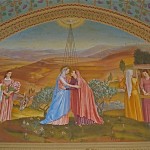
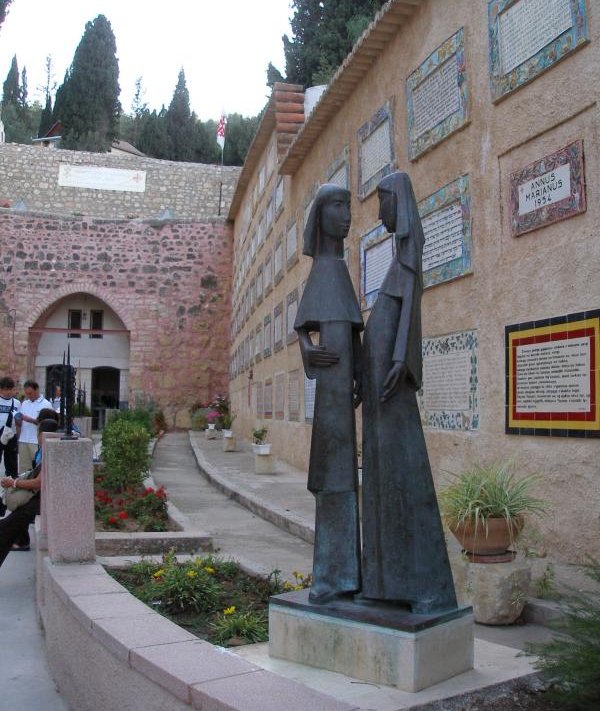
Mary meets Elizabeth, at the Church of the Visitation (Seetheholyland.net)

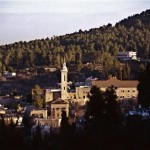
Christian tradition places the birth of John the Baptist — who announced the coming of Jesus Christ, his cousin — in the picturesque village of Ein Karem 7.5km south-west of Jerusalem.

Luke’s Gospel tells of the circumstances of John’s birth (1:5-24, 39-66).

The angel Gabriel appeared to the elderly priest Zechariah while he was serving in the Temple and told him that his wife Elizabeth was to bear a son. Zechariah was sceptical, so he was struck dumb and remained so until the baby John was born.

In the meantime, Gabriel appeared to the teenage Virgin Mary in Nazareth, telling her that she was to become the mother of Jesus. As proof, he revealed that Mary’s elderly cousin Elizabeth was already six months’ pregnant.

Mary then “went with haste to a Judean town in the hill country” — a distance of around 120km — “where she entered the house of Zechariah and greeted Elizabeth. When Elizabeth heard Mary’s greeting, the child leaped in her womb.” (Luke 1:39-41)


Two sites for two houses

The two main sites in the “Judean town” of Ein Karem are linked to the understanding that Zechariah and Elizabeth had two houses in Ein Karem (also known as Ain Karim, Ain Karem, ’Ayn Karim and En Kerem).

Their usual residence was in the valley. But a cooler summer house, high on a hillside, allowed them to escape the heat and humidity.

The summer house is believed to be where the pregnant Elizabeth “remained in seclusion for five months” (Luke 1:24) and where Mary visited her.

The house in the valley is where John the Baptist was born. Here, also, old Zechariah finally regained his power of speech after his son was born, when he obediently wrote on a writing tablet that the baby’s name was to be John.

Ein Karem is still a tranquil place of trees and vineyards, but the municipality of Jerusalem has spread to incorporate the former Arab village. It is now a town of Jewish artisans and craftspeople, but Christian churches and convents abound.


Church of the Nativity of St John the Baptist
Ein Karem

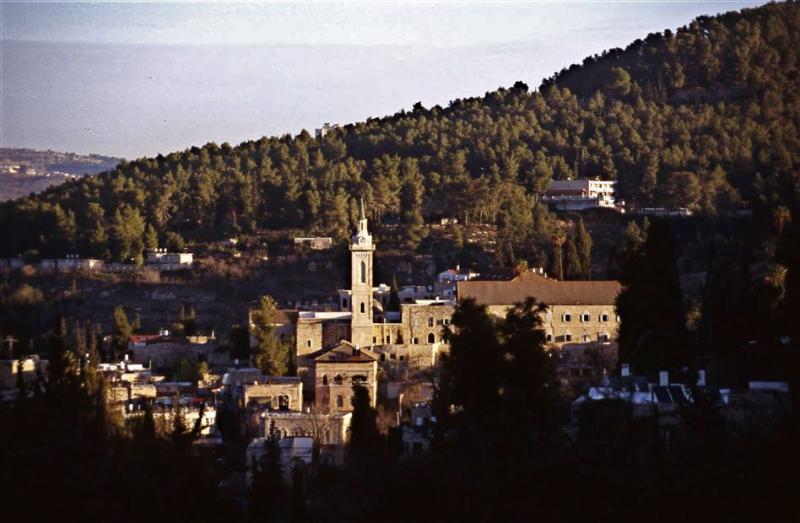
Church of St John the Baptist in the centre of Ein Karem (© Israel Ministry of Tourism)

There are two major churches of St John the Baptist in the town. Best-known is the Catholic Church of the Nativity of St John, identifiable by its tall tower topped by a round spire. It is also called “St John in the mountains”, a reference to the “hill country” of the Scripture.

The church combines remnants of many periods. An early church on this site was used by Muslim villagers for their livestock before the Franciscans recovered it in the 17th century. The Franciscans built the present church with the help of the Spanish monarchy.

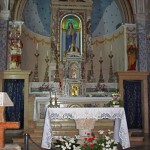
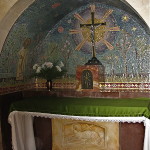
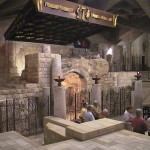
The high altar is dedicated to St John. To the right is Elizabeth’s altar. To the left are steps leading down to a natural grotto — identified as John’s birthplace and believed to be part of his parents’ home.

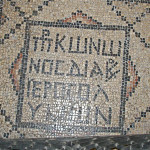
A chapel beneath the porch contains two tombs. An inscription in a mosaic panel reads, in Greek, “Hail martyrs of God”. Whom it refers to is unknown.

The other church, built in 1894, is Eastern Orthodox.


Church of the Visitation
Ein Karem

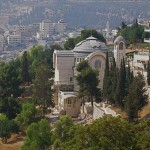
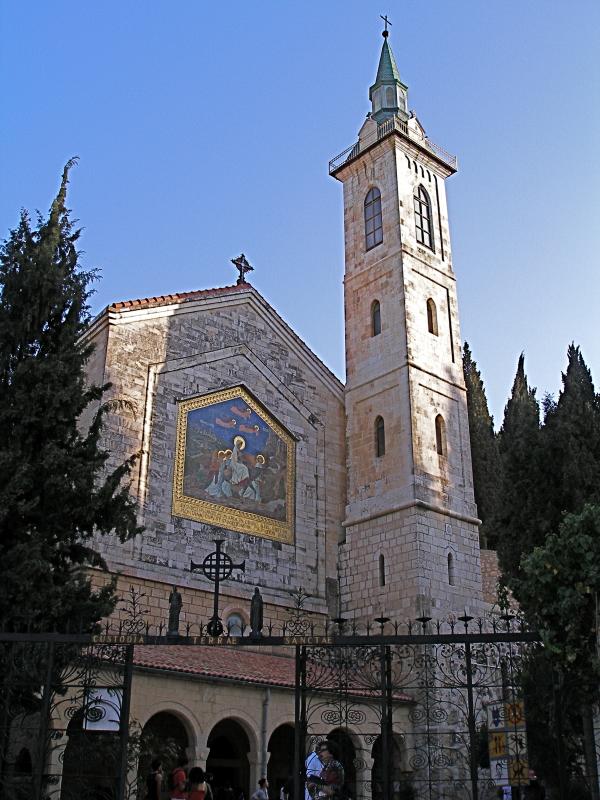
Church of the Visitation, Ein Karem (Seetheholyland.net)

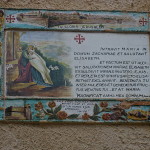
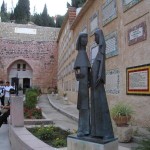
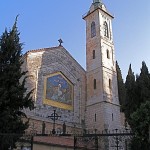
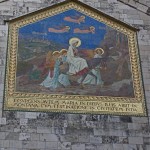
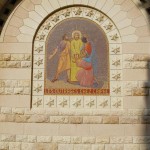
The Virgin Mary’s visit to Elizabeth — depicted in mosaic on the façade — is commemorated in a two-tiered church, on a slope of the hill south of Ein Karem.

Completed in 1955 to a design by Antonio Barluzzi, the artistically decorated Church of the Visitation is considered one of the most beautiful of all the Gospel sites in the Holy Land.

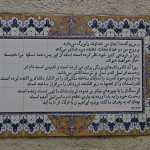
This is believed to be the site of Zechariah and Elizabeth’s summer house, where Mary came to visit her cousin. On the wall opposite the church, ceramic plaques reproduce Mary’s canticle of praise, the Magnificat (Luke 1:46-55) in some 50 languages.

In the lower chapel, a vaulted passage leads to an old well. An ancient tradition asserts that a spring joyfully burst out of the rock here when Mary greeted Elizabeth.

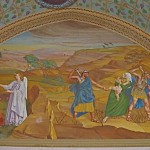
A huge stone set in a niche is known as the Stone of Hiding. According to an ancient tradition, the stone opened to provide a hiding place for the baby John during Herod’s Massacre of the Innocents — an event depicted in a painting on the wall.

 

Mary’s Spring and the Desert of St John

In a valley on the south of the village is a fresh-water spring known as Mary’s Spring or the Fountain of the Virgin. Tradition has it that Mary quenched her thirst from this spring before ascending the hill to meet Elizabeth.

The water has become contaminated and is no longer safe to drink.

The spring gives the village its name — from the Arabic “ein” (spring) and kerem (vineyard or olive grove). Built over the spring is a small abandoned mosque, another reminder that this was once an Arab village.

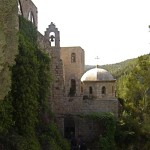
South-west of Ein Karem, off Route 386, a Greek Melkite monastery and a Franciscan convent mark the Desert of St John, a site where John the Baptist is believed to have lived in seclusion.


In Scripture:

The birth of John the Baptist: Luke 1:5-24, 39-66

Mary visits Elizabeth: Luke 1:39-45

The Magnificat: Luke 1:46-55


Administered by: Franciscan Custody of the Holy Land

Tel.: Visitation Church 972-2-6417291; St John’s Church 972-2-6323000

Open: St John’s Church, 8am-noon, 2.30-5.45pm (4.45pm Oct-Mar); Visitation Church, 8-11.45am, 2.30-6pm (5pm Oct-Mar)


References

Brownrigg, Ronald: Come, See the Place: A Pilgrim Guide to the Holy Land (Hodder and Stoughton, 1985)
Freeman-Grenville, G. S. P.: The Holy Land: A Pilgrim’s Guide to Israel, Jordan and the Sinai (Continuum Publishing, 1996)
Gonen, Rivka: Biblical Holy Places: An illustrated guide (Collier Macmillan, 1987)
Inman, Nick, and McDonald, Ferdie (eds): Jerusalem & the Holy Land (Eyewitness Travel Guide, Dorling Kindersley, 2007)
Kloetzli, Godfrey: “Ain Karim”, Holy Land, winter 2003
Murphy-O’Connor, Jerome: The Holy Land: An Oxford Archaeological Guide from Earliest Times to 1700 (Oxford University Press, 2005)
Wareham, Norman, and Gill, Jill: Every Pilgrim’s Guide to the Holy Land (Canterbury Press, 1996)


External links
Ain Karem – Saint John the Baptist (Custodia Terrae Sanctae)
Ain Karem – The Visitation (Custodia Terrae Sanctae)
Ain Karem – Saint John in the Desert (Custodia Terrae Sanctae)
Ein Karem (Wikipedia)
« Newer PostsOlder Posts »

Dome of the Ascension

Jerusalem

Dome of the Ascension

Dome of the Ascension (© Israel Ministry of Tourism)

The shrine marking the place where Jesus is believed to have ascended to heaven offers Christians a disappointing experience.

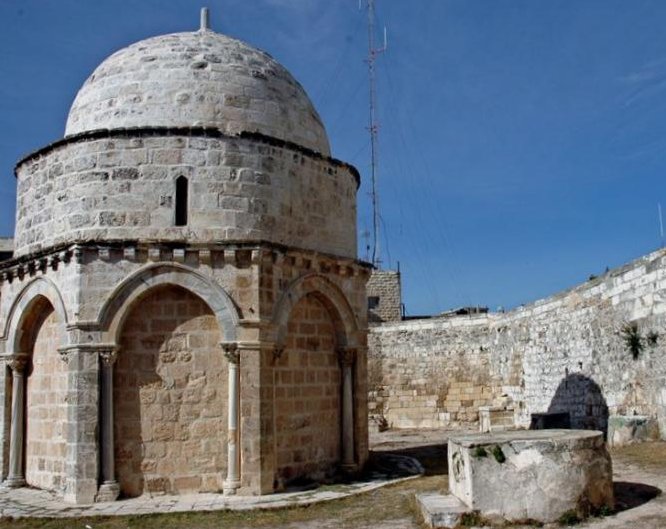
All that remains of the several churches built to celebrate the Ascension is a small octagonal structure on a property that is now part of a mosque.

Plain and unadorned, the Dome of the Ascension stands in a walled compound east of the main road that runs on the top of the Mount of Olives in Jerusalem. The location is just north of the Church of Pater Noster — which is built over a cave that the first Christians used as a more secluded place to commemorate the Ascension.

The last church on the site was captured by the Muslim sultan Saladin when he defeated the Crusaders in 1187. Since Muslims also believe in the Ascension of Jesus, it was converted into a mosque.

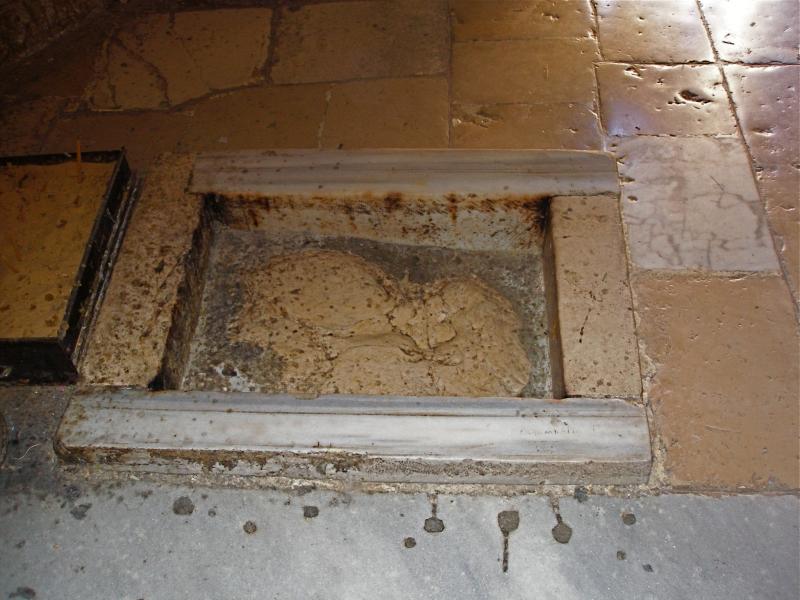
An unusual feature of the tiny building is that it contains what has been traditionally regarded as the last impression of Jesus’ right foot on earth before he ascended into heaven.


First church was open to the sky

Dome of the Ascension

Footprint stone in Dome of Ascension (Seetheholyland.net)

The first church on the hill was funded by Poemenia, a wealthy Roman woman who was a member of the imperial family, around AD 380.

Known as the Imbomon (Greek for “on the hill”), it was a rotunda, open to the sky, surrounded by circular porticos and arches. In the centre of the stone floor was a rock on which it was believed Jesus’ final footprints could be seen in the dust.

By 670 the original structure had been destroyed and rebuilt but the English pilgrim Arculf reported to his countrymen that the footprints were still to be seen in the dust of its floor.

In the 12th century the Crusaders rebuilt an octagonal chapel, set within a fortified monastery. From this strategic position on the crest of the Mount of Olives, the Crusaders controlled the road between Jericho and Jerusalem.

The footprints were still venerated, but now they were reported to be carved into the face of the rock.

Part of this rock remains today in the Dome of the Ascension, although the Muslims have moved it adjacent to a mihrab they inserted to indicate the direction of Mecca. They took the section bearing the left footprint to the Al-Aqsa Mosque on the Temple Mount, where it was placed behind the pulpit there.


Christian celebrations are allowed

Dome of the Ascension

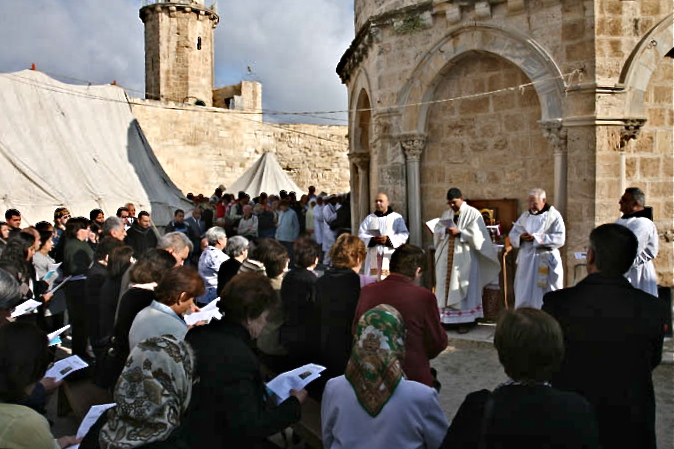
Celebrating the Ascension at the Dome of the Ascension (© Custodia Terrae Sanctae)

The Muslims also walled in the open spaces between the columns and put a dome over the opening in the roof.

The ornately carved capitals on top of the columns are well preserved. The designs depict foliage and fabulous animals.

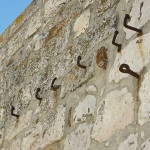
The various Christian communities are permitted to hold celebrations here on their Ascension feast days. Hooks in the courtyard wall are used to erect their awnings, ribbons and flags on these occasions.

To the right of the entrance to the Dome of the Ascension is a small mosque built in 1620.

An underground tomb near the entrance is revered by all three monotheistic religions, although they differ about its occupant. Jews believe it contains the Old Testament prophetess Huldah; Christians regard it as the grave of the 5th-century St Pelagia; Muslims maintain it is the tomb of the Sufi holy woman Rabi’a al-’Adawiyya (for whom the mosque is named).


Three more recent Ascension churches

Three more recent churches on the Mount of Olives commemorate the Ascension.

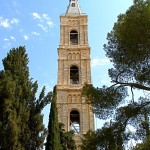
At the summit is the Russian Orthodox Church of the Ascension, dating from the late 19th century. Its tall tower, one of Jerusalem’s most prominent landmarks, was built to enable pilgrims to see the Jordan River.

On the north side is the German Lutheran Church of the Ascension (also known as Augusta Victoria, after the wife of the Emperor Wilhelm II of Germany who initiated plans for the church in 1898), dating from the early 20th century. Its fortress-like compound with a tall bell tower now hosts a hospital for the Palestinian population of Jerusalem.

Between the Russian and Lutheran churches is the Greek Orthodox Viri Galilaei Church. Its name means “men of Galilee”, a reference to the question posed to the apostles by two men in white after the Ascension: “Men of Galilee, why do you stand looking up to heaven…?”

Related site: Church of the Ascension


In Scripture:

The Ascension of Jesus: Luke 24:50-51; Acts 1:4-11

Administered by: Islamic Waqf Foundation

Open: Daily (if door is not open, ring the bell)


References

Bagatti, Bellarmino: “ ‘Footprints’ of the Saviour on the Mount of Olives”, Holy Land, winter 2005.
Bar-Am, Aviva: Beyond the Walls: Churches of Jerusalem (Ahva Press, 1998)
Inman, Nick, and McDonald, Ferdie (eds): Jerusalem & the Holy Land (Eyewitness Travel Guide, Dorling Kindersley, 2007)
Gonen, Rivka: Biblical Holy Places: An illustrated guide (Collier Macmillan, 1987)
Murphy-O’Connor, Jerome: The Holy Land: An Oxford Archaeological Guide from Earliest Times to 1700 (Oxford University Press, 2005)
Walker, Peter: In the Steps of Jesus (Zondervan, 2006)
Wareham, Norman, and Gill, Jill: Every Pilgrim’s Guide to the Holy Land (Canterbury Press, 1996)


External links
Chapel of the Ascension, Jerusalem (Sacred Destinations)
Chapel of Ascension (BibleWalks)
Chapel of the Ascension panorama (Jesus in Jerusalem)
« Newer PostsOlder Posts »

Dead Sea

Israel/Jordan/West Bank

Dead Sea

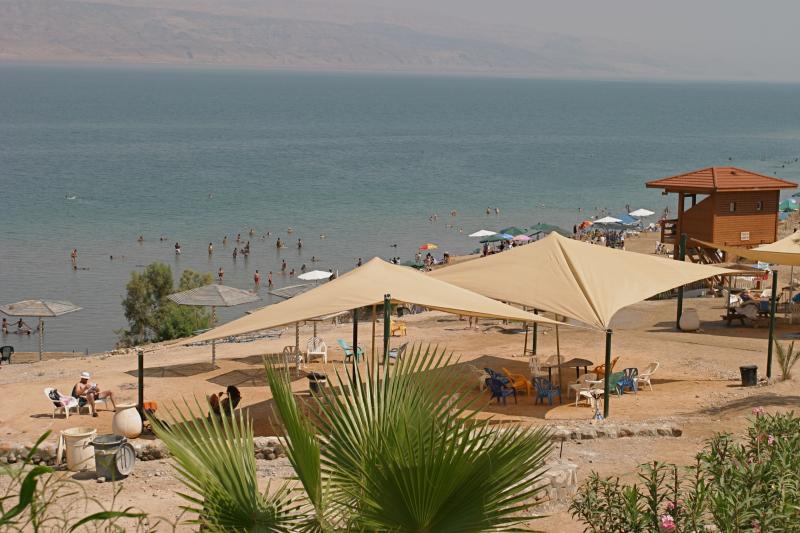
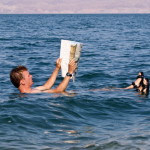
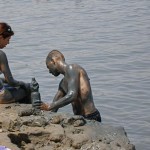
Bathers by the shore of the Dead Sea (© Tom Callinan / Seetheholyland.net)

The Dead Sea, which shimmers like a blue mirror under all-day sunshine, is one of the most unusual bodies of water in the world.

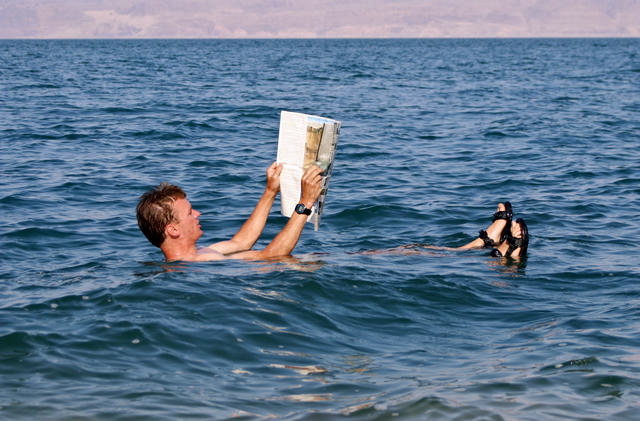
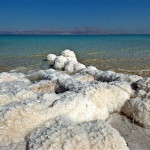
It is set in the lowest dry land on earth, so it has no outlet. It is so loaded with minerals that no fish can live in it. It is so dense that bathers can lie back on its surface and read a newspaper.

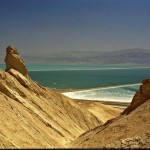
The Dead Sea is located about 25km east of Jerusalem, along the border between Israel and Jordan. About half of it is actually in Jordanian territory.

The ancient Hebrews called this body of water the Sea of Salt. Other ancient names include the Sea of Solitude, the Sea of Arabah and the Asphalt Sea. The Crusaders called it the Sea of Satan.

The Dead Sea’s therapeutic qualities attracted Herod the Great. Its minerals and sticky black mud provided balms for Egyptian mummies and cosmetics for Cleopatra.

Now its health resorts treat psoriasis and arthritis, its skin-care products are marketed worldwide, and its industrial evaporation pans harvest potash and other minerals.


Wicked cities were destroyed

Dead Sea

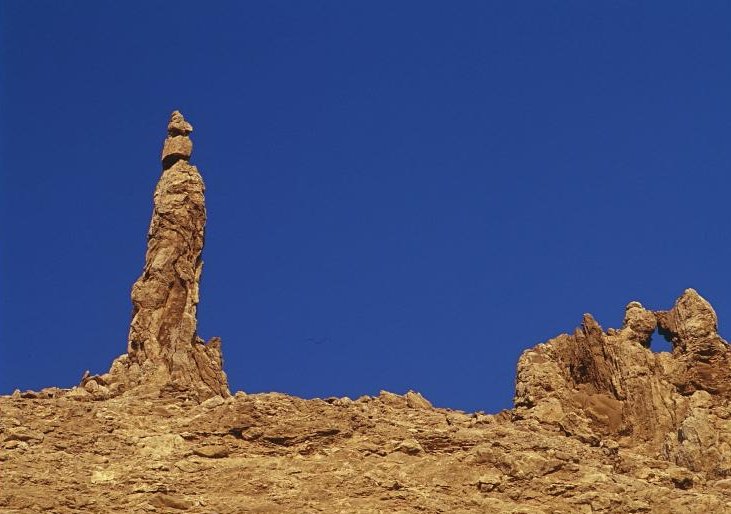
Pillar of salt, on Jordanian side of Dead Sea, known as Lot’s Wife (© Visitjordan.com)

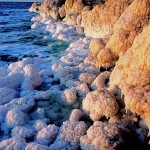
The region has many biblical connections. Here, though their locations are unknown, the wicked cities of Sodom and Gomorrah were destroyed by God with “sulphur and fire” and Lot’s wife was turned into a pillar of salt for looking back at the destruction (Genesis 19:24-26). Among the salt encrustations around the sea is an unusual column at the southern end called Lot’s Wife (though it is 20 metres high).

On the eastern side, the highest peak visible is Mount Nebo, where Moses glimpsed the Promised Land. Further south stands the fortress of Machaerus, where Herod Antipas imprisoned and then executed John the Baptist.

On the western side, from north to south, are Qumran, where the Dead Sea Scrolls were found; Ein Gedi, where David hid from King Saul in a cave (and cut off a corner of the king’s cloak when he entered the cave to relieve himself); and Herod the Great’s fortress of Masada.


Evaporation concentrates the minerals

Dead Sea

Afloat in the Dead Sea (David Niblack)

By 2013 the Dead Sea was 50km long, 15km across at its widest point, and 430 metres below sea level. Its area was constantly shrinking and the water level was dropping by more than a metre a year.

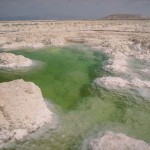
Because it has no exit, water is lost only through evaporation, which leaves behind the minerals. The Dead Sea is nearly 10 times as salty as the open seas. The high concentration of minerals (predominantly magnesium chloride) provides the buoyancy that keeps bathers suspended — as well as a bitter taste.

A low promontory of land called el-Lisan (“the tongue”) projects across the sea from the east, dividing the southern third from the northern section. The southern part is now devoted to evaporation pools for mineral extraction.

Most of the water that once flowed from the Jordan River into the Dead Sea is being diverted for drinking water and agricultural purposes, so there is not enough to offset the high evaporation rate.

Since the late 1980s the landscape around the sea has been reshaped by thousands of sinkholes — caused by fresh water from the mountains dissolving underground levels of salt. This phenomenon has caused some tourist beaches in Israel to close.

Rescue proposals to prevent the sea drying up have included canals to bring water from the Mediterranean Sea or the Red Sea.

If the Dead Sea becomes rejuvenated with fresh water, this could fulfil a prophecy in Ezekiel 47:8-10, that it will “become fresh . . . and there will be very many fish”.

In December 2013, representatives of Israel, Jordan and the Palestinian Authority agreed on a long-term desalination project in which brine would be piped about 180 kilometres from Aqaba, Jordan, to replenish the Dead Sea.


Related sites:

Qumran

Masada

In Scripture:

God destroys Sodom and Gomorrah: Genesis 19:24-26

Prophesy that the Dead Sea will become fresh: Ezekiel 47:8-10


References

Anonymous: “The Dead Sea”, Holy Land, summer 2005
Charlesworth, James H.: The Millennium Guide for Pilgrims to the Holy Land (BIBAL Press, 2000)
Dyer, Charles H., and Hatteberg, Gregory A.: The New Christian Traveler’s Guide to the Holy Land (Moody, 2006)
Freeman-Grenville, G. S. P.: The Holy Land: A Pilgrim’s Guide to Israel, Jordan and the Sinai (Continuum Publishing, 1996)
Frumkin, Amos: “How Lot’s Wife Became a Pillar of Salt”, Biblical Archaeology Review, May/June 2009
Kershner, Isabel: “A Rare Middle East Agreement, on Water”, New York Times, December 9, 2013
Lidman, Melanie: “As the Dead Sea dries, its collapsing shores force a return to nature”, Times of Israel, February 13, 2017
Martin, James: A Pilgrim’s Guide to the Holy Land (Westminster Press, 1978)
Murphy-O’Connor, Jerome: The Holy Land: An Oxford Archaeological Guide from Earliest Times to 1700 (Oxford University Press, 2005)
Walker, Peter: In the Steps of Jesus (Zondervan, 2006)


External links

Dead Sea (Wikipedia)
« Newer PostsOlder Posts »

Church of the Nativity

West Bank

Church of the Nativity

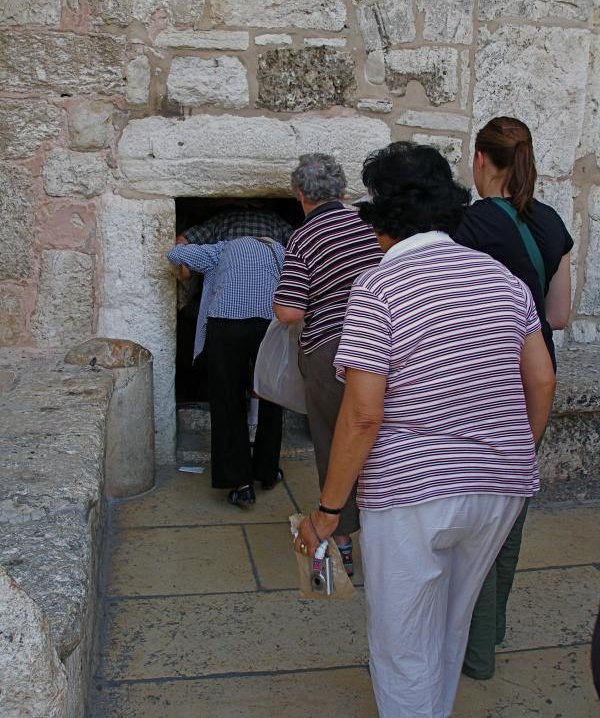
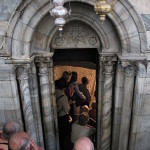
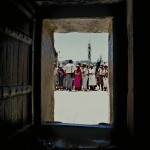
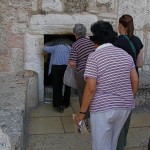
Entering Church of the Nativity (Seetheholyland.net)

Entering the church that marks the site of Christ’s birthplace means having to stoop low. The only doorway in the fortress-like front wall is just 1.2 metres high.

The previous entrance to the Church of the Nativity in Bethlehem was lowered around the year 1500 to stop looters from driving their carts in. To Christians, it seems appropriate to bow low before entering the place where God humbled himself to become man.

Today’s basilica, the oldest complete church in the Christian world, was built by the emperor Justinian in the 6th century. It replaced the original church of Constantine the Great, built over the cave venerated as Christ’s birthplace, and dedicated in AD 339.

Before Constantine, the first Christian emperor, the Romans had tried to wipe out the memory of the cave. They planted a grove dedicated to the pagan god Adonis, lover of Venus, and established his cult in the cave.

As St Jerome wrote in AD 395, “The earth’s most sacred spot was overshadowed by the grave of Adonis, and the cave where the infant Christ once wept was where the paramour of Venus was bewailed.”


Invading Persians spared the church

Church of the Nativity

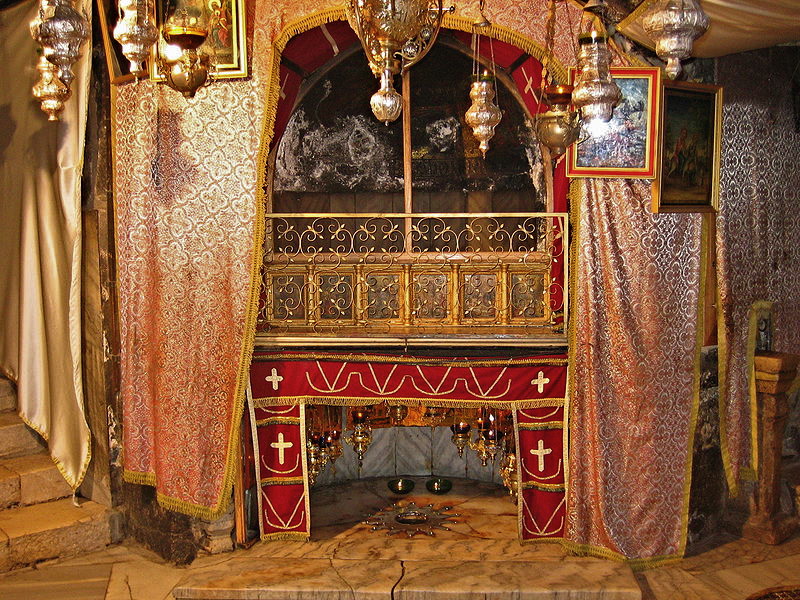
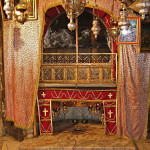
Grotto of the Nativity (Darko Tepert)

The Gospels do not say that Jesus was born in a cave, but there are written references to the Nativity cave as far back as AD 160. Even today in the Judean hills, families live in primitive houses built in front of natural caves used for storage or to shelter animals.

When the original Church of the Nativity was built, the cave was enlarged to make room for pilgrims and a silver manger was installed.

St Jerome did not approve: “If I could only see that manger in which the Lord lay! Now, as if to honour the Christ, we have removed the poor one and placed there a silver one; however, for me the one which was removed is more precious . . . .”

Persians invaded Palestine in 614 and destroyed many churches. They spared the Church of the Nativity when they saw a mosaic on an interior wall depicting the Three Wise Men in Persian dress.

In 1482 King Edward IV sent English oak and tons of lead to renew the roof. In the 17th century the Turks looted the lead to melt into bullets. The roof rotted and most of the rich mosaics on the walls of the nave were ruined.

When Unesco put the basilica on its list of world heritage sites in 2012, it was also deemed to be endangered because of damage due to water leaks. A $US15 million restoration of the church’s roof, walls and mosaics began in 2013.


Christmas is observed on January 7

Church of the Nativity

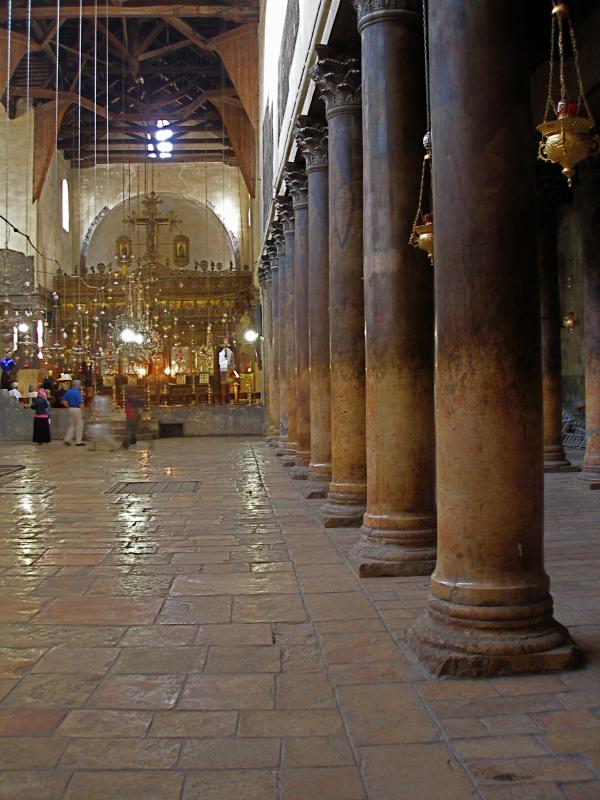
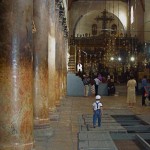
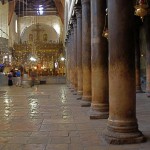
Columns of red limestone in Church of the Nativity (Seetheholyland.net)

Today’s Church of the Nativity is cool and dark, its interior bare with no pews. Wall mosaics from the 12th century — depicting saints, angels and Church councils — have had their original sheen restored.

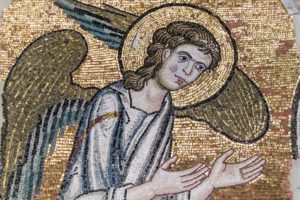
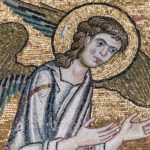
The restorers even uncovered a 2-metre mosaic of an angel that had been lost for centuries.

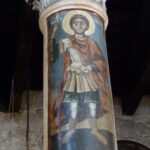
Trapdoors in the floor allow glimpses of the mosaic floor of Constantine’s basilica. The red limestone pillars were quarried locally. Many are adorned with Crusader paintings of saints.

Steps to the right of the iconostasis (the carved screen, adorned with icons, that stands in front of the main altar) lead down to the Grotto of the Nativity.

As the ornamentation, icons and lamps in the front of the church suggest, the basilica is now almost wholly a Greek Orthodox place of worship. The Armenian Orthodox own the northern transept. The Catholics have the site of the manger and the adjoining altar next to the Nativity grotto.

So while Christians in the Western world celebrate Christ’s birthday on December 25 of the Gregorian calendar, the church at his birthplace still has 13 days to wait for the Orthodox, using the old Julian calendar, to celebrate it on January 7. Then the Armenians celebrate Jesus’ birth and baptism together on January 19.

Rediscovered mosaic of an angel (© Piacenti Restoration Center)

Rediscovered mosaic of an angel in Church of the Nativity (© Piacenti Restoration Center)

So where does the televised Christmas Eve service on December 24 come from? The adjoining Church of St Catherine of Alexandria, which is Catholic.

Other sites in the Bethlehem area:

Bethlehem

Grotto of the Nativity

St Jerome’s Cave

Church of St Catherine of Alexandria

Milk Grotto

Shepherds’ Field

Tomb of Rachel

Field of Boaz

Herodium

In Scripture:

The birth of Jesus: Luke 2:1-20; Matthew 1:18-25

The visit of the Wise Men: Matthew 2:1-12

Administered by: Greek Orthodox Church, Franciscan Custody of the Holy Land, Armenian Apostolic Church

Tel.: 972-2-2742440

Open: April-September, Mon-Sat 6.30am-7.30pm. October-March, Mon-Sat: 5.30am-5pm (5.30pm in January, 6pm February-March). Grotto opens at 11.30am on Sundays.


References

Baldwin, David: The Holy Land: A Pilgrim’s Companion (Catholic Truth Society, 2007)
Bastier, Claire, and Halloun, Nizar: “Restoration: Revealing the glories of the Basilica of the Nativity in Bethlehem”, Holy Land Review, winter 2016
Blaiklock, E. M.: Eight Days in Israel (Ark Publishing, 1980)
Brownrigg, Ronald: Come, See the Place: A Pilgrim Guide to the Holy Land (Hodder and Stoughton, 1985)
Chabin, Michele: “Church of the Nativity’s Face-Lift Reveals Ancient Treasures”, National Catholic Register, June 15, 2016
Freeman-Grenville, G. S. P.: The Holy Land: A Pilgrim’s Guide to Israel, Jordan and the Sinai (Continuum Publishing, 1996)
Gonen, Rivka: Biblical Holy Places: An illustrated guide (Collier Macmillan, 1987)
Inman, Nick, and McDonald, Ferdie (eds): Jerusalem & the Holy Land (Eyewitness Travel Guide, Dorling Kindersley, 2007)
Joseph, Frederick: “Bethlehem”, Holy Land, winter 2002
Martin, James: A Pilgrim’s Guide to the Holy Land (Westminster Press, 1978)
Murphy-O’Connor, Jerome: The Holy Land: An Oxford Archaeological Guide from Earliest Times to 1700 (Oxford University Press, 2005)
Wareham, Norman, and Gill, Jill: Every Pilgrim’s Guide to the Holy Land (Canterbury Press, 1996)

External links
Bethlehem (Obethlehem.com)
Church of the Nativity (Wikipedia)
Bethlehem (Custodia Terrae Sanctae)
« Newer PostsOlder Posts »

Church of the Dormition

Jerusalem

Church of the Dormition

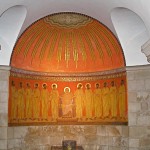
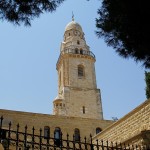
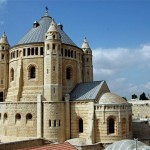
Dome of Church of the Dormition (Seetheholyland.net)

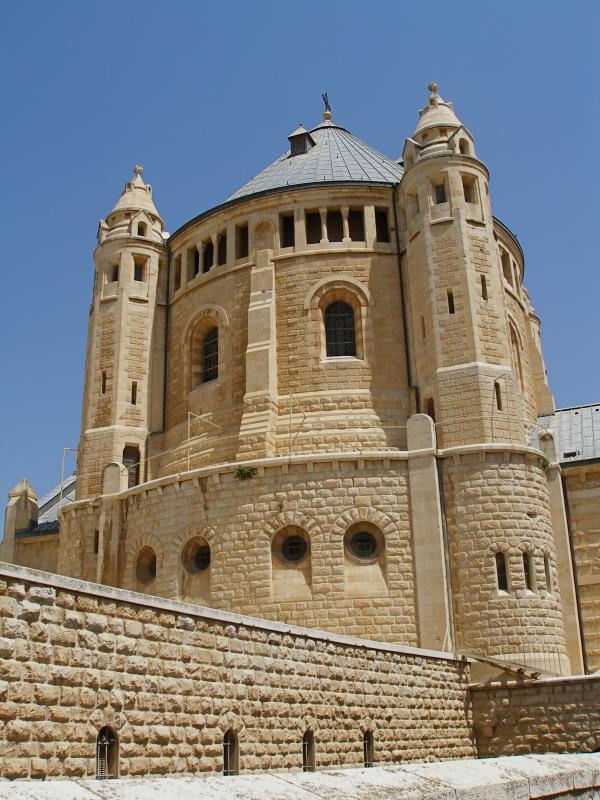
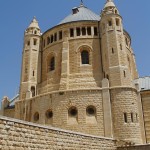
The hill of Mount Zion, the highest point in ancient Jerusalem, is dominated by the Church of the Dormition. The location is identified in Christian tradition as the place where the Virgin Mary died — or “fell asleep”, as the name suggests.

The fortress-like building, with a conical roof and four corner towers, stands south of the Old City’s Zion Gate. Nearby soars the bell tower of the Hagia Maria Sion Abbey (formerly the Abbey of the Dormition), a Benedictine monastery.

During the Byzantine period, the Church of Hagia Sion (Holy Zion), one of the three earliest churches in Jerusalem, stood on this site. Built by the Emperor Constantine, it was regarded as the Mother of all Churches. In AD 614 it was destroyed by the Persians.


Claims made for two cities

Two cities, Jerusalem and Ephesus (in present-day Turkey), claim to be the place where the Virgin Mary died. The Ephesus claim rests in part on the Gospel account that Christ on his cross entrusted the care of Mary to St John (who later went to Ephesus).

Church of the Dormition

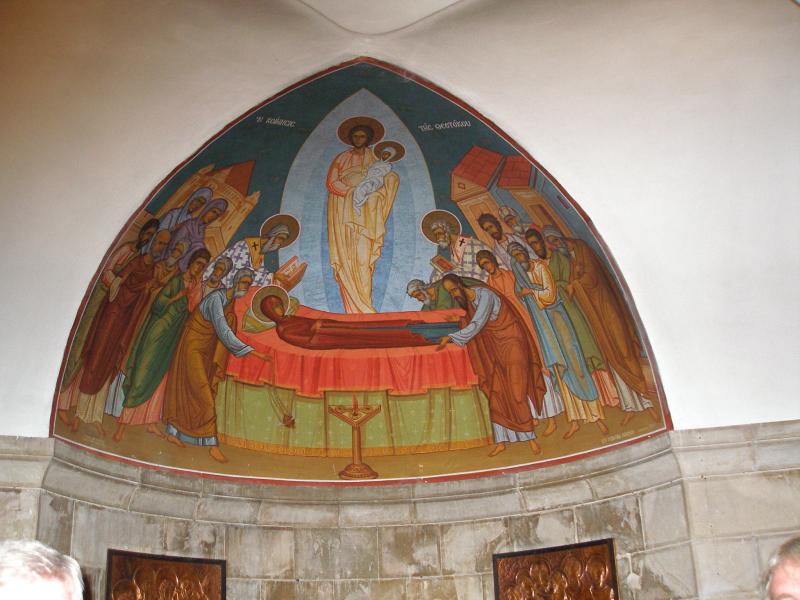
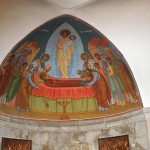
Apostles at the death of Mary, in the Church of the Dormition (Seetheholyland.net)

But the earliest traditions all locate the end of Mary’s life in Jerusalem, where the Tomb of Mary is venerated at the foot of the Mount of Olives.

Accounts of Mary’s death in Jerusalem appear in early sources such as De Orbitu S. Dominae, Transitus Mariae and Liber Requiei Mariae. These books are described as apocryphal (meaning “hidden” or “secret”). Their authenticity is uncertain and they are not accepted as part of the Christian canon of Scripture.

But, according to biblical scholar Lino Cignelli, “All of them are traceable back to a single primitive document, a Judaeo-Christian prototype, clearly written within the mother church of Jerusalem some time during the second century, and, in all probability, composed for liturgical use right at the Tomb of Our Lady.

“From the earliest times, tradition has assigned the authorship of the prototype to one Lucius Carinus, said to have been a disciple and fellow labourer with St John the Evangelist.”

By the reckoning of Transitus Mariae, Mary would have been aged no more than 50 at the time of her death.


Early writers favour Jerusalem

The early sources are summarised in this way by the Catholic Encyclopedia:

“The apocryphal works of the second to the fourth century are all favourable to the Jerusalem tradition. According to the Acts of St John by Prochurus, written (160-70) by Lencius, the Evangelist went to Ephesus accompanied by Prochurus alone and at a very advanced age, i.e. after Mary’s death.

“The two letters B. Inatii missa S. Joanni, written about 370, show that the Blessed Virgin passed the remainder of her days at Jerusalem. That of Dionysius the Areopagite to the Bishop Titus (363), the Joannis liber de Dormitione Mariae (third to fourth century), and the treatise De transitu B.M. Virginis (fourth century) place her tomb at Gethsemane . . . .

“There was never any tradition connecting Mary’s death and burial with the city of Ephesus.”


Belief in the Assumption

The belief that the Virgin Mary was bodily assumed into heaven is mentioned in the above books and also in authenticated sermons by Eastern saints such as St Andrew of Crete and St John of Damascus.

The Assumption of Mary has been a subject of Christian art for centuries (and its feast day was made a public holiday in England by King Alfred the Great in the 9th century). It was defined as a doctrine of the Catholic Church by Pope Pius XII in 1950.

St John of Damascus describes the origin of this belief in these words:

“St Juvenal, Bishop of Jerusalem, at the Council of Chalcedon [AD 451], made known to the Emperor Marcian and Pulcheria, who wished to possess the body of the Mother of God, that Mary died in the presence of all the apostles, but that her tomb, when opened, upon the request of St Thomas [who arrived late], was found empty; wherefrom the apostles concluded that the body was taken up to heaven.”

The Eastern Orthodox churches celebrate the feast of the Dormition of the Mother of God on August 15, the same day that the Catholic Church and some Protestant churches celebrate the feast of the Assumption of Mary.


Land was given by sultan

Church of the Dormition

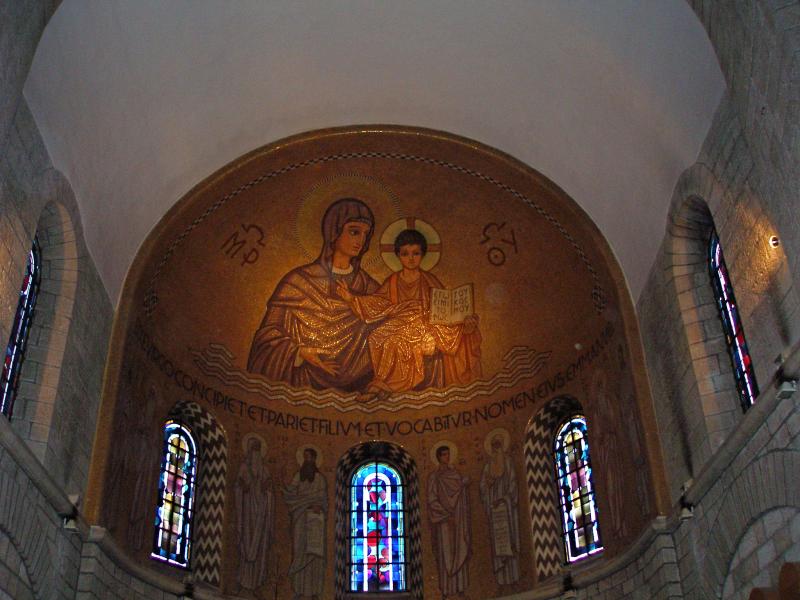
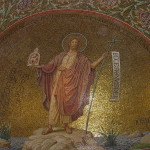
Mary and Jesus mosaic in the Church of the Dormition (Seetheholyland.net)

The land on which the Church of the Dormition stands was given in 1898 by the Turkish Sultan Abdul Hamid II to Kaiser Wilhelm II of Germany, who presented it to the Catholic Church. Construction was completed in 1910.

Like the Crusader church that preceded it, the basilica is built on two levels with the high altar and monastic choir on the upper of these, and the crypt with its Marian shrine on the lower.

Light from several large windows pours into the upper level, and colourful wall mosaics depict events from Christian and Benedictine history.

High above the main altar is a mosaic of Mary and the infant Jesus. The Latin inscription below it is from Isaiah 7:14: “Behold, a virgin shall conceive, and bear a son, and shall call his name Immanuel.”

Life-size statue of Mary in death

Church of the Dormition

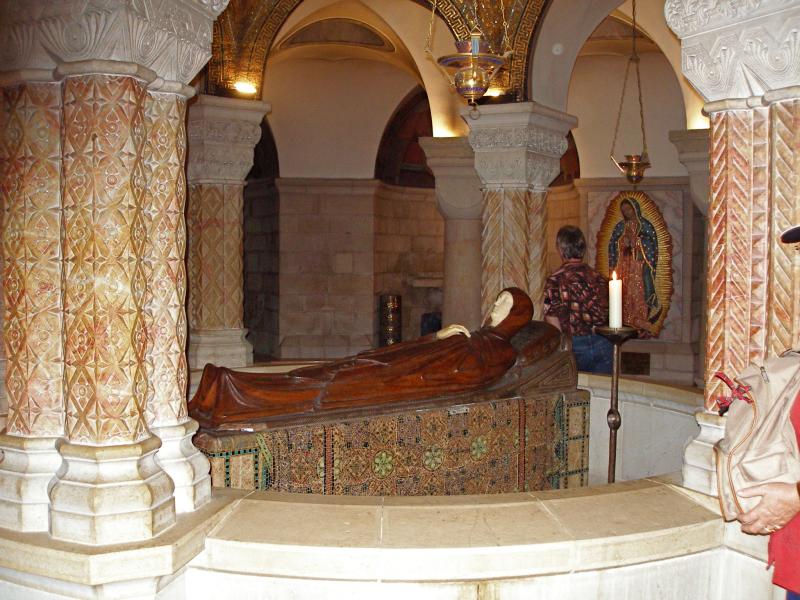
Lifesize image of Mary in death, in the Church of the Dormition (Seetheholyland.net)

If the upper floor of the Church of the Dormition is luminous, the circular crypt seems totally shrouded when first entered.

In the centre, under a rotunda, is a simple bier on which rests a life-size statue of Mary, fallen asleep in death. The statue is made of cherry wood and ivory.

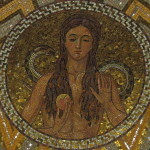
The dome above the statue is adorned with mosaic pictures of six women of the Old Testament: Eve, Miriam, Jael, Judith, Ruth and Esther.

In the 1948 Arab-Israeli War, the church was seriously damaged by military bombardment. During the 1967 Six Day War, Israeli forces took possession of the building and the Mother and Child mosaic in the apse received a barrage of machine-gun bullets from the interior of the church.

The Dormition Church has a fine organ, which is often used for concerts.

Related site:

Tomb of Mary


Administered by: Benedictine Order

Tel.: 972-2-5655330

Open: Mon-Fri 8.30-11.45am, 12.40-5.30pm; Sat 8.30-11.45am, 12.40-2.45pm, 3.30-5.30pm; Sun 10.30-11.45am, 12.30-5.30pm


References


Bar-Am, Aviva: Beyond the Walls: Churches of Jerusalem (Ahva Press, 1998)
Maas, Anthony: “The Blessed Virgin Mary”, The Catholic Encyclopedia (Robert Appleton Company, 1912).
Gonen, Rivka: Biblical Holy Places: An illustrated guide (Collier Macmillan, 1987)
Petrozzi, Maria Tereza: “The Place of Mary’s Dormition”, Holy Land, spring 2005
Wareham, Norman, and Gill, Jill: Every Pilgrim’s Guide to the Holy Land (Canterbury Press, 1996)


External links
Hagia Maria Sion Abbey (Dormition Abbey)
Tomb of the Blessed Virgin Mary (Catholic Encyclopedia)
« Newer PostsOlder Posts »

Church of the Annunciation

Israel

Church of the Annunciation

Church of the Annunciation (© Tom Callinan / Seetheholyland.net)

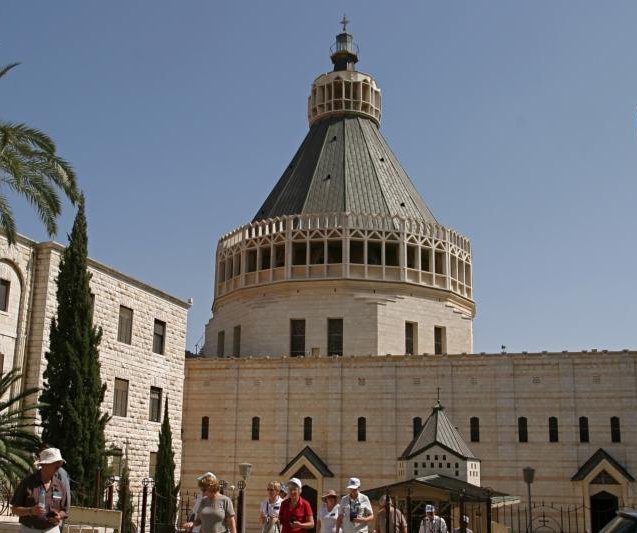
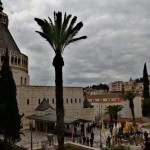
The towering cupola of the Church of the Annunciation in Nazareth stands over the cave that tradition holds to be the home of the Virgin Mary.

Here, it is believed, the archangel Gabriel told the young Mary, aged about 14, that she would become the mother of the Son of God. And here Mary uttered her consent: “Let it be done to me according to your word.”

The outcome of Mary’s consent is carved in Latin across the façade over the triple-doorway entrance: “The Word was made flesh, and dwelt among us” (John 1:14).

The massive two-storey basilica, in strikingly modern architectural style and colourfully decorated, became the largest Christian church in the Middle East when it was completed in 1969 (since overtaken in 2019 by the Coptic Orthodox Cathedral of the Nativity of Christ in Egypt’s new capital).

It contains two churches, the upper one being the parish church for Nazareth’s Catholic community.

The cupola, which dominates modern-day Nazareth, is surmounted by a lantern symbolising the Light of the World.

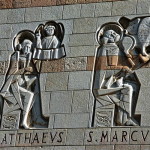
Entry is from the west, where signs indicate a route for visitors. On the cream limestone façade are reliefs of Mary, Gabriel and the four evangelists, Matthew, Mark, Luke and John. Above them is a bronze statue of Jesus.

Over a door on the southern side stands a statue of Mary aged 14, welcoming all who come to visit her home.


Grotto contains cave-home

Church of the Annunciation

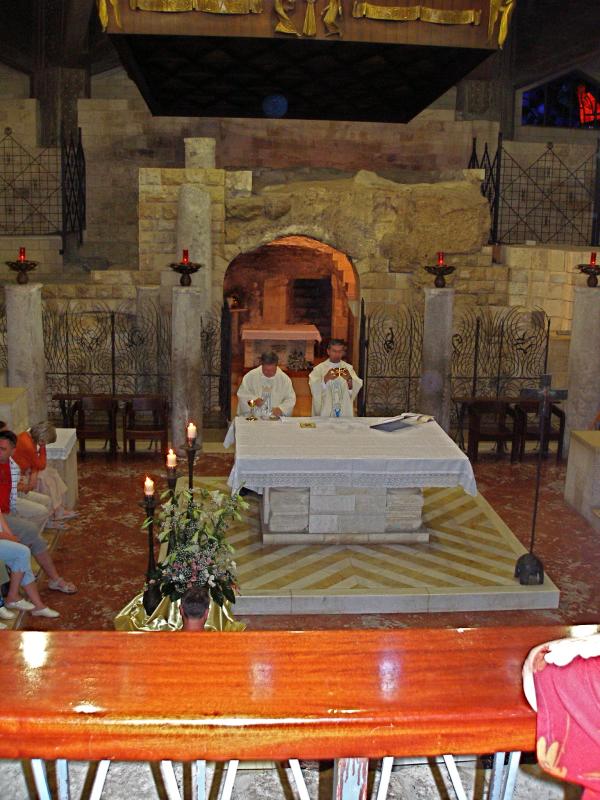
Eucharist in front of grotto in Church of the Annunciation (Seetheholyland.net)

The lower level of the Church of the Annunciation enshrines a sunken grotto that contains the traditional cave-home of the Virgin Mary.

The cave is flanked by remnants of earlier churches on the site. Its entrance is sometimes closed by a protective grille. Inside the cave stands an altar with the Latin inscription “Here the Word was made flesh”.

To the left of the cave entrance is a mosaic floor inscribed with the words “Gift of Conon, deacon of Jerusalem”.

The deacon may have been responsible for converting the house of Mary into the first church on the site, around 427.

In front of the cave is another simple altar, with tiers of seats around it on three sides. Above it, a large octagonal opening is situated exactly under the cupola of the church.


Cupola represents a lily

The plan of two churches, one above the other and interconnected, was conceived by the Italian architect Giovanni Muzio.

As well as preserving the remains of previous churches on the lower level, he allowed for the risk of earthquake by constructing the building in three separate sections of reinforced concrete.

Church of the Annunciation

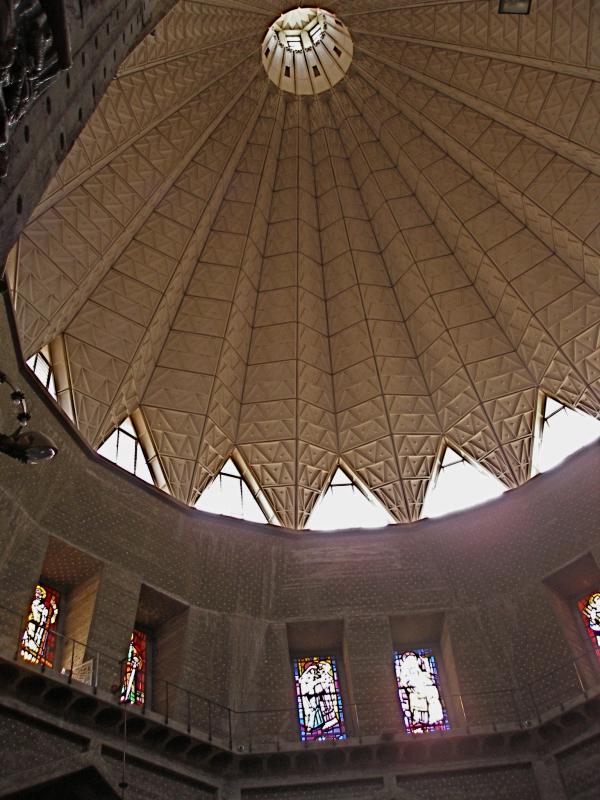
Dome of Church of the Annunciation (Seetheholyland.net)

The soaring cupola represents an inverted lily opening its petals to the shrine below. The symbolism combines the lily, as an image of Mary’s purity, with one of the Semitic meanings of the name Nazareth, a flower.

A spiral stairway at the main entrance leads to the large and spacious upper church. This is the parish church for the Catholic community of Nazareth (which is why the inscriptions on the ceramic Stations of the Cross are in Arabic).

The main entrance of the upper church is on the northern side, leading off a large elevated square overlooking the valley of Nazareth.

Around the walls of the upper church are colourful representations of the Virgin Mary in a variety of materials, presented by many countries.

Behind the main altar is a huge mosaic, one of the biggest in the world, depicting the “one, holy, catholic and apostolic church”.


Excavations revealed early shrine

The first church on the site venerated as Mary’s home was built around 427. The Crusaders built a huge basilica on its ruins, but this too was destroyed when the Crusader kingdom fell in 1187.

In 1620 the Franciscans managed to purchase the site from the local Arab ruler, but it was a further 120 years before they were allowed to build a new church.

When that church was demolished to prepare for the modern basilica, extensive excavations took place. These revealed the remains of the ancient village of Nazareth with its silos, cisterns and other cave-dwellings.

The most sensational discovery was of a shrine or synagogue-church dating back to before the first church was built. Scratched on the base of a column appeared the Greek characters XE MAPIA, translated as “Hail Mary” — the archangel Gabriel’s greeting to Mary.


First-century house

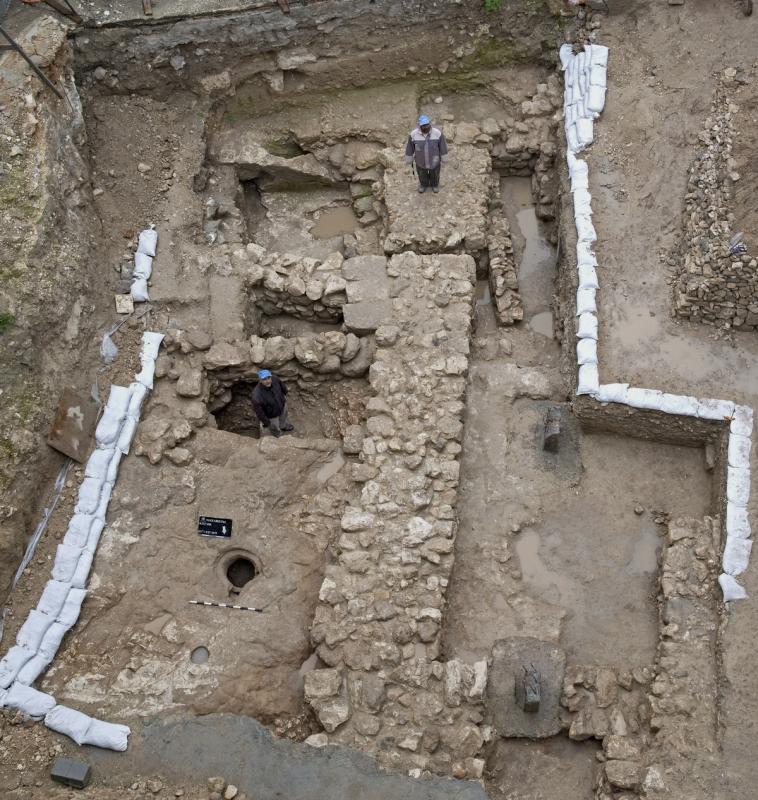
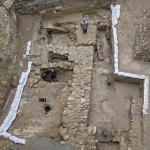
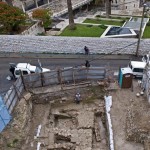
In December 2009 the Israel Antiquities Authority announced the discovery of a house from the time of Christ, on a property next to the Church of the Annunciation.

Nazareth

First-century Nazareth house discovered in 2009 (© Assaf Peretz / Israel Antiquities Authority)

The authority described it as “the very first” residential building found from the old Jewish village.

Small and modest, the house consisted of two rooms and a courtyard with a cistern to collect rainwater.

The remains of the house were found during an excavation prior to construction of the Mary of Nazareth International Center. They are conserved and displayed inside that building.

Other sites in Nazareth:

Nazareth

Church of St Joseph

Nazareth Village

In Scripture:

The Annunciation: Luke 1:26-38


Administered by: Franciscan Custody of the Holy Land

Tel.: 972-4-6572501

Open: 8am-6pm


References

Brownrigg, Ronald: Come, See the Place: A Pilgrim Guide to the Holy Land (Hodder and Stoughton, 1985)
Doyle, Stephen: The Pilgrim’s New Guide to the Holy Land (Liturgical Press, 1990)
Freeman-Grenville, G. S. P.: The Holy Land: A Pilgrim’s Guide to Israel, Jordan and the Sinai (Continuum Publishing, 1996)
Gonen, Rivka: Biblical Holy Places: An illustrated guide (Collier Macmillan, 1987)
Israel Antiquities Authority: “A Residential Building from the Time of Jesus was Exposed in the Heart of Nazareth”, media release, December 23, 2009
Joseph, Frederick: “Basilica of the Annunciation in Nazareth”, Holy Land, spring 2005
Kilgallen, John J.: A New Testament Guide to the Holy Land (Loyola Press, 1998)
Murphy-O’Connor, Jerome: The Holy Land: An Oxford
Archaeological Guide from Earliest Times to 1700 (Oxford University Press, 2005)
Walker, Peter: In the Steps of Jesus (Zondervan, 2006)
Wareham, Norman, and Gill, Jill: Every Pilgrim’s Guide to the Holy Land (Canterbury Press, 1996)


External links
Nazareth (Custodia Terrae Sanctae)
Basilica of Annunciation (BibleWalks)
Nazareth (Christus Rex)
Nazareth (Nazareth Cultural & Tourism Association)
Nazareth (Wikipedia)
Nazareth (Catholic Encyclopedia)
« Newer PostsOlder Posts »

Church of St Peter in Gallicantu

Jerusalem


Church of St Peter in Gallicantu

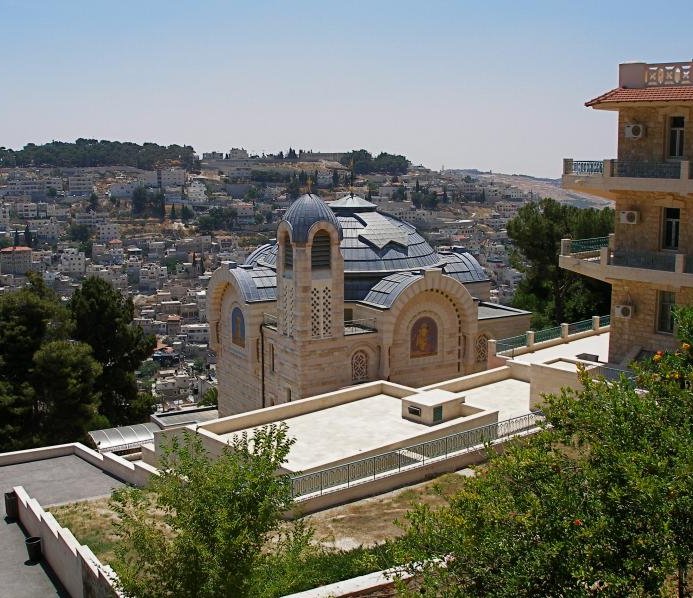
Church of St Peter in Gallicantu (Seetheholyland.net)

One of the most striking churches in Jerusalem commemorates the apostle Peter’s triple denial of his Master, his immediate repentance and his reconciliation with Christ after the Resurrection.

Built on an almost sheer hillside, the Church of St Peter in Gallicantu stands on the eastern slope of Mount Zion.

On its roof rises a golden rooster atop a black cross — recalling Christ’s prophesy that Peter would deny him three times “before the cock crows”. Galli-cantu means cockcrow in Latin.

Peter’s denial of Christ is recorded in all four Gospels (most succinctly in Matthew 26:69-75). Three of the Gospels also record his bitter tears of remorse.

The scene of Peter’s disgrace was the courtyard of the high priest Caiaphas. The Assumptionist congregation, which built St Peter in Gallicantu over the ruins of a Byzantine basilica, believes it stands on the site of the high priest’s house.

Under the church is a dungeon thought to be the cell where Jesus was detained for the night following his arrest.


Blend of contemporary and ancient art

Church of St Peter in Gallicantu

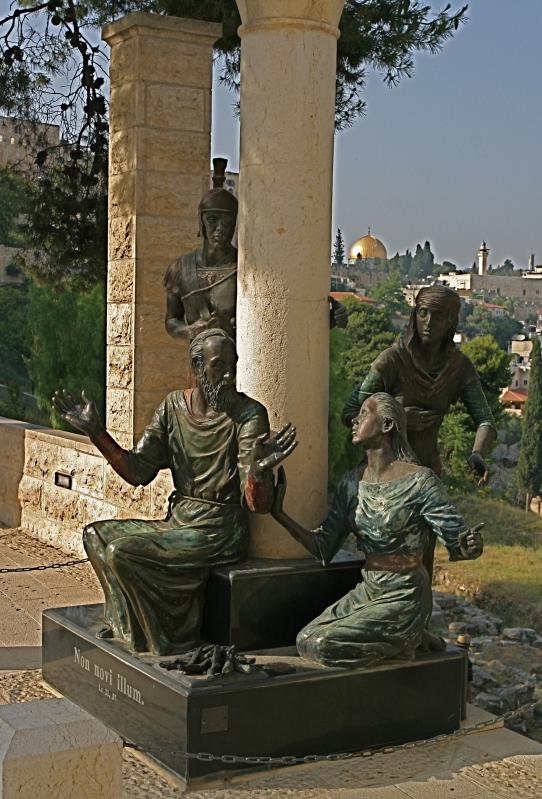
St Peter denies Christ, outside the Church of St Peter in Gallicantu (Seetheholyland.net)

The Church of St Peter in Gallicantu is built on four different levels — upper church, middle church, guardroom and dungeon. Its design and art are a colourful blend of contemporary and ancient works.

In the courtyard a statue depicts the denial, including the rooster, the woman who questioned Peter, and a Roman soldier.

Inside, on the right, are two Byzantine-era mosaics. Uncovered during excavation, they were most likely part of the floor of the fifth-century Byzantine church.

The ceiling is a striking feature. It is dominated by a huge cross-shaped window designed in a radiant variety of colours.

Three large mosaics cover the back wall and two side walls. Facing the entrance is a bound Jesus being questioned in the house of Caiaphas; on the right, Jesus and the disciples are shown at the Last Supper; on the left, Peter is depicted in ancient papal dress as the first pope.

Downstairs, in the middle church, icons above the altars depict St Peter’s denial, his repentance and his reconciliation with his Master on the shore of the Sea of Galilee after the Resurrection.

Many of the inscriptions in the church are in French, since the Assumptionists are a French religious order.


Guardroom and prisoner’s cell

Church of St Peter in Gallicantu

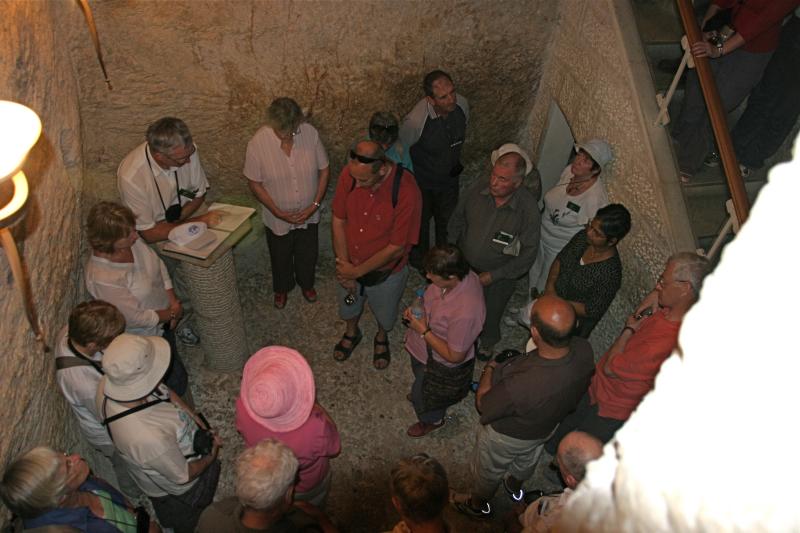
Pilgrims praying in the Sacred Pit under the Church of St Peter in Gallicantu (Seetheholyland.net)

The lower levels of the Church of St Peter in Gallicantu contain what are believed to have been a guardroom and a prisoner’s cell, both hewn out of bedrock.

• The guardroom contains wall fixtures to attach prisoners’ chains. Holes in the stone pillars would have been used to fasten a prisoner’s hands and feet when he was flogged. Bowls carved in the floor are believed to have contained salt and vinegar, either to aggravate the pain or to disinfect the wounds.

Jesus, of course, was not flogged by the Jews but by the Romans. But some of his disciples, probably including Peter, were flogged by order of the Jewish council after the Resurrection for teaching in the name of Jesus in the Temple (Acts 5:40).

• The prisoner’s cell offers a sobering insight into where Christ might have spent the night before he was crucified. It has become known as “Christ’s Prison”.

The only access to the bottle-necked cell was through a shaft from above, so the prisoner would have been lowered and raised by means of a rope harness. A mosaic depicting Jesus in such a harness is outside on the south wall of the church.

A small window from the guardroom served as a peephole for a guard standing on a stone block.


Disagreement over house of Caiaphas

Though pilgrims’ reports back as far as AD 333 attest to this place being the site of the house of Caiaphas, archaeologists are divided.

Some favour an alternative site for the high priest’s house at the Armenian Orthodox Church of the House of Caiaphas on the summit of Mount Zion, adjacent to the Dormition Abbey.

Jerome Murphy-O’Connor considers it “much more likely that the house of the high priest was at the top of the hill”.

Bargil Pixner, a former prior of the Dormition Abbey, disagrees, saying “this late and astonishing theory originated at the time of the Crusaders and is quite improbable”.

Excavations at St Peter in Gallicantu have revealed a water cistern, corn mill, storage chambers and servants’ quarters.

Artefacts discovered include a complete set of weights and measures for liquids and solids as used by the priests in the Temple, and a door lintel with the word “Korban” (sacrificial offering) inscribed in Hebrew.


Steps that Jesus trod

Church of St Peter in Gallicantu

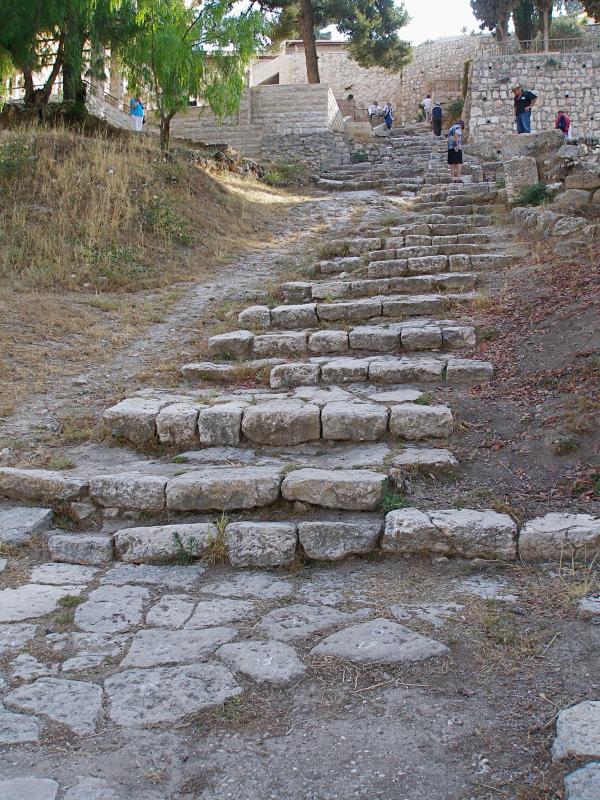
Steps leading to the House of Caiphas (Seetheholyland.net)

Beside the Church of St Peter in Gallicantu, excavations have brought to light a stepped street which in ancient times would have descended from Mount Zion to the Kidron Valley.

These stone steps were certainly in use at the time of Christ. On the evening of his arrest, he probably descended them with his disciples on their way from the Last Supper to Gethsemane.

And, even if the House of Caiphas was situated further up Mount Zion than the present church, it would have been by this route that Jesus was brought under guard to the high priest’s house.

The Church of St Peter in Gallicantu illustrates the tumultuous history of religious sites in the Holy Land: A major church built here in 457 was damaged in 529 during the Samaritan Revolt and destroyed in 614 by the Persians. It was rebuilt around 628 and destroyed in 1009 by the mad Caliph Hakim. Rebuilt around 1100 by the Crusaders, it was destroyed in 1219 by the Turks. Then a chapel was built, but it was destroyed around 1300. The present church was completed in 1932.

In Scripture:

Peter denies Jesus: Matthew 26:69-75

Administered by: Augustinians of the Assumption

Tel.: 972-2-6731739

Open: 8.30am-5pm (closed Sunday)


References

Bar-Am, Aviva: Beyond the Walls: Churches of Jerusalem (Ahva Press, 1998)
Brownrigg, Ronald: Come, See the Place: A Pilgrim Guide to the Holy Land (Hodder and Stoughton, 1985)
Gonen, Rivka: Biblical Holy Places: An illustrated guide (Collier Macmillan, 1987)
Mackowski, Richard M.: Jerusalem: City of Jesus (William B. Eerdmans, 1980)
McCormick, James R.: Jerusalem and the Holy Land (Rhodes & Eaton, 1997)
Martin, James: A Pilgrim’s Guide to the Holy Land (Westminster Press, 1978)
Murphy-O’Connor, Jerome: The Holy Land: An Oxford Archaeological Guide from Earliest Times to 1700 (Oxford University Press, 2005)
Pixner, Bargil: With Jesus in Jerusalem – his First and Last Days in Judea (Corazin Publishing, 1996)
Wareham, Norman, and Gill, Jill: Every Pilgrim’s Guide to the Holy Land (Canterbury Press, 1996)


External links
The Shrine of St Peter in Gallicantu (Augustinians of the Assumption)
St. Peter in Gallicantu (BibleWalks)
« Newer PostsOlder Posts »

Church of St Mary Magdalene

Jerusalem

Church of St Mary Magdalene

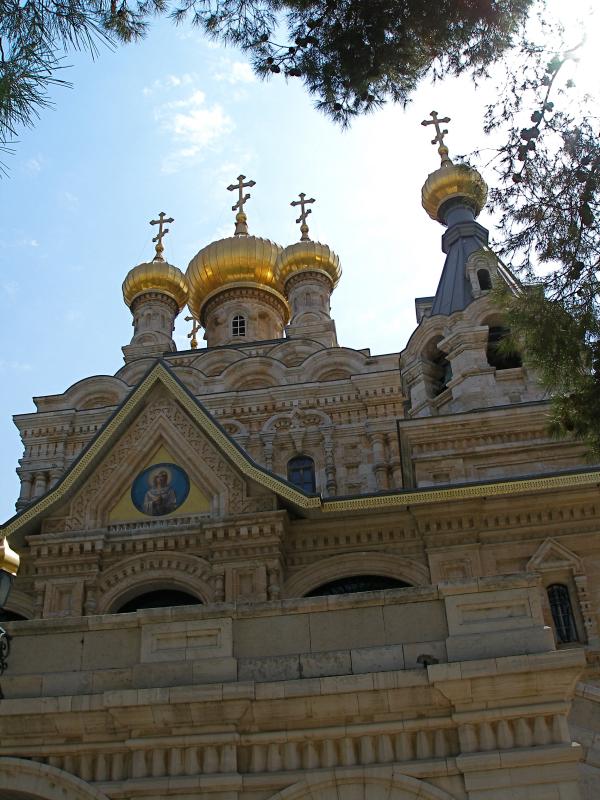
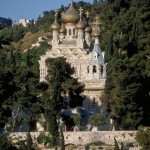
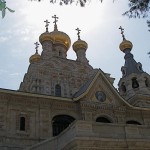
Onion domes and ornate frontage of Church of St Mary Magdalene (Seetheholyland.net)

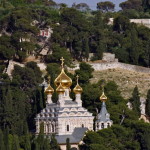
Seven gilded onion domes, each topped by a tall Russian Orthodox cross, make the Church of St Mary Magdalene one of Jerusalem’s most picturesque sights.

It makes an especially striking spectacle at night, when its floodlit domes seem to be floating above the dark trees that surround it.

The church stands on the western slope of the Mount of Olives, above the Garden of Gethsemane and the Church of All Nations. It commemorates the enigmatic Mary from Magdala  — revered as a saint by the Orthodox, Catholic, Anglican and Lutheran churches — who was one of the few persons named in the Gospels as being present at Christ’s crucifixion and who was the first recorded witness of his Resurrection.

In its convent live about 30 Russian Orthodox nuns from several different countries. While particularly known for the quality of their liturgical singing, they also paint icons, embroider vestments and items for liturgical use, and decorate Russian eggs.


Design reflects Muscovite architecture

Church of St Mary Magdalene

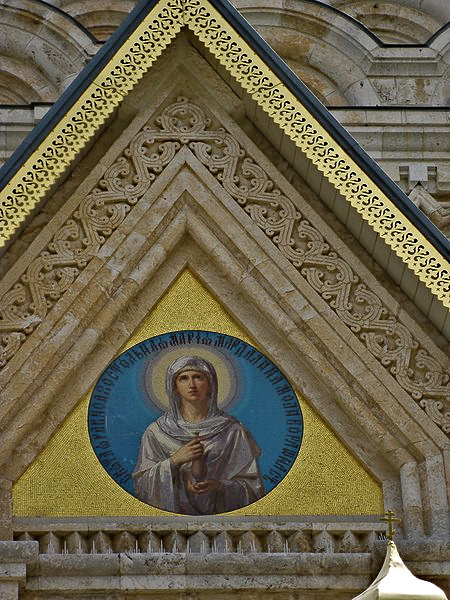
Medallion above door of Church of St Mary Magdalene (© Deror Avi)

The Church of St Mary Magdalene was built in 1888 by Czar Alexander III of Russia, in memory of his mother, Empress Maria Alexandrovna, whose patron saint was Mary Magdalene.

Its onion-shaped domes and the general style reflect the architecture of Moscow during the 16th and 17th centuries.

Although the intricately decorated façade appears to be made of marble, it is actually of sculpted white sandstone.

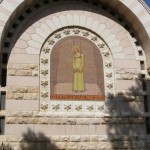
Above the entrance a circular blue mosaic medallion depicts Mary Magdalene robed in white.


Painting illustrates Mary Magdalene legend

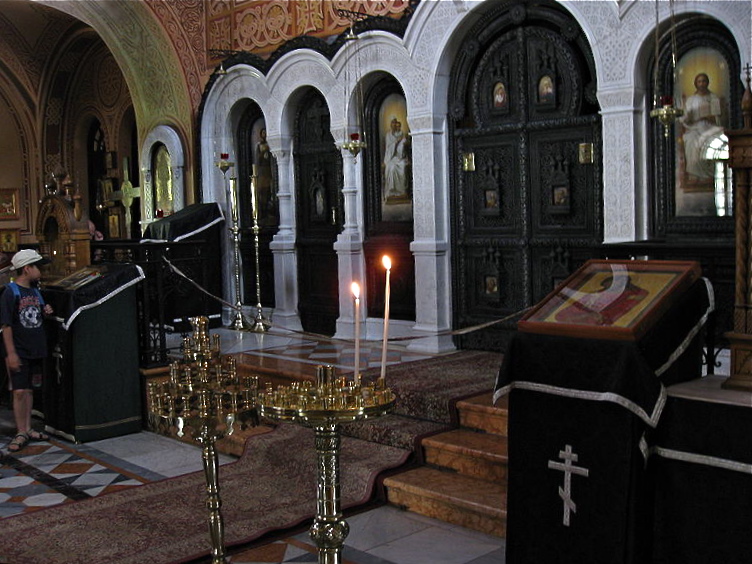
In contrast to the exterior, the interior of the Church of St Mary Magdalene is rather plain. The walls are covered with designs, predominantly in shades of brown.The white marble and bronze iconostasis — the partition that separates the nave from the sanctuary — holds icons and paintings, including depictions of the four Evangelists, the Virgin Mary and the archangel Gabriel.

Church of St Mary Magdalene

Inside Church of St Mary Magdalene (© Deror Avi)

Above the iconostasis, a large canvas by Russian artist Sergei Ivanov illustrates a popular legend in which Mary Magdalene travels to Rome to tell the Emperor Tiberius of Jesus’ unfair trial and unjust sentence. She is shown presenting the emperor with a red egg, symbolising the Resurrection and eternal life.

To the right side of the iconostasis, a 16th-century icon of the Virgin Mary in a hand-carved wooden case has a place of honour. The icon is said to have miraculous powers.


Two Russian saints are buried

On either side of the nave is a marble sarcophagus, each containing the body of a Russian Orthodox saint.

The better known one is Grand Duchess Elizabeth Feodorovna. A German princess, she was the wife of the Czar’s brother Sergei, a sister of the Czar’s wife Alexandra — and a granddaughter of Queen Victoria.

The grand duchess took a deep personal interest in the church and was responsible for commissioning its art works.

Widowed when an assassin killed her husband in 1905, she founded a convent and became its abbess. She and her nuns did much to help alleviate the suffering of the poor in Moscow.

After the Russian Revolution, Grand Duchess Elizabeth, her companion Sister Barbara Yakovleva and other members of the Russian imperial family were thrown down a mine shaft by the Bolsheviks in 1918 and left to die.

The bodies of Grand Duchess Elizabeth and Sister Barbara (whose remains are in the other sarcophagus) were eventually smuggled out of Russia and brought to Jerusalem. Both women have been canonised as martyrs by the Russian Orthodox Church.

In a crypt below the church is buried Princess Alice of Greece, the mother of Prince Philip, Duke of Edinburgh. She had expressed a wish to be buried near Grand Duchess Elizabeth, who was her aunt.

In Scripture:

Jesus appears to Mary Magdalene: John 20:1-18

Administered by: Russian Ecclesiastical Mission in Jerusalem

Tel.: 972-2-6284373

Open: Tuesday and Thursday, 10am-noon


References

Bar-Am, Aviva: Beyond the Walls: Churches of Jerusalem (Ahva Press, 1998)
Gonen, Rivka: Biblical Holy Places: An illustrated guide (Collier Macmillan, 1987)
Inman, Nick, and McDonald, Ferdie (eds): Jerusalem & the Holy Land (Eyewitness Travel Guide, Dorling Kindersley, 2007)
Wareham, Norman, and Gill, Jill: Every Pilgrim’s Guide to the Holy Land (Canterbury Press, 1996)


External links
Convent of St Mary Magdalene — the Garden of Gethsemane (Russian Ecclesiastical Mission in Jerusalem)
« Newer PostsOlder Posts »

Church of St Joseph

Israel

Church of St Joseph

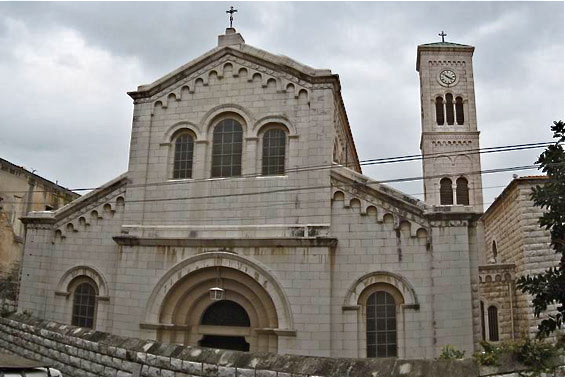
Church of St Joseph, Nazareth (Seetheholyland.net)

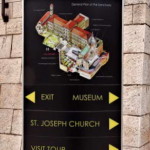
A fond tradition asserts that the Church of St Joseph in Nazareth is built over the carpentry workshop of the husband of the Virgin Mary.

The church (also known as the Church of the Nutrition and the Church of Joseph’s Workshop) is a solid and unpretentious building. It stands very much in the shadow of the soaring cupola of the Church of the Annunciation on its southern side — just as St Joseph himself lived in the shadow of Jesus and Mary.

But there is no evidence that the cave over which the church is built was Joseph’s workshop. Even if this is the site of the Holy Family’s home, the cave is unlikely to have been a carpentry workshop in the modern sense.

The Gospels use the Greek word tekton, meaning builder or artisan, to describe Joseph. He most likely worked with both stone and wood, since stone was the common building material in the area.

Joseph’s work may have taken him away from his home. A likely place of employment was the Roman city of Sepphoris or Tzippori, which was being rebuilt by Herod Antipas at the time the Holy Family arrived from Egypt. The building site was a 50-minute walk from Nazareth.


Cave system under church

Church of St Joseph

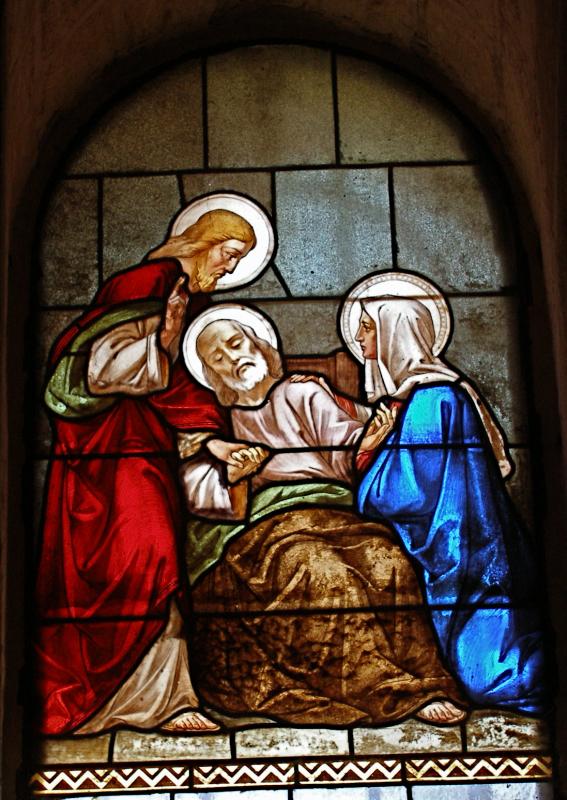
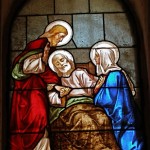
Death of St Joseph, stained glass in Church of St Joseph (Seetheholyland.net)

The Church of St Joseph was built in 1914 on the remains of a Crusader church and over a cave system. The first mention of the site occurs in the work of a 17th-century Italian writer and Orientalist, Franciscus Quaresmius, who described it as “the house and workshop of Joseph”.

The apse of the church has three noteworthy paintings: The Holy Family, The Dream of Joseph, and The Death of Joseph in the Arms of Jesus and Mary.

A stairway in the church descends to a crypt where caverns can be seen through a grille in the floor. Seven further steps lead to a 2-metre square basin or pit with a black-and-white mosaic floor. This is believed to have been a pre-Constantinian Christian baptistry, perhaps used as early as the 1st century.

Beside the basin, a flight of rough steps leads down to a narrow passage which, after turning 180 degrees, opens into an underground chamber 2 metres high.

Off this are openings to grain silos and water cisterns, cut into the soft limestone rock by early dwellers. Such underground repositories were typical of ancient Nazareth.

Other sites in Nazareth:

Nazareth

Church of the Annunciation

Nazareth Village

In Scripture:

Joseph takes Mary as his wife: Matthew 1:18-25

Administered by: Franciscan Custody of the Holy Land

Tel.: 972-4-6572501

Open: 8am-6pm


References

Brownrigg, Ronald: Come, See the Place: A Pilgrim Guide to the Holy Land (Hodder and Stoughton, 1985)
Doyle, Stephen: The Pilgrim’s New Guide to the Holy Land (Liturgical Press, 1990)
Freeman-Grenville, G. S. P.: The Holy Land: A Pilgrim’s Guide to Israel, Jordan and the Sinai (Continuum Publishing, 1996)
Gonen, Rivka: Biblical Holy Places: An illustrated guide (Collier Macmillan, 1987)
Joseph, Frederick: “Basilica of the Annunciation in Nazareth”, Holy Land, spring 2005
Kilgallen, John J.: A New Testament Guide to the Holy Land (Loyola Press, 1998)
Murphy-O’Connor, Jerome: The Holy Land: An Oxford Archaeological Guide from Earliest Times to 1700 (Oxford University Press, 2005)
Walker, Peter: In the Steps of Jesus (Zondervan, 2006)
Wareham, Norman, and Gill, Jill: Every Pilgrim’s Guide to the Holy Land (Canterbury Press, 1996)


External links
St. Joseph Church (BibleWalks)
Nazareth – Saint Joseph (Custodia Terrae Sanctae)
Nazareth (Wikipedia)
Nazareth (Catholic Encyclopedia)
« Newer PostsOlder Posts »

Church of St Catherine of Alexandria

West Bank

Church of St Catherine

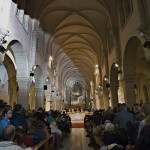
Christmas Midnight Mass in St Catherine’s Church (© Custodia Terrae Sanctae)

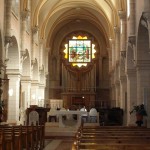
The midnight Mass beamed from Bethlehem to television viewers worldwide on Christmas Eve is celebrated in the Church of St Catherine of Alexandria.

This 19th-century church adjoins the 6th-century Church of the Nativity, built over the cave where Jesus was born. It even shares a wall with the Nativity church.

The Church of St Catherine is the parish church for Bethlehem’s Catholics. It is also often used by groups of pilgrims.


Martyr broke torture wheel

Church of St Catherine

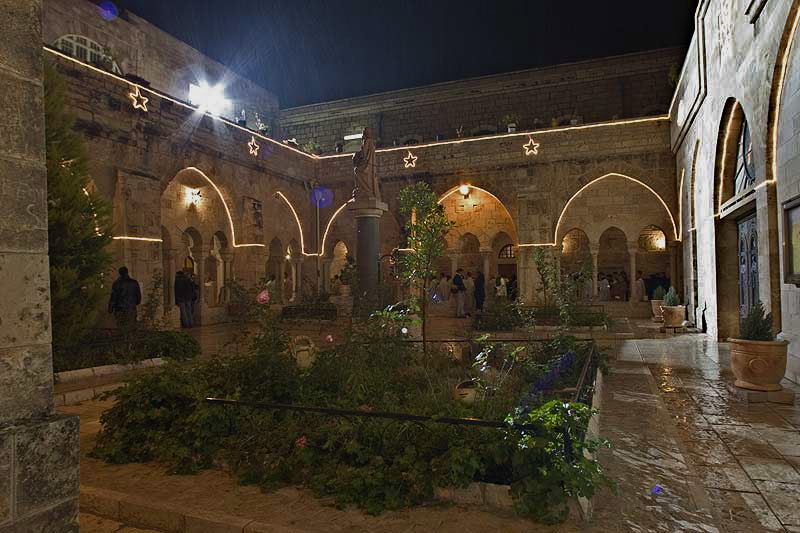
Christmas lighting in the courtyard of St Catherine’s Church (© Custodia Terrae Sanctae)

And who was St Catherine of Alexandria? Though she has been widely venerated in both East and West, there are few reliable facts about her life.

According to the traditional story, this early 4th-century martyr from Egypt was of noble birth and well educated. At the age of 18, she challenged the emperor Maxentius (or his father, the emperor Maximian) for persecuting Christians and worshipping false gods.

The enraged emperor ordered her to be tortured on a wheel — hence the term “Catherine wheel”. But when Catherine touched the wheel, it broke. She was then beheaded and tradition says angels carried her body to Mount Sinai, where in the 6th century a church and monastery were built in her honour.

This latter part of the story was, however, unknown to the earliest pilgrims to the mountain. It was two or three centuries later that the story of St Catherine and the angels began to circulate.

St Catherine of Alexandria has been ranked with St Margaret and St Barbara as one of the 14 “most helpful” saints in heaven. She is also one of the saints reputed to have spoken to St Joan of Arc.


Complex of caves under church

Church of St Catherine

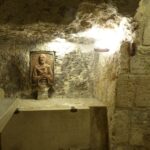
Chapel of the Holy Innocents under St Catherine’s Church (© Custodia Terrae Sanctae)

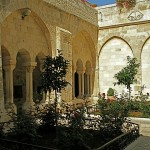
The Bethlehem church dedicated to St Catherine was built in 1882 on the ruins of the Crusader church and monastery belonging to the Augustinians. Beneath the paving of the cloister are the foundations of an earlier monastery, possibly that of St Jerome (whose statue stands on a pedestal in the cloister).

A door in the southwest corner of the cloister leads to a Crusader chapel. The chapel walls are decorated with remnants of Crusader wall paintings, which were partially restored in 1950.

A narrow stairway on the right hand side of the nave leads down into a complex of caves and rock-cut chambers.

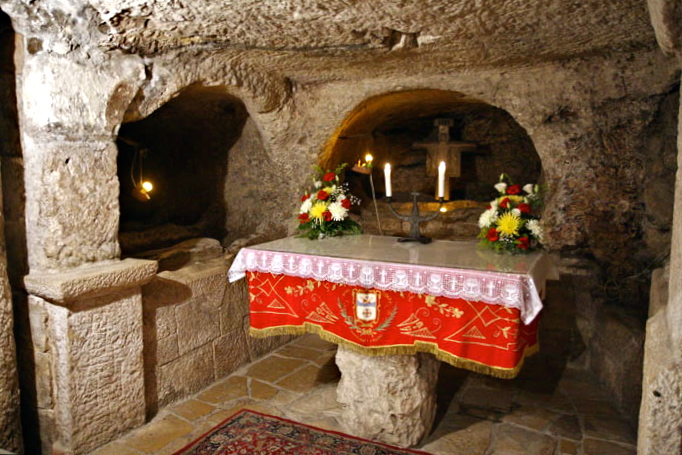
These contain a number of chapels. They include the Cave of St Jerome, who translated the Vulgate version of the Bible; St Joseph’s Chapel, recalling the dream in which an angel warned Joseph to take the Holy Family to Egypt; and the Chapel of the Holy Innocents, commemorating the children massacred by Herod.

Other sites in the Bethlehem area:

Bethlehem

Church of the Nativity

Grotto of the Nativity

St Jerome’s Cave

Milk Grotto

Shepherds’ Field

Tomb of Rachel

Field of Boaz

Herodium

In Scripture:

An angel warns Joseph: Matthew 2:13-15

Massacre of the Holy Innocents: Matthew 2:16-18

Administered by: Franciscan Custody of the Holy Land

Tel.: 972-2-2742425

Open: Apr-Sep 6am-7.30pm, Oct-Mar 5.30am-5pm (grottos closed on Sunday mornings)


References:

Doyle, Stephen: The Pilgrim’s New Guide to the Holy Land (Liturgical Press, 1990)
Freeman-Grenville, G. S. P.: The Holy Land: A Pilgrim’s Guide to Israel, Jordan and the Sinai (Continuum Publishing, 1996)
Gonen, Rivka: Biblical Holy Places: An illustrated guide (Collier Macmillan, 1987)
Inman, Nick, and McDonald, Ferdie (eds): Jerusalem & the Holy Land (Eyewitness Travel Guide, Dorling Kindersley, 2007)
Wareham, Norman, and Gill, Jill: Every Pilgrim’s Guide to the Holy Land (Canterbury Press, 1996)


External links
Church of St. Catherine of Alexandria (Travelujah)
Bethlehem (Obethlehem.com)
« Newer PostsOlder Posts »
All content © 2022, See the Holy Land | Site by Ravlich Consulting & Mustard Seed
You are welcome to promote site content and images through your own
website or blog, but please refer to our Terms of Service | Login